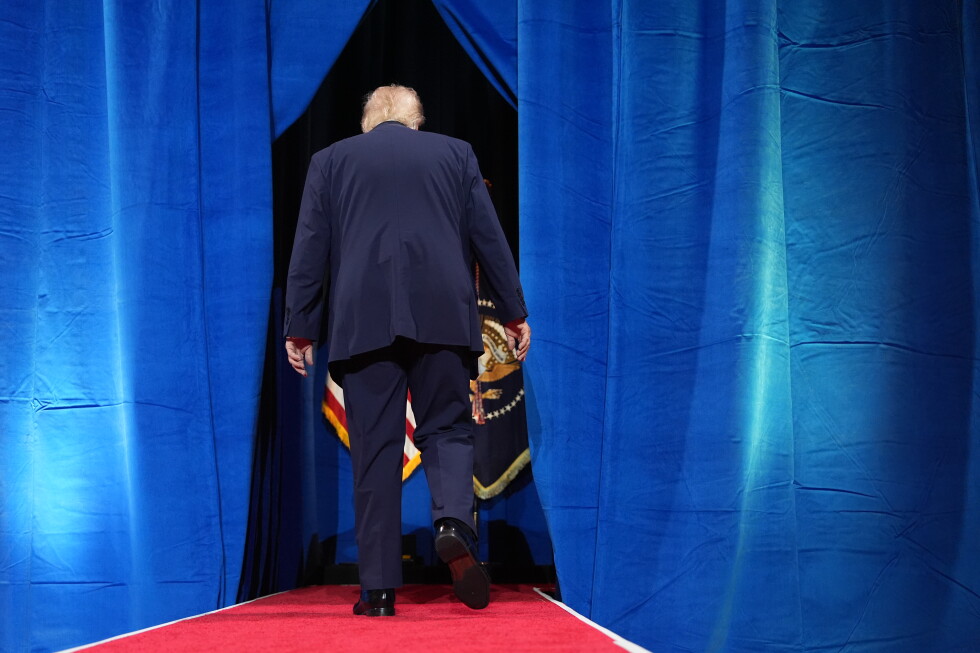
President Donald Trump has repeatedly suggested he wants to seek a third term, promoting another campaign, wearing 2028 caps and discussing possible ways to make it happen, even while acknowledging that the Constitution bars him from doing so. Recently, however, Trump has begun speaking more openly about life after the White House, suggesting that even he may not expect another campaign to happen.
During recent speeches, Trump has described what his life could look like after his term ends in January 2029. He has predicted that he will be at home, watching his successor take credit for his accomplishments.
“Your next president is going to say, ‘What a great job I did,’” Trump told an event on Long Island, New York, this month. “He’ll be sitting around, watching television. A real stiff. Unless you vote Republican, of course.”
A sitting president discussing the possibility of becoming a former president is politically sensitive. With the midterm elections now just nine weeks away, Trump is approaching the stage of his presidency when reminders of his eventual loss of power are likely to become more frequent.
Trump discusses life after the presidency
Trump’s willingness to acknowledge the possibility of a White House without him represents a notable shift. Since his first term—and almost immediately after winning a second—he has left open the possibility of remaining in office for more than eight years.
“He is all over the place,” said Brian Kalt, a Michigan State University constitutional law professor. “And what that does is, it allows him to point to his own words to support any number of mutually exclusive things.” Trump can say, “’Oh yeah, I made it clear that I wasn’t gonna run,’” Kalt said. “Or, if he decides that he will, he could say, ’Well, you know, I never said I wouldn’t.’”
The White House rejected suggestions that Trump is increasingly focused on the end of his presidency and the legacy he will leave behind. Spokesperson Olivia Wales said he “is fighting every day” to deliver on promises to reduce violent crime,crack down on the U. S-Mexico border and lower prescription drug prices.
“The only legacy President Trump is concerned with is making America greater than ever before,” Wales said.
Still, Trump has recently spoken more often about how he will be remembered.
At a rally in Pennsylvania, he said, “Whoever the next president is, he’s going to be talking about what a brilliant president he is. And I’ll be home. And I’ll be saying, ’That son of a gun,’ because we did the job.”
A week later in Georgia, Trump predicted that he would be sitting at home after his presidency ended. “I may be crying,” the president added, arguing that Democrats could retake the Senate and eliminate filibuster rules, making it easier to pass their key legislation.
In Michigan, Trump expressed some uncertainty about whether he was ready to leave the Oval Office and return to Florida. “In two and a half years, you may have a different president — may,” he said, emphasizing the word “may.”
“I’ll be sitting home. I’ll be reading the papers. I’ll be watching television,” Trump said before criticizing his predecessor, President Joe Biden. “And I’ll be having some guy — like last time, a real idiot — stand up and say, ‘We are doing record business.’”
Trump continues to send mixed signals about 2028
Although Trump has begun suggesting that he will leave office, he has continued to tease a possible 2028 presidential campaign.
At the rescheduled White House Correspondents’ Association dinner last month, Trump joked, “Just like my presidency, the second time is always better” and that “the third time will be better yet. I’m only kidding.” He later wore a 2028 campaign cap as he finished the speech.
The 22nd Amendment to the Constitution states that no person can be elected president more than twice. It was ratified in 1951, six years after President Franklin Delano Roosevelt died several months into his fourth term. Until Roosevelt, no other president had broken the tradition of stepping down after two terms established by George Washington.
Only a few months after returning to the White House, Trump told NBC News, “There are methods which you could” use to seek a third term. He acknowledged that one option would be to run as Vice President JD Vance’s running mate in 2028 and then have Vance step aside if they won.
“There are others, too,” Trump said at the time, alluding to additional options. He later told Time Magazine, “There are some loopholes,” while also saying he did not believe they should be used.
Trump has frequently used social media to promote “Trump 2028” logos featuring his “Make America Great Again” slogan. At other times, however, he has appeared definitive about the constitutional ban on another run, recently telling reporters: “I’d love to run, but the law is very strong.”
Kalt examined whether a two-term president could potentially return to office by running for vice president in constitutional Cliffhangers: A Legal Guide for Presidents and Their Enemies. “People do tend to find, in Trump’s words, whatever it is that they want to hear,” he said.
Trump may be confronting the lame-duck factor
Second-term presidents typically see their power and influence decline during their final two years, particularly when their party suffers significant losses in the midterm elections. Trump’s comments may also indicate that he is thinking about cementing his legacy, a stage many of his predecessors eventually reached.
“They all, particularly as they cross the midpoint of their second term, start thinking about legacy,” said Paul Begala, a former adviser to President Bill Clinton. “They all banish the word. I know Clinton and Bush, they said, ’Can’t use the L-word.’ But they do,” Begala said, referring to his former boss Clinton and President George W. Bush. “They all think about it. And the staff thinks about it and the Cabinet thinks about it.”
During his final two years in office, Clinton focused on efforts to broker a Middle East peace agreement. Bush used the slogan “sprint to the finish” during the final year of his presidency in 2008, while Biden adopted a “run through the tape” approach after ending his reelection campaign.
Trump has sought to shape the White House and the wider Washington area in his own image, recalling his career as a real estate developer in New York during the 1970s and 1980s. His administration has ordered a towering arch near the Lincoln Memorial and restored city fountains, while also building a Rose Garden patio and helipad on the White House lawn and adding numerous gilded features to the building’s interior and exterior.
The administration is also rushing to complete a large ballroom despite legal challenges. Trump has said the project will not be finished until late 2028, shortly before he leaves office.
“It’s not for me, ‘cause I’m going to be here a very short period of time” when the work is finished, Trump recently told reporters in the Oval Office. “I’ll be there for four, five, six months. This is for future presidents.”