Iranian Strikes Damage Hundreds of U.S. Military and Diplomatic Sites, Pentagon Watchdog Reports
A new Department of Defense Office of the Inspector General report reveals that Iranian strikes have damaged or destroyed hundreds of buildings and structures at U.S. bases across the Middle East during the ongoing conflict. The assessment, among the first official evaluations of Operation Epic Fury since its February 28 launch, details extensive infrastructure damage, rising casualties, and a $33.4 billion price tag that excludes future reconstruction costs.
Widespread Base Damage Across Eight Nations
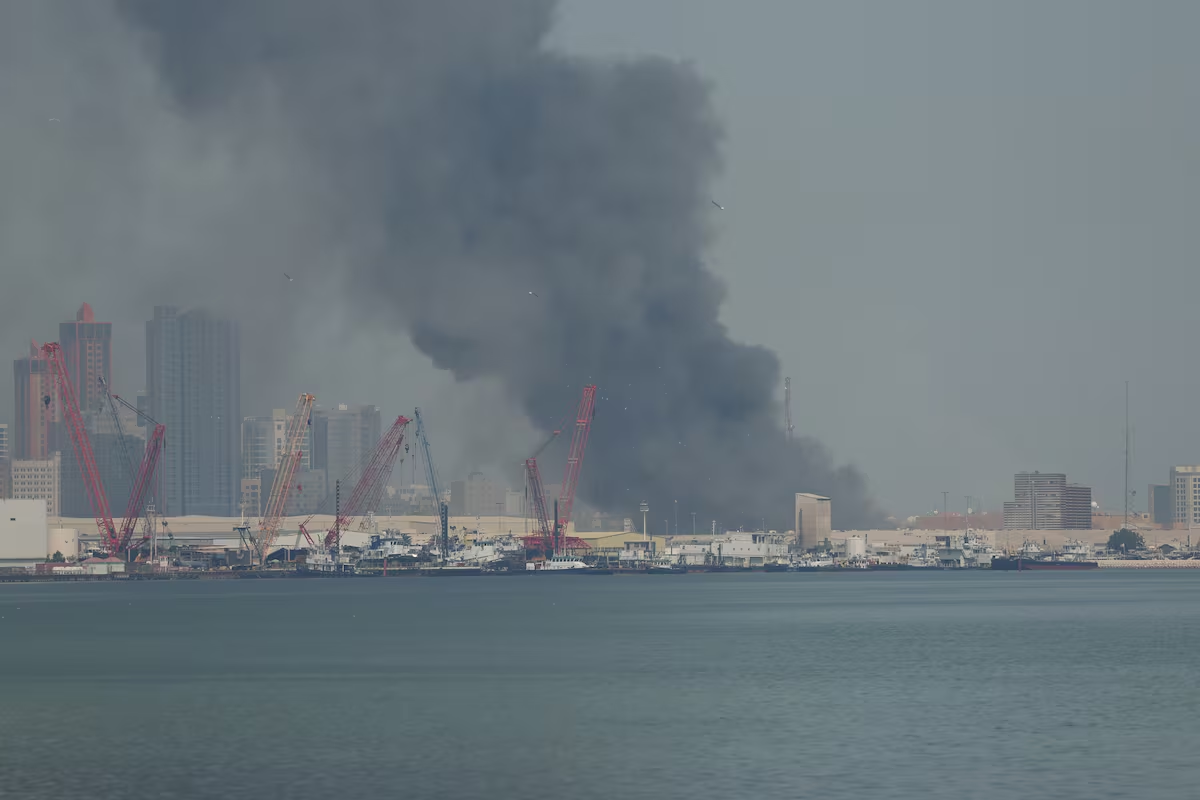
U.S. Central Command informed IG investigators that “Iranian strikes damaged and destroyed hundreds of buildings and structures at U.S. bases in Kuwait, Bahrain, Qatar, UAE, Saudi Arabia, Iraq, Oman, and Jordan during the conflict.” While the report did not itemize specific military facility losses, it provided concrete figures for diplomatic infrastructure.
The State Department disclosed that “U.S. diplomatic facilities in four countries suffered physical damage from Iranian strikes, with an estimated total cost of about $184 million.” U.S. diplomatic sites in Iraq endured more than 600 attacks, while the embassies in Kuwait City and Riyadh were also struck.
Operation Epic Fury Costs Surpass $33 Billion
As of June 29, Pentagon estimates place the cost of Operation Epic Fury at $33.4 billion. The breakdown includes:
- $22.3 billion in expended munitions
- $3.7 billion in equipment losses
- $7.4 billion in costs beyond CENTCOM’s normal operating expenses
Critically, these estimates do not include the cost of repairing damaged infrastructure. The report states the Department of Defense “did not include the cost of military construction for damaged infrastructure in its estimate because the DoD has not determined what its future posture will be in the region, how it will construct its bases, and what percentage of the construction costs allies and partners will contribute.”
Funding Gaps Strain Military Budgets
Because Congress has not appropriated dedicated war funding, costs are being diverted from standard operating budgets for training and maintenance. The IG noted that “The absence of a dedicated appropriation for OEF means that it can be difficult to calculate the total ‘cost’ of OEF.”
U.S. Transportation Command, which flew more than 1,500 support missions, is also facing financial pressure. “During peak OEF times, airlift surged to 30 to 40 daily missions directly into the CENTCOM [area of responsibility], with an additional 20 to 30 daily aircraft pushing into the USEUCOM AOR for transload operations,” the report said. This effort cost nearly $2.4 billion as of June 30.
“While these obligations have been largely reimbursed by the military services to date, USTRANSCOM reported that it anticipates delayed payments moving forward as service funding is depleted without a supplemental appropriation,” the IG warned.
Aircraft Losses and Rising Casualties
The report confirmed dozens of U.S. manned and unmanned aircraft destroyed or damaged, citing a Congressional Research Service report from May vetted by CENTCOM as of August 24. Confirmed losses include:
- Four F-15E Strike Eagles
- One A-10 Thunderbolt II
- Four AH-6 Little Bird helicopters
- One AH-64 Apache
- One MH-60 Black Hawk
- One MQ-4C Triton drone
- Up to 30 MQ-9 Reaper drones
Human costs are mounting. The report lists 18 U.S. military personnel dead as of August 27. The Pentagon reported 417 wounded as of June 30, though casualty figures released in late August surged to 774.
Michael Peck is a correspondent for Defense News and a columnist for the Center for European Policy Analysis. He holds an M.A. in political science from Rutgers University. Find him at theuncommondefense.com. His email is [email protected].