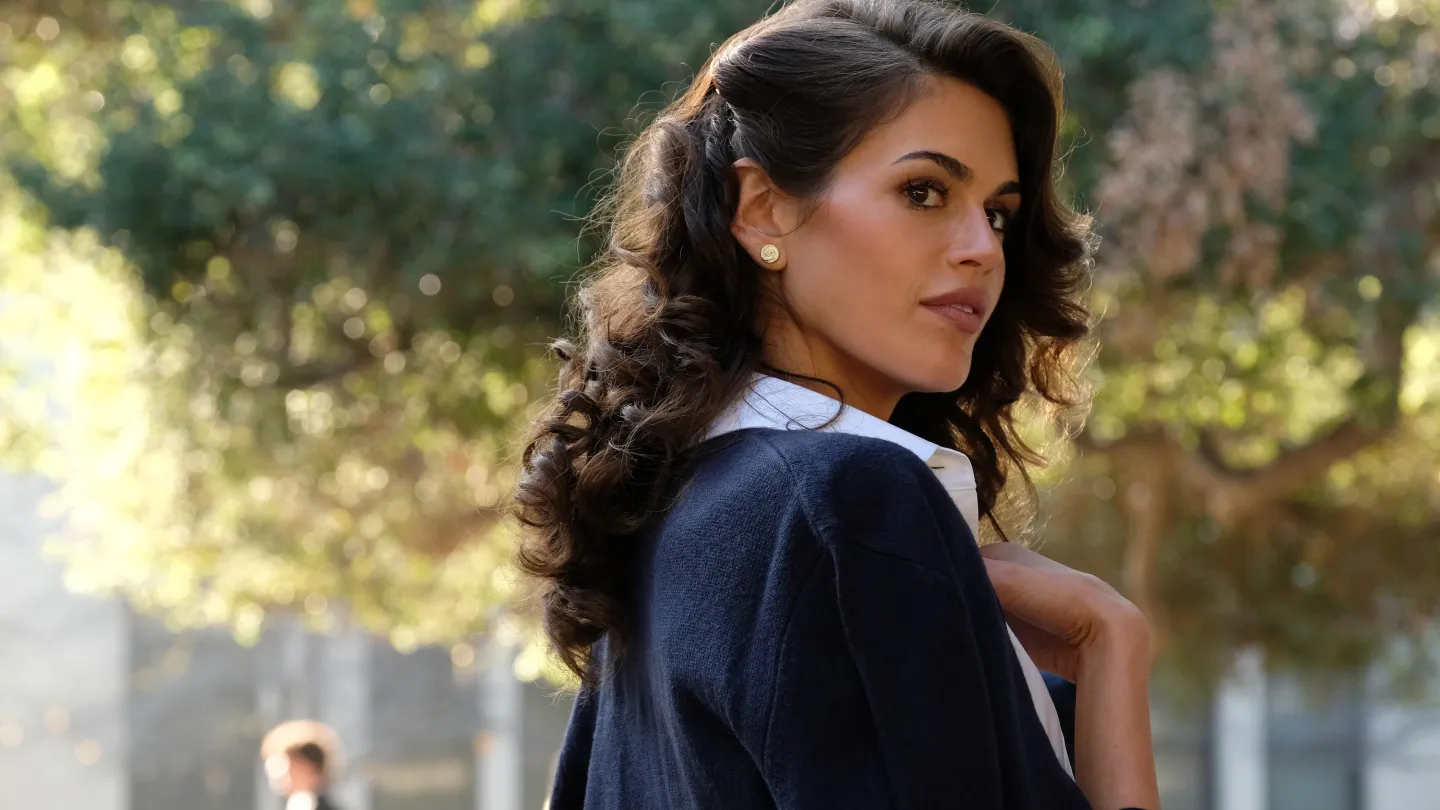
[This story contains MAJOR spoilers from The Shards finale, “Stairway to Heaven.”]
FX’s The Shards concluded its first season by turning every main character into a suspect. After nine episodes of a serial killer dubbed “The Trawler” terrorizing 1981 Los Angeles, the Ryan Murphy adaptation of Bret Easton Ellis’ novel ends with police questioning the core group: Bret (Igby Rigney), Robert (Homer Gere), Debbie (Hayes Warner), her mother (Evan Rachel Wood), Steven (Jordan Roth), Thom (Graham Campbell), Ryan (Daniel Dale), and Susan (Kaia Gerber).
Kaia Gerber on the Finale’s Cliffhanger and Susan’s Suspect Status
Gerber acknowledges that queen-bee high schooler Susan potentially being the serial killer — or the person who threw Debbie’s father, Terry (Wes Bentley), off a balcony in the finale — comes as a surprise. Yet she confirms the possibility is very real.
“We know it’s one of us,”
she tells The Hollywood Reporter of the ending.
While Ellis’ novel never explicitly revealed The Trawler’s identity, Gerber is confident the series will eventually solve the mystery. Murphy previously told THR that he and Ellis planned three or four seasons, with this finale covering roughly one-third of the book. With ample runway left, every character remains a viable suspect — including Susan.
“It’s hard for me to empathize with Susan in certain moments — the relentless winning is infuriating. I like that everyone is very complicated and layered in their own ways,”
she says.
Casting Susan: From Fan Interaction to Ryan Murphy’s Call
Gerber’s path to the role began years before production. She had worked with Murphy on American Horror Story season 10, calling it her first professional acting job.
“I’ve always felt, in such a large way, that he started my career and gave me an opportunity before anyone else did. I always wanted to work with him again. I’m such a fan.”
A chance meeting with Ellis around the book’s release proved pivotal.
“I just want to tell you, I’ve read everything you’ve ever written, and I’m reading The Shards right now. I think the amount of love you have for these characters, and particularly the female characters, you can see it and feel it in the writing, and I just wanted to say that.”
Ellis’ response was immediate.
“You are Susan.”
Gerber disagreed.
“I’m nothing like Susan.”
Ellis demurred.
“I don’t know what we’re doing with it”
— noting the project wasn’t yet in Murphy’s hands.
Four years later, Murphy called in February 2024.
“Hey, I don’t know if you know this book, The Shards, but I’m making it and Bret and I agree you should play Susan.”
Gerber’s response:
“Okay. Literally whatever you want!”
But she questioned the casting logic.
“I don’t know what quality of mine you think is right for Susan.”
Six months of preparation followed. Meeting the ensemble cast eased the pressure.
“Well, maybe it is something I can’t really explain and just something about me.”
Filming deepened her connection to the character.
“As we were filming, I was like, ‘I don’t know if they’re writing to me or if I’m starting to become more like Susan,’ but as the series progressed, and as we got new scripts, I felt closer to Susan. When you spend a long enough time playing someone, you can’t help but love them and feel protective over them and empathize with them.”
Navigating Famous Lineage and On-Screen Chemistry
Murphy addressed the inevitable comparisons stemming from Gerber (daughter of Cindy Crawford) and Gere (son of Richard Gere) sharing famous parents. He insisted he wouldn’t proceed unless all parties were comfortable.
“People are obviously going to point this out.”
Gerber found the concern unwarranted once filming began.
“Homer just happened to be the right person for this role. Regardless of our history or our parents’ history, the incredible and relieving thing is that as soon as we started filming, Homer was perfect for this role. And it would not have been fair or right if it went to somebody else just to avoid all the other stuff that goes with it, which really is just noise and not as significant, I think, as the work.”
Murphy remained an accessible collaborator.
“What do I wear? I’m panicking and I’m scared.”
Gerber recalls texting him an hour before the New York premiere.
The Vogue Interview and Vulnerability
A joint Vogue profile with Gere, written by psychiatrist Rob Haskell, felt unexpectedly therapeutic.
“I think that Rob [Haskell, writer] had the same effect on both of us. He’s very disarming, and he’s also a psychiatrist. So very quickly, I forgot that I was doing the interview, which could be a very scary thing, and probably scary to hear for a publicist. (Laughs.) But it was clear to me that he’s a very kind person who doesn’t take vulnerability for granted. I trusted that he would handle it with care, and I really think he did. Both Homer and I were like, ‘He has a way of getting you to open up.’ I was grateful that he treated that with respect and kindness. It didn’t feel too exposing, which I was grateful for.”
Living Susan’s High School Fantasy
Susan’s effortless popularity — prom queen, class president, constant winner — offered Gerber a vicarious experience.
“All of it. I wanted to be class president very badly, and I lost the election tragically. So it was really fun to film those scenes where I was giving speeches or addressing the student body — and you’re fully aware that the background [actors] are being paid. They were doing their job well because there were moments where I genuinely believed they were clapping for me, and not for the sake of the scene, which I realize they were. (Laughs.) I think I would never want to go back to high school, but it was fun to exist in that time, and be that age with the freedom and carelessness that especially opens the season. We had so much fun filming those first few episodes, because it was a lot about young teenage freedom and excess and access.”
Season Two Hopes and Book Divergences
With the series covering roughly one-third of the novel, Gerber is eager to continue.
“Yes, as a fan of a book, there’s so much in the book that that we didn’t get to cover in season one. One of the most iconic scenes from the novel is the balcony fight between Bret and Robert. Then there’s Palm Springs… There’s so much in the book we didn’t get to cover, so hopefully the plan is to get to go back and do more.”
Murphy’s expansions — including the original “Dance Off!” episode — open narrative possibilities beyond the source material.
“That’s the exciting part. The book is 100 percent from Bret’s POV. You don’t see anything Bret hasn’t himself witnessed or imagined happened. Whereas in our show, we’re following all these different characters, even when Bret is not present. Suddenly, there are these whole new worlds. I appreciated as one of the characters who isn’t Bret that we’re getting to know Susan outside of Bret’s idea of who she is in relation to him.”
She praises the added material.
“”Dance Off!” was completely a Ryan brainchild, which was so fun to film, along with “Really Rhonda” and getting all of these other things to explore to expand on the world that Bret so genius-ly created.”
The Finale Attack: Was It Thom?
The finale’s attack on Susan diverges from the novel, where she and Thom are assaulted together. Gerber filmed the sequence without Campbell present.
“Is it Thom? Or is it not Thom?”
She wondered during production.
“When we filmed it, I was so certain it wasn’t Thom. Mainly because Graham wasn’t there. We filmed my whole attack with the incredible stunt guy, Troy Brown, who I actually have known since I was 12 years old, so it was very nice to have a familiar face — who is trying to stab me to death. If you’re going to be in that situation, it’s lovely when it’s someone that you know. I want to shout out to Troy for really selling that kick, because I don’t think I would have been able to fight someone off in that way.”
Logistics complicated her read.
“We filmed it, and I screamed in the bathroom for a lot longer. We would reset from there, and then Graham got there later in the day to barge in. So I think because I screamed for a long time, I was like, ‘There really is time for Thom to have come in.'”
Watching the finished episode shifted her theory.
“But then when I watched the finale, I was like, ‘I think it might be Thom, actually!’ And when we walk out and look for the body and don’t see it, then I was like, ‘I think maybe it is Thom.’ So, the jury is still out, but I convinced myself that it was Thom for the sake of Susan then accusing Thom.”
A “Shelley Duvall Moment” and the Physical Toll
The bathroom attack script explicitly referenced The Shining.
“Her Shelley Duvall moment.”
Gerber, a longtime admirer, keeps a signed Shelley Duvall poster on her wall.
“I’ll never reach what Shelley did, but at least I know what we’re aiming for and the level of terror. This was probably the most scream queens moment I’ve gotten to have.”
The sequence required 20 to 30 takes.
“We would do it from the very beginning until Graham would come in and I’d end screaming in the bathroom, hyperventilating. Then we’d reset, which is where I’m fully asleep and get woken up by the phone. So getting your heart rate back down in the span of 20 seconds while they reset, and getting the tears out of my eyes to then be in a very peaceful, cozy sleep mode was the most challenging part. Just calming my nervous system as we were resetting from that screaming, hyperventilating in the bathroom moment.”
The Trawler’s Identity and the AIDS Metaphor
Gerber has a private theory on the killer.
“I don’t know who did it, but I have my suspicion, for sure. And it’s not an obvious one.”
Filming Terry’s balcony death proved emotionally complex. Bentley’s kindness contrasted sharply with Terry’s menace.
“For the opening to episode nine, which I think is one of the greatest finale openings ever, I went first in pushing Terry off the balcony. Wes [Bentley] is such a great guy; such a kind, incredible person, which is ironic that he always plays these villainous characters when there’s nothing villainous about him. I don’t think there’s a mean bone in his body.”
They shared few scenes prior.
“I hadn’t really interacted with Terry that much in the show. We hadn’t really done scenes together. So it was really challenging for me to feel genuine rage while looking at sweet Wes’ face, but he was so supportive and really can lock in when he has to. Right when they were rolling, he’d go into creepy Terry, which made it easier to scream at him and push him. Then as soon as the take was done, he’d be like, ‘Sweetie, that was great!’ He made it so much easier, but it was challenging to try and come up with reason enough to push sweet Wes off a balcony.”
Online speculation runs rampant.
“There are so many theories, too — I’ve read all the Reddit threads. I get a new conspiracy theory every time.”
Murphy has framed The Trawler as a metaphor for the AIDS epidemic. Gerber believes the show will ultimately name a human culprit.
“I think so, yes. One-hundred percent. That’s why you do a mystery and a thriller. But the wonderful thing about all of Ryan’s shows is they’re massively entertaining on a wide scale, and you don’t have to look deeper into them if you don’t want to and can still enjoy them massively. But Ryan always, always has a deeper meaning to everything. It’s always a metaphor for something, something very poignant and serious and real. You can take it at face value and enjoy it for what it is, or you can look deeper and there will always be a deeper reason for it.”
She finds the metaphor resonant.
“Hearing Ryan talk about particularly the metaphor for AIDS and what AIDS meant to him, and that AIDS was quite literally a thing killing beautiful young people in the ’80s; people who felt untouchable and invincible. That doesn’t have to be at the forefront of your mind while watching it, but I do think it’s really interesting to think about how that is a thing that it could be a metaphor for.”
On Palm Royale Cancellation
Gerber addressed the cancellation of Apple TV+’s Palm Royale after one season.
“I was really sad, but also, it was my longest job I ever did up until that point and to be surrounded by literally every acting comedy hero I’ve ever had? It was four years. It was like going to university. It was the most sad thinking, ‘Wait, am I not going to get to hang out with these people who have become my family?’ But I’ve been comforted by how we’ve all stayed really close. I went up and visited Carol [Burnett] two months ago and had dinner with her. We’ve all stayed very close, so I think that’s been helpful. But we do miss it.”
The Shards season one is now streaming in its entirety on Hulu.