Onslaught is proof that director Adam Wingard has not lost his talent for creating vividly bizarre details, even after a decade spent working within established intellectual properties. Now returning to lean, original filmmaking, Wingard fills the film’s opening minutes with images that hint at a much larger, more outrageous story: grinning jack-o’-lanterns exploding in a dusty canyon, gnarled carrots sliced to resemble human fingers, and an ancient Nazi scientist licking a woman’s stilettoed foot.
Each moment feels like a promise of the ultraviolent spectacle to come. The problem is that Onslaught builds anticipation more effectively than it delivers a satisfying payoff. The action thriller is gloriously crafted but narratively underdeveloped, making it an entertaining watch that occasionally seems capable of being something much better.
A former sniper faces a military experiment
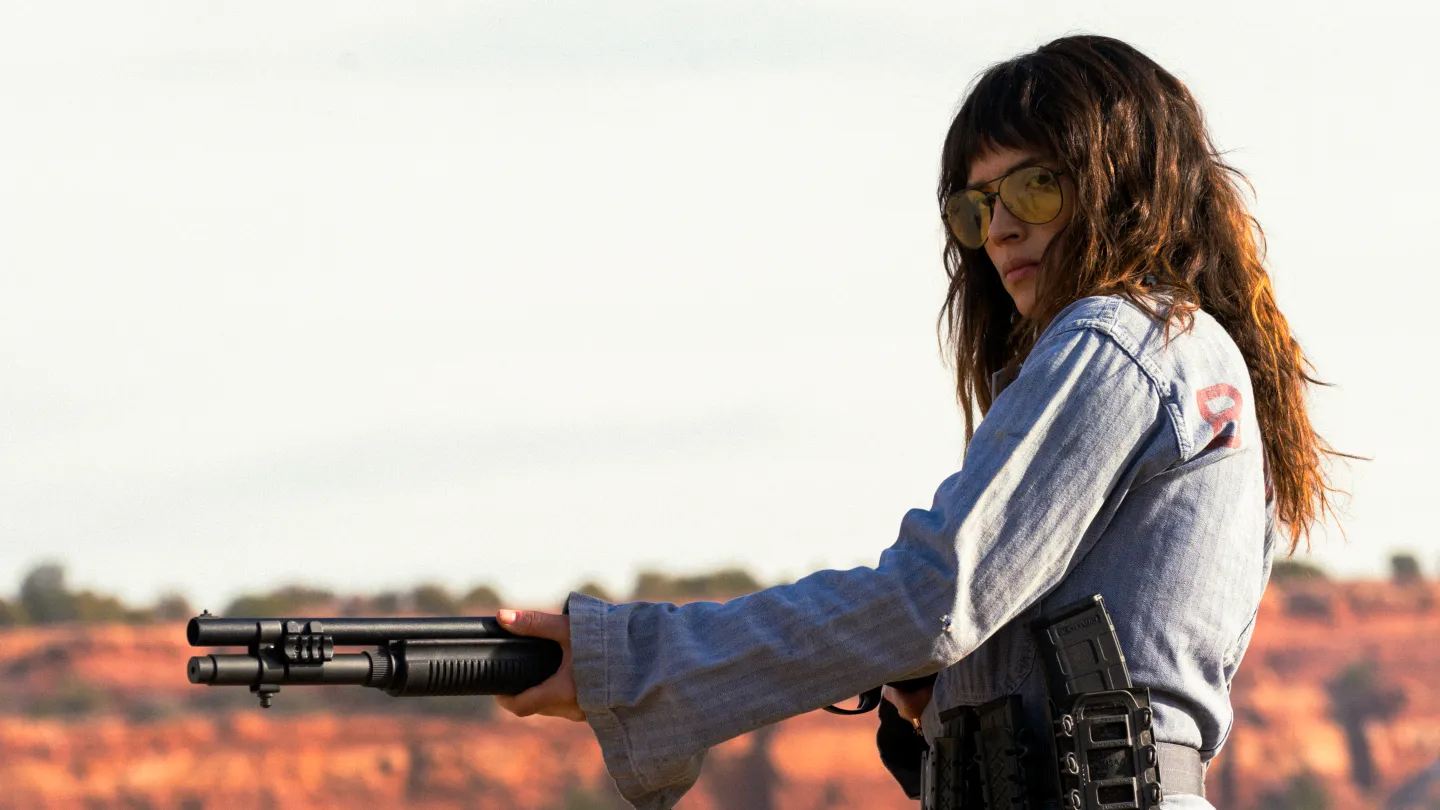
Celeste (Adria Arjona), the woman firing at the pumpkins, is a former Army sniper struggling with PTSD. With shaky hands, an extensive gun collection and a sink full of dirty dishes, she is barely holding her life together. She has withdrawn to Windy Oasis, a remote desert trailer park populated by eccentric residents who seem more comfortable away from the rest of society.
Among them are Josiah (Reginald VelJohnson), a kindly Vietnam veteran, and Kovacks (Eric Wareheim), a bitter, alcoholic police officer. Their relative safety ends when three super-soldiers escape from a secret military bunker nearby. The experiments are described to an eager businessman as “the human equivalent of heat-seeking missiles,” and they soon begin closing in on Celeste, her young daughter Daisy (Blake Kennedy) and the rest of the community.
That setup leads to the kind of home-invasion thriller that helped establish Wingard with You’re Next in 2011 and The Guest in 2014. On those terms, Onslaught works well enough. The soldiers are nearly impervious to bullets, immune to pain and devoid of conscience. Before long, they have left a body count numbering in the dozens, cutting through walls, smashing through windows and blowing off heads with cold, mechanical efficiency.
Stylish action, underused characters
The film’s technical craftsmanship is consistently impressive. Nick Interlandi’s sound design alternates between the relentless rat-a-tat of machine guns and the precise crunch of glass breaking against bone. Oren Soffer’s cinematography moves from sickly clinical imagery to startling sensuality, giving the violence a polished and distinctive visual identity.
Still, the second half feels like a letdown. Wingard introduces a collection of striking characters and stylish set pieces, then struggles to find enough meaningful action for them beyond smashing those elements together.
Dan Stevens’ Kammler makes an immediate impression as a perverse, unsettling eccentric, but he receives less space than expected to parade around in his snow-white capes. Rebecca Hall, playing his elegantly domineering wife, is given even less to do. Drew Starkey has one of the film’s most memorable introductions as Cyrus, an elite operative whose bare torso the camera practically caresses as he rolls on molly and ogles women in G-strings at a sex club. Yet the character contributes little beyond appearing at scenes of carnage; at one point, he is explicitly told not to do anything at all.
Political ideas that never fully develop
Onslaught gestures toward larger political themes from its opening collage, which combines images of robot soldiers, photographs of Abu Ghraib torture victims and headlines about the United States embracing Nazi scientists after World War II. Together, the references suggest a long history of profound horror carried out or enabled by the American military.
Those ideas remain present throughout the film, but they are never fully explored. The story hints at the ambient paranoia of a militarized age without developing that potential into a deeper critique or a more substantial thematic payoff.
Arjona anchors the film
The strongest development belongs to the heroes, who are less flamboyant than the villains but more compelling because of their grounded humanity. Celeste gives Arjona another opportunity to show her range. She can glare, shoot and create a bloody mess with the best action-film protagonists, while also bringing the warmth and comic timing that have made her so appealing in movies such as Hit Man.
Her scenes with Josiah are especially effective. The two battle-scarred veterans tease each other and come to one another’s aid with the unspoken understanding that comes from shared experience. Josiah’s quiet decency, even more than Daisy’s innocence or Celeste’s protective determination, makes Windy Oasis feel like a place worth saving.
Onslaught delivers inventive violence, strong performances and eye-catching technical work. Its villains are memorable in concept but underused in execution, while its political ideas remain largely undeveloped. The result is a stylish, often enjoyable action thriller that promises a feast but ultimately serves only a partial meal.
Source: www.hollywoodreporter.com