This article contains spoilers for Season 1, Episode 3, “OutKast,” of Lanterns.
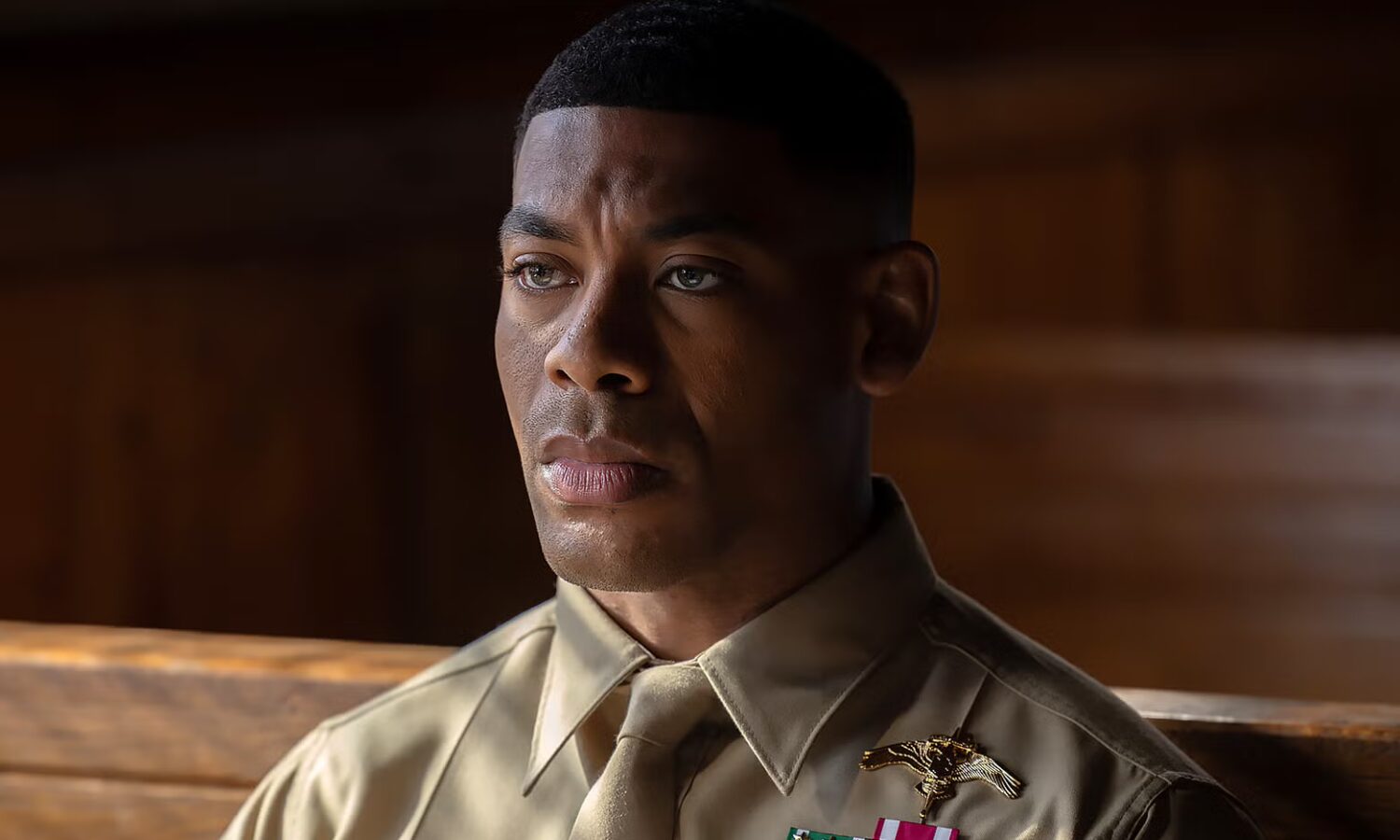
Lanterns, HBO’s new adaptation of DC’s Green Lantern comics, has unfolded as a series of mysteries nested within one another. Each revelation leads to another, while the characters’ histories remain largely concealed. Three episodes in, the series finally explores the origin of its unflappable co-lead, John Stewart (Aaron Pierre), a former U.S. Marine and Green Lantern trainee to Hal Jordan (Kyle Chandler), the jaded, green-clad hero charged with protecting Earth from alien threats.
Written by Vanessa Baden Kelly, Episode 3, “OutKast,” expands the show beyond its puzzles and superhero spectacle to examine John’s experience as a Black hero in training. His life has been shaped by immense pressure to defy racial expectations, much of it imposed by his parents, whose motivations the episode treats with unusual nuance and care.
John Stewart’s family history in Lanterns
The episode reveals that John’s father, John Stewart Sr. (J. Alphonse Nicholson), was approached by the Guardians of the Universe to become a Green Lantern before Hal Jordan. An extraterrestrial presence kidnaps John Sr. in a green bubble and asks him the question required to pass the test: “Are you afraid?”
John Sr. answers honestly: Yes, he is. The opportunity ends there. When no one believes his claim that an alien abducted him, least of all his wife, Bernadette (Jasmine Cephas Jones), his mental state begins to deteriorate. Bernadette only accepts that he was telling the truth when an unnamed Guardian, played by Laura Linney, appears before her and apologizes for any “emotional turmoil” caused by the Lantern initiation process.
Bernadette is furious that her husband was rejected. She challenges the Guardian: “Do you understand how unfair it is to ask a Black man in America if he’s afraid?” She continues, “We are terrified daily of persecution and still show up, sometimes better than everyone around us. Did you know that?” When the Guardian admits that she did not, Bernadette responds: “Even in space y’all don’t consider us.”
The Guardian then hints that John’s younger son could become a candidate to replace the current Lantern someday. Bernadette’s resentment over the Guardians passing over John Sr. drives both parents to believe in that possibility. As Bernadette tells her husband: “We didn’t break every stereotype and face down every fear for you to be penalized because you’re scared to leave the people that you love.”
From that point forward, the couple ruthlessly “conditions” John to become “used to fear,” hoping to transform him into an almost inhuman candidate for the Green Lantern role. They train him to be an expert sniper and force him to act as a target, with his father shooting apples from his head. John is later made to perform the same exercise against his parents.
His childhood is stripped of ordinary comforts. He sleeps in a separate room from his older brothers and is forced to walk home through unfamiliar, potentially dangerous neighborhoods while barely a teenager. He must give up his interest in drawing, his relationships with his brothers and his emotional capacity so he can eventually become the next Green Lantern—and prove that Black people should not be excluded from conversations about ability, power and prestige.
The burden of Black excellence
That dream ultimately proves hollow. John becomes a Marine but is dishonorably discharged for a mistake everyone knows he did not make. The Guardians later instruct him, in practical terms, to stay quiet and follow orders. Even the Green Lantern job itself offers little reward: It pays poorly, and as Hal’s trainee, John is forced to endure the mediocre hero’s uninspiring instruction. Hal’s shortcomings also contributed to John’s dishonorable discharge.
John’s parents raised him to pursue an honored position, but the episode asks what that sacrifice was for. John realizes that he is still expected to answer to a questionable group of beings that values him only for what he can do for them. After a lifetime under the psychological and emotional weight of his parents’ expectations, he has gained little more than the same old crap.
This revelation exposes the pressure and fallacy of “Black excellence,” a phrase often used to describe Black people breaking barriers or achieving accomplishments that even their white peers find remarkable. Black success should be celebrated, and the idea that Black people can be great should be accepted as obvious rather than treated as something that must be proven.
But in a world where people from other backgrounds are allowed to be mediocre, fail upward and display imperfections, Black people should be granted the same freedom. They should not face what can feel like life-ending or career-disrupting consequences for falling short of perfection. Greatness should not be the only thing Black people are permitted to be, particularly when the standards of greatness are set by groups that continue to disregard them.
Why Lanterns treats John’s parents with empathy
Lanterns addresses that conflict directly. John’s parents do not simply try to make him exceptional; they try to make him something less than human. It is painful to watch the young John, played by Cairo Cash Lee, separated from the people and activities he loves.
The series could easily have presented his parents as villains. They understand the sacrifices they are demanding from a son too young to consent to them. “He’s gonna hate us,” John Sr. says. Bernadette replies, “So be it.”
Yet John does not hate them, and neither does the series. Instead, Lanterns makes clear that his parents believed they were making the best decision for their family. Their actions emerge from exhaustion with surviving under the threat of persecution while being repeatedly judged as inadequate.
As Bernadette tells John Sr., “We can’t raise three boys and believe that no matter how good they are, they get looked over.” For Bernadette, everything began “falling apart” on “the night they rejected” John Sr. Her choice of the word “rejected” is significant: She does not view the incident as her husband’s failure. She understands that the Guardians’ test did not account for the totality of his experience.
By refusing to assign simple, total blame, Lanterns considers what happens when a Black parent dedicates a child’s life to making him undeniably exceptional in a world that seems determined to test him. John Sr. and Bernadette’s decision is misguided, but it is rooted in a deeply justified dissatisfaction with the status quo.
The show can challenge the idea of Black excellence because it first establishes why John’s parents embraced it. The series suggests that entrenched cultural ideas are best dismantled through empathy and an understanding of where they came from.
John Stewart’s story connects superhero politics to real life
John’s story is difficult, but it reflects the Black American experience in ways that exceed expectations for a series that might otherwise have been about heroes flying through space in green Lycra. The integration of Black family dynamics into a story about intergalactic politics is less surprising when considering that Lanterns co-creator Damon Lindelof also made Watchmen, another series that managed a similarly difficult balance.
During a panel at San Diego Comic-Con, Pierre delivered a heartfelt speech about the importance of John Stewart, a major Black hero in DC Comics. He said: “My hope is that when folks watch this, they watch it and they feel a tangible relatability.”
For Pierre, that means embodying John’s “heart” and honoring the role of Green Lantern as John Stewart deserves. For viewers, it may also mean recognizing—and beginning to unlearn—the harsh expectations the world has unfairly placed on us.
Source: slate.com