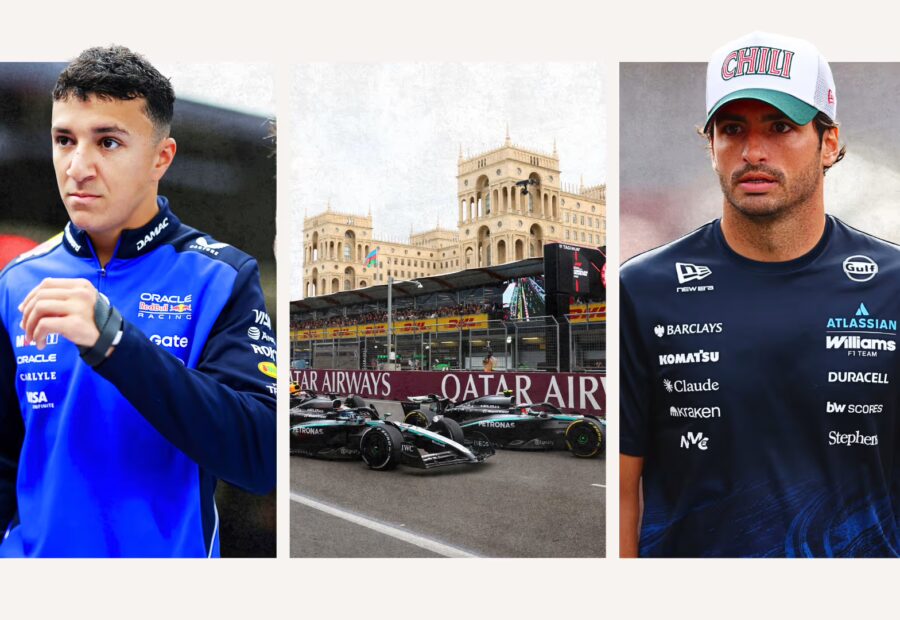
Carlos Sainz believes Formula 1’s regulation changes have played a major role in reshaping the competitive order among drivers in 2026.
F1 introduced its biggest rules overhaul last winter, changing both the chassis and power unit. The new regulations moved the sport away from ground-effect cars and introduced active aerodynamics, alongside a 50/50 split between internal-combustion and electrical power.
The changes created a fresh challenge for drivers, who had to adapt to different car characteristics and manage power units that were significantly different from those used during the 2022-25 era.
Sainz links F1 regulation changes to driver performance swings
Sainz believes that transition has contributed to the changes in competitiveness seen among drivers in 2026.
“Let’s start with one thing: it’s been impressive to see how much the performance balance between team-mates has changed. Not only between Antonelli and Russell, but also between Hamilton and Leclerc, and with Verstappen not being as dominant over Hadjar,” Sainz said in an exclusive interview.
“I think it’s a lesson for everyone. We’ve had confirmation that when the fundamental concept of a car changes, the competitive picture can change as well.
Lewis Hamilton, Ferrari, Charles Leclerc, Ferrari
Photo by: Joe Portlock / Getty Images
“It’s something I’ve always believed: a car can suit you extremely well or it can be far from what you would ideally want, but sooner or later you have to adapt. It might take some time, but eventually you have to find a way.
“I’ve always thought that many results in Formula 1 have also been helped by the combination of being in the right place at the right time. For many years, I’ve believed there are cars that simply suit your driving style from the very first laps.”
Why ground-effect cars did not suit Sainz
Sainz said the ground-effect era did not naturally fit his preferred driving style, forcing him to adapt in order to maximise his performance.
“It happened when the ground-effect regulations came in. From 2022 onwards, for four years, I was never able to drive in my natural style,” he explained.
“I adapted and still managed to achieve some good results, but I remain convinced that the Carlos who drove during the ground-effect era wasn’t the same Carlos who drove the 2021, 2020 or 2019 cars.
“I’m not saying I was slow with the ground-effect cars. I think I had some very good races during that period, both with Ferrari and Williams, but I always had to adapt to something that didn’t come as naturally to me.
Charles Leclerc, Ferrari F1-75, passes the beached car of Carlos Sainz, Ferrari F1-75
Photo by: Andy Hone / Motorsport Images
“I had to work harder at it, and I think it was the same for other drivers too.”
Changing teams can transform an F1 driver’s performance
The four-time grand prix winner also believes moving between teams can have a similar effect. However, he said joining a new team is not necessarily a disadvantage when it comes to adapting to a different car or working alongside a team-mate who is already established.
“At the final test of the season in Abu Dhabi [December 2018], I got into their [McLaren’s] car for the first time and immediately felt that it drove in a way that was exactly in line with what I liked,” Sainz said.
“I think during my two years with McLaren, you saw the best version of me, although I also really liked the Toro Rosso. I liked the Renault a little less, while I immediately liked the 2021 Ferrari and I always performed very well in that car.
“Then, with the arrival of the ground-effect regulations, things became more difficult, but this year, I’ve started enjoying the driving more again.
“In the end, I don’t think a team can design a car specifically around your driving style. Sometimes you just get a fortunate combination, and when that happens you feel unbeatable. You have the feeling that it’s your car.”