

[ad_1]
- With its hawkish signal, the Fed has significantly shifted interest rate expectations for 2026, increasing macroeconomic pressure on Bitcoin.
- At the same time, Bitcoin is showing relative strength through spot-driven demand, but remains vulnerable from a chart perspective.
Yesterday’s Fed interest rate decision significantly shifted expectations for 2026 and somewhat dampened the optimism in the Bitcoin market in recent days. BloFin Research rates the session in anPost on Thursday as a turning point:
“Overnight, Powell again adopted a more hawkish tone. He warned that the impact of the Middle East situation on the US economy was ‘uncertain’. Energy prices will drive up near-term inflation.”

The macro outlook has clouded considerably
The key point from a market perspective: If the inflation path is not convincingly pointing downwards, the Fed is likely to keep the door to interest rate cuts narrower than previously hoped. BloFin points out that 7 out of 19 Fed members no longer see any rate cuts at all for 2026. This is a different starting point than just a few weeks ago.
Fed votes 11-1 to leave benchmark interest rate in a target range of 3.5%-3.75%. Governor Miran voted against the decision in favor of lowering rates by a quarter-point. Fed says implications of Middle East developments uncertain. Fed maintains projections for one rate cut in… pic.twitter.com/4BY48CQv5R
— Holger Zschaepitz (@Schuldensuehner) March 18, 2026

Added to this is an increasingly unpleasant macro situation. The fourth quarter of 2025 GDP was revised downwards to just 0.7% annualized, down from 4.4% in the third quarter. At the same time, inflation remained slow: the core PCE increased by 0.4% in December and January compared to the previous month, and over the year it rose to 3.1% – the highest level since spring 2024. The Truflation PCE quoted by BloFin was already over 2.41% in March. The classification of the sources of inflation was particularly sharp:
“Tariffs account for about half to three-quarters of core inflation Iran war drives oil prices above $100. Both mess up the Fed’s handbook.”
BREAKING: In a stunning moment, Jerome Powell just directly blamed Donald Trump’s tariffs for causing inflation to skyrocket. Holy cow. pic.twitter.com/4cUViOQ8N7
— Democratic Wins Media (@DemocraticWins) March 18, 2026
Whether you completely agree with this reading or not, what matters for risk assets is that the market has to reprice a more restrictive path.
That’s precisely why Bitcoin’s reaction in the last few days has been remarkable. According to BloFin, BTC is up around 13% since the conflict broke out on February 27th both gold as well as tech stocks. At the same time, the correlation with the software sector has recently visibly loosened. More importantly, this move does not appear to be driven by aggressive leverage. BloFin writes:
“The decoupling narrative is back, and it is not leveraged. Funding rates on perpetuals remain negative, showing leveraged longs are not leading this move. The rally is driven by spot demand.”
A spot-driven rise is typically considered more robust than a run based primarily on crowded futures positions. However, there was another setback yesterday before the FOMC meeting.
Producer prices in the US rose unexpectedly sharply in February 2026 (before the start of the Iran War): PPI rose 0.7% month-on-month and 3.4% year-on-year, significantly exceeding forecasts of 0.3% and 2.9%, respectively.
BREAKING: US February PPI inflation rises to 3.4%, above expectations of 2.9%.
Core PPI inflation rises to 3.9%, above expectations of 3.7%.
Core PPI inflation is at its highest since February 2023 and this data does not include the Iran war.
Rate cuts are being priced-out.
— The Kobeissi Letter (@KobeissiLetter) March 18, 2026
The US Federal Reserve’s restrictive dot plot then provided the second setback for risk assets such as Bitcoin.
Bitcoin price could fall to $52.50o
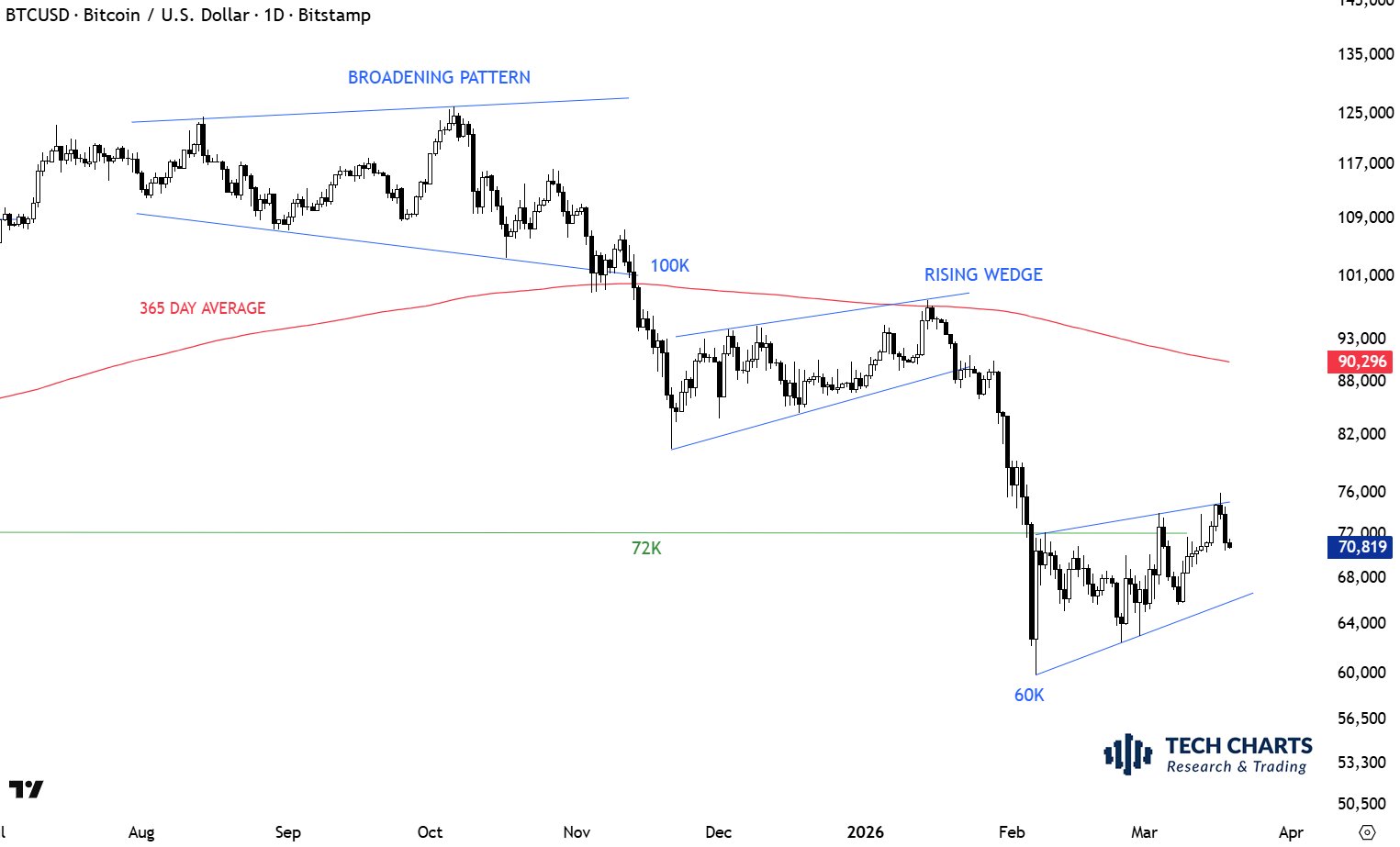
Accordingly, the technical situation for the Bitcoin price remains fragile. While Bitcoin rose to $76,000 on Tuesday, supported by bullish momentum, it then suffered a sharp setback.
Renowned chart analyst Aksel Kibar refers on its previous analysis of a bearish wedge pattern from mid-November last year to mid-January this year and now sees the possibility of a similar structure forming again. His warning is deliberately worded cautiously, not prognostic, but the danger is real:
“See my analysis at the time of the previous bearish wedge pattern. A similar pattern could be developing now. This is not a forecast. A break of the lower boundary line would be the signal of a possible move towards $52,500.”





No Comments