Key Highlights
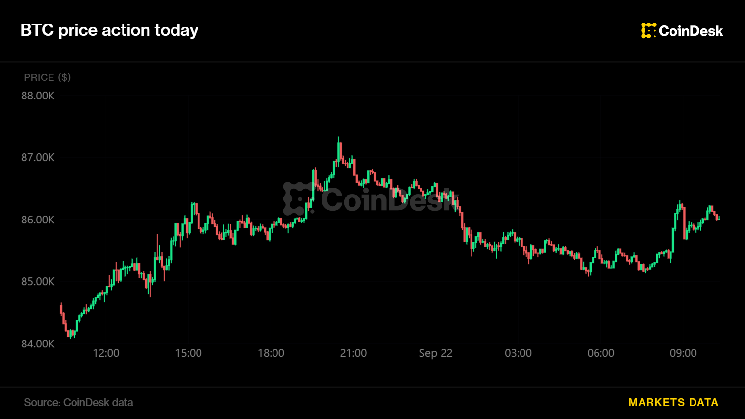
- Bitcoin holds near $84,000, demonstrating resilience despite the Federal Reserve’s benchmark rate holding at 4.00% following last week’s hawkish stance.
- The SEC’s conditional five-year exemption window for tokenized securities pilot trading opens September 22, allowing select institutional venues to trade tokenized stocks on public blockchains.
- Major governance votes are underway across Lido DAO, Uniswap, and CoW DAO, addressing liquidity provisions, protocol fee extensions, and solver competition redesigns.
Bitcoin Resilience Amid Macro Uncertainty
Cryptocurrency markets opened the week on a firm footing, with bitcoin BTC trading at $83,915.85 and testing the psychologically significant $84,000 threshold. The digital asset’s stability comes as investors digest the Federal Reserve’s latest policy posture, which maintained the benchmark target rate at 4.00% after last week’s hawkish signaling. While traditional risk assets often react negatively to restrictive monetary policy, bitcoin’s current price action suggests a decoupling from immediate rate-sensitive impulses, at least in the near term.
The macroeconomic calendar this week centers on a cluster of high-impact U.S. data releases that could recalibrate rate-cut expectations. Initial jobless claims for the period ending September 19 are estimated at 201,000, up from the previous 196,000, while new home sales for August are forecast to decline to 700,000 from 739,000. Durable goods orders are expected to contract 0.3% month-over-month in August after a 1.1% gain previously, and the final University of Michigan Consumer Sentiment Index for September is seen at 47.8, down sharply from 51.7. Canadian retail sales for August are also due, estimated at -0.8% versus a prior 0.6% gain. Cross-asset markets continue to process the divergent policy paths emerging from the Bank of Japan and the Bank of England, adding another layer of complexity to the global liquidity backdrop.
SEC Tokenized Securities Pilot Framework Goes Live
A pivotal regulatory milestone arrives on September 22, when the U.S. Securities and Exchange Commission’s conditional five-year exemption window officially opens. This framework permits select institutional venues to commence pilot trading of tokenized stocks directly on public blockchains. The initiative represents the most concrete step yet by U.S. regulators to bridge traditional securities infrastructure with distributed ledger technology, potentially unlocking new paradigms for settlement efficiency, fractional ownership, and market accessibility. Market participants will be closely monitoring which venues receive approval and the volume dynamics during the pilot’s early phase.
Governance Activity Intensifies Across Major DAOs
Decentralized autonomous organizations are driving a busy week of on-chain governance. Lido DAO is voting on a proposal to authorize a contingent LDO centralized-exchange liquidity market-making mandate, budgeting up to $1.5 million in recallable LDO and 480,000 USDC to maintain orderbook depth and mitigate potential exchange delisting risks. Voting concludes September 21. Uniswap Governance is conducting a temperature check on extending its protocol fee collection and UNI burn infrastructure to Arc, a Layer 1 network built by Circle, with voting ending September 23. Meanwhile, CoW DAO is voting on a redesign of its solver quote competition, allocating a dedicated quote reward budget equal to 10% of protocol revenue to enhance price routing and order conversion; this vote wraps up September 25.
Token Unlock Schedule Presents Supply Dynamics
Several notable token unlocks are scheduled this week, introducing incremental supply into circulating markets. Canton (CC) unlocks 0.38% of its circulating supply, valued at approximately $17.17 million, on September 21. Toncoin (TON) follows on September 22 with a 1.3% unlock worth $51.2 million. Humanity (H) releases 14.7% of its circulating supply, valued at $20.8 million, on September 23. No major token launches are confirmed for the period, and the conference calendar remains clear.
Why This Matters
The convergence of bitcoin’s price resilience, the SEC’s tokenized securities pilot launch, and heightened DAO governance activity signals a maturing market structure where regulatory engagement, institutional infrastructure, and decentralized coordination are advancing simultaneously. The SEC pilot, in particular, could establish precedent for how traditional assets are issued, traded, and settled on-chain, potentially attracting broader institutional participation. Meanwhile, the governance votes at Lido, Uniswap, and CoW reflect the growing operational sophistication of major protocols as they address liquidity sustainability, cross-chain fee architectures, and execution quality—issues critical to long-term protocol viability. Traders should monitor this week’s macro data for signals on the Fed’s next move, as any shift in rate expectations could rapidly reassert correlation between digital assets and traditional risk markets.
Frequently Asked Questions
What is the SEC’s tokenized securities pilot framework?
The SEC’s conditional five-year exemption window, opening September 22, allows select institutional venues to conduct pilot trading of tokenized stocks directly on public blockchains. This regulatory sandbox aims to test distributed ledger technology for securities settlement and trading under supervised conditions.
Why are the Lido, Uniswap, and CoW DAO votes significant?
These governance proposals address critical operational priorities: Lido seeks to secure exchange liquidity for LDO to prevent delistings; Uniswap explores extending its fee and burn mechanism to Circle’s Arc network; CoW Protocol aims to improve solver competition and order routing through a dedicated reward budget. Outcomes will shape protocol economics and cross-chain strategies.
Which macroeconomic data points should crypto traders watch this week?
Key releases include U.S. initial jobless claims (Sept. 24, 8:30 a.m. ET), new home sales (Sept. 24, 10:00 a.m. ET), durable goods orders (Sept. 25, 8:30 a.m. ET), and the final Michigan Consumer Sentiment Index (Sept. 25, 10:00 a.m. ET). These indicators will influence Federal Reserve policy expectations and broader risk sentiment.