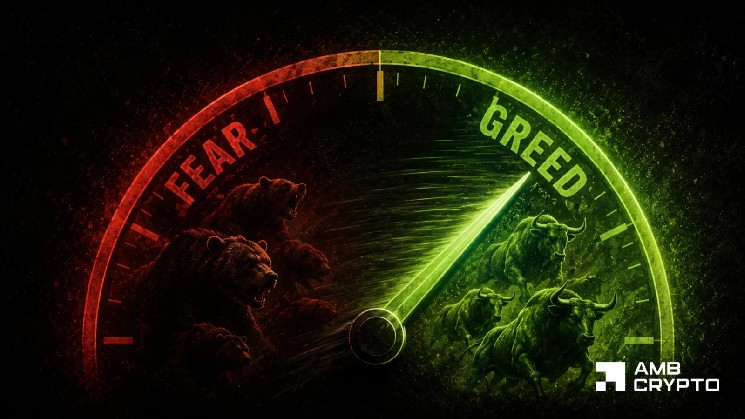
Crypto market sentiment has shifted sharply in just a few days. After spending months between “Fear” and “Extreme Fear,” the market has now moved into “Greed.”
At press time, the Crypto Fear and Greed Index stood at 68, placing it in the “Greed” zone. CoinShares’ recent report, ‘From despair to greed in a week: a rally is not a verdict’, highlighted a more favorable environment for Bitcoin’s rally.
However, the shift does not indicate a fundamental improvement across the entire cryptocurrency industry.
Source: Alternative
Why did crypto sentiment change so quickly?
Jean-Marie Mognetti, CEO of CoinShares, believes conditions surrounding digital assets have become more favorable, particularly for Bitcoin [$BTC]. However, most individual crypto projects have not suddenly become stronger businesses simply because their prices have increased.
Mognetti put it best when he said:
This is where the rally becomes more dangerous to interpret.
Just one month earlier, more than 100 crypto projects had reportedly shut down, entered bankruptcy, or disappeared in 2026. Major industry names were also announcing closures or filing for bankruptcy, creating the impression that the crypto sector was entering another major downturn.
The situation then changed rapidly. Bitcoin climbed back above $80,000, other digital assets followed, and options traders began placing large bets that Bitcoin could rise above $82,000.
What is driving the Bitcoin rally?
Several factors have contributed to the latest crypto market rally. The most prominent was last week’s White House meeting, during which President Trump urged Congress to pass a “fair version” of the CLARITY Act.
Treasury buybacks, a hawkish tone from the Federal Reserve, and US federal debt surpassing US$40 trillion were additional factors supporting the market’s momentum.
Despite these developments, the rally has not resolved the fundamental problems that caused more than 100 crypto projects to disappear in 2026. Many failed after running out of funds or experiencing security issues, while cryptocurrency exploits caused more than $1 billion in losses during the first half of 2026.
These developments suggest that the rally has genuine support from a stronger macroeconomic backdrop. However, rising prices do not automatically validate every asset participating in the rally.
Mognetti added:
What deserves scepticism is the assumption that a rising market validates everything rising with it.
The warning is significant because a similar level of market greed preceded Bitcoin’s correction of more than 30% in October 2025.
This time, the total crypto market capitalization has risen by more than 22% in a week. However, the weekly relative strength index is extremely overbought, so caution remains warranted. Longer-term data, meanwhile, continues to indicate that the rally may have further room to run.
Crypto sentiment has not reached peak greed
Institutional demand remains a key difference in the current market cycle. Spot Bitcoin ETFs recorded more than $1 billion in inflows last week alongside a 21% $BTC rally. October’s inflows, however, exceeded $3 billion, suggesting there may still be scope for stronger institutional demand.
The Coinbase Premium Index previously reached 0.18, reflecting strong accumulation by US investors. That signal is currently absent. As a result, despite short-term overbought conditions, sentiment around 75 may not yet represent peak greed or guarantee an imminent correction.
These changes followed Bitcoin’s move back above $80,000. Nevertheless, some concerning market data suggest that the rally could continue while also highlighting the risks of interpreting rising prices as evidence of broad-based strength across the crypto industry.