Bitcoin’s August rally is facing a tougher test as investors assess whether sustained spot exchange-traded fund (ETF) demand can offset rising expectations of a September Federal Reserve rate hike.
Bitfinex analysts said in an Aug. 31 market report shared with crypto.news that Bitcoin’s latest advance has increasingly been driven by spot buying rather than excessive leverage. That could leave the market better positioned to absorb selling even as U.S. monetary conditions become less supportive.
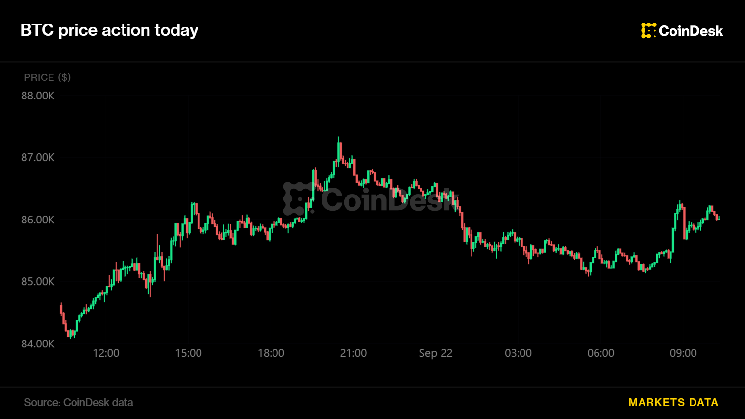
Bitcoin ($BTC) was trading near $78,700 at the time of writing, down about 0.4% over 24 hours, according to crypto.news data. The cryptocurrency briefly climbed above $81,000 last week before falling to $76,857 after Federal Reserve Chair Kevin Warsh used his Jackson Hole address to signal that interest rates may still need to rise.
The decline interrupted a rally that lifted Bitcoin from below $65,000 in mid-August to above $80,000. As previously reported by crypto.news, Bitcoin gained about 24% during the preceding week as Treasury buybacks, ETF demand and forced short covering fueled the recovery.
Bitcoin ETF demand faces a tougher test
Bitfinex analysts said the derivatives market has not displayed the rapid leverage buildup typically associated with an overheated rally. Bitcoin open interest stood at $55.6 billion, more than 20% above its level at the start of August, but the increase has been gradual and basis levels have remained relatively low.
“We are in a market driven by spot buying and, notwithstanding large short liquidations, open interest has only gradually increased, while basis has remained relatively low and at healthy levels historically,” the analysts said.
According to the report, Bitcoin holding the $77,100 level, which Bitfinex identified as important lower-timeframe support, alongside continued spot buying would suggest that market conditions remain relatively balanced.
ETF flows offer another indication of whether that demand can continue. U.S. spot Bitcoin ETFs absorbed about $3.04 billion during nine consecutive positive sessions from Aug. 17 through Aug. 27, according to Bitfinex. Friday marked the first net outflow in 10 sessions, with investors withdrawing $201.9 million as Bitcoin reversed from above $81,000.
Despite those redemptions, the funds recorded $924.5 million in net inflows for the week. Inflows over the preceding two weeks totaled about $2.8 billion.
BlackRock’s IBIT accounted for just $33.4 million of Friday’s withdrawals after attracting roughly $2.3 billion during the previous nine sessions. ARKB and BITB recorded a combined $164.6 million in outflows.
Institutional demand has also absorbed Bitcoin sold by larger holders, Bitfinex said. Whale addresses holding between 1,000 and 10,000 $BTC reduced their balances by 50,500 $BTC since the end of June, while institutional custodial holdings associated with exchanges and ETF platforms increased by 59,100 $BTC.
During the latest August advance, custodial balances rose by 31,500 $BTC, closely tracking ETF inflows, according to the analysts.
“While whales took profits during the rally, institutional demand absorbed that supply, indicating that assets moving into these regulated vehicles may be less prone to sudden liquidation on the basis of short-term macroeconomic news.”
$80K–$83K could test the strength of real demand
Jeff Ko, chief analyst at CoinEx, told crypto.news that part of Bitcoin’s August rally resulted from Treasury buybacks pushing yields and the dollar lower while traders held large short positions.
Ko said the mechanical portion of the resulting short squeeze has now “largely played out,” making spot demand increasingly important around $80,000.
“Treasury buybacks pushed yields and the dollar lower, and that impulse collided with crowded short positioning to produce the squeeze,” Ko said. “What matters from here is whether spot buyers keep absorbing supply around $80K.”
The Treasury catalyst had already produced a sharp market response earlier in August. On Aug. 19, the department announced that it would at least double the maximum size of liquidity-support buybacks for 10-to-20-year and 20-to-30-year nominal coupon securities from $2 billion to at least $4 billion per operation from Sept. 9 through Nov. 4.
The change helped compress long-term yields as Bitcoin surged. An Aug. 20 analysis of the buybacks found that $BTC rose 8.2% from an intraday low of $64,100 to $69,500 within 12 hours of the Treasury announcement, while $1.44 billion in short positions were liquidated.
Ko views the $80,000–$83,000 range as more than a technical resistance zone. The area could reveal whether new investment can replace the buying pressure previously generated by forced short covering.
“It is a major supply zone, and the point at which the rally stops being a short squeeze and becomes a test of real capital allocation.”
Ether could provide another signal of broader cryptocurrency risk appetite. Ko said ETH traded near $2,490 heading into Jackson Hole but subsequently lagged Bitcoin in price performance. If Treasury yields and the dollar remain elevated while Ether begins outperforming Bitcoin in both price and investment flows, he would view that as evidence of stronger crypto demand.
Bitfinex also identified Ether ETFs as a potential demand gauge. U.S. spot Ether products attracted $815.7 million last week, extending their positive streak to 10 sessions, according to the firm. Nearly 12.3% of cumulative Ether ETF inflows since launch arrived during August, while demand adjusted for the relative size of the assets was roughly four times stronger than Bitcoin ETF demand during the past week.
Fed rate hike risk threatens Bitcoin’s liquidity support
Bitcoin is now facing pressure from a less favorable interest-rate outlook. Warsh’s Jackson Hole remarks lifted the market-implied probability of a September rate increase to about 57%, according to Bitfinex.
Ko said CME-implied odds rose from 39.9% on Aug. 21 to 57% following the speech. The two-year Treasury yield moved to around 4.31%, while the dollar returned toward a two-week high.
Bitfinex analysts said persistent inflation remains a key obstacle to easier monetary policy. Headline Personal Consumption Expenditures inflation stood at 3.7%, with core inflation at 3.3%, while private domestic demand expanded at a 4.2% annualized pace during the second quarter.
Jeff Mei, chief operating officer of BTSE, told crypto.news that Warsh’s speech raised the hurdle for Bitcoin because higher interest rates could reduce the liquidity available to cryptocurrency assets.
“For a sustained rally, we need a few things to happen. First, ETF demand has to stay strong across all ETF products, and not just BlackRock’s IBIT ETF. Second, we need better inflation data for the Fed to back off and keep rates steady.”
Mei also warned that the boost from Treasury buybacks could fade quickly. Earlier in August, Bitcoin broke above $76,000 as ETF inflows accelerated alongside improving U.S. liquidity conditions. Spot Bitcoin ETFs attracted $606 million on Aug. 20 alone, extending the institutional demand that accompanied the recovery from mid-August lows.
U.S. economic data could shape Bitcoin’s next move
Market attention is turning to a series of U.S. economic releases that could change interest-rate expectations before the Federal Reserve’s September meeting.
Ko identified Friday’s August payroll report as the most important immediate event and the final jobs report before the FOMC decision. July payrolls fell by 23,000 compared with an 80,000 consensus estimate, while May and June payrolls were revised lower by a combined 103,000 jobs, according to figures cited by Ko. The unemployment rate currently stands at 4.1%.
Before the payrolls report, ISM Manufacturing and JOLTS data are due Tuesday. ADP employment figures and the Federal Reserve’s Beige Book are scheduled for Wednesday, followed by ISM Services data on Thursday. Bitfinex analysts also identified the August labor-market and inflation reports as the next major tests for rate expectations.
The August inflation report is scheduled for Sept. 11, placing another important data release immediately before the Sept. 15–16 FOMC meeting.
Ko also pointed to the CLARITY Act as a crypto-specific U.S. catalyst, with a Senate procedural vote currently scheduled for Sept. 15. He considers the vote one of the largest asset-specific events on the September calendar, while the Federal Reserve meeting will determine the monetary backdrop for Bitcoin and other risk assets.
For Bitcoin’s price, Mei sees $87,000 as the next level that would materially strengthen the bullish case after the cryptocurrency clears nearer resistance zones.
“If we break the $87k mark and hold, $100K becomes the real target, and we could be looking at a bull market.”