Key Highlights
- Mashable publishes daily spoiler-free hints and definitions for the NYT Connections puzzle to help players understand word meanings without revealing answers.
- Today’s word list includes terms spanning architecture, nature, fashion history, and pop culture such as “Log cabin,” “Twiggy,” and “Sin City.”
- Mashable also offers daily solutions for Wordle and Strands, plus a games hub featuring Mahjong, Sudoku, and free crosswords.
Mashable Expands Daily Puzzle Support With Contextual Word Definitions
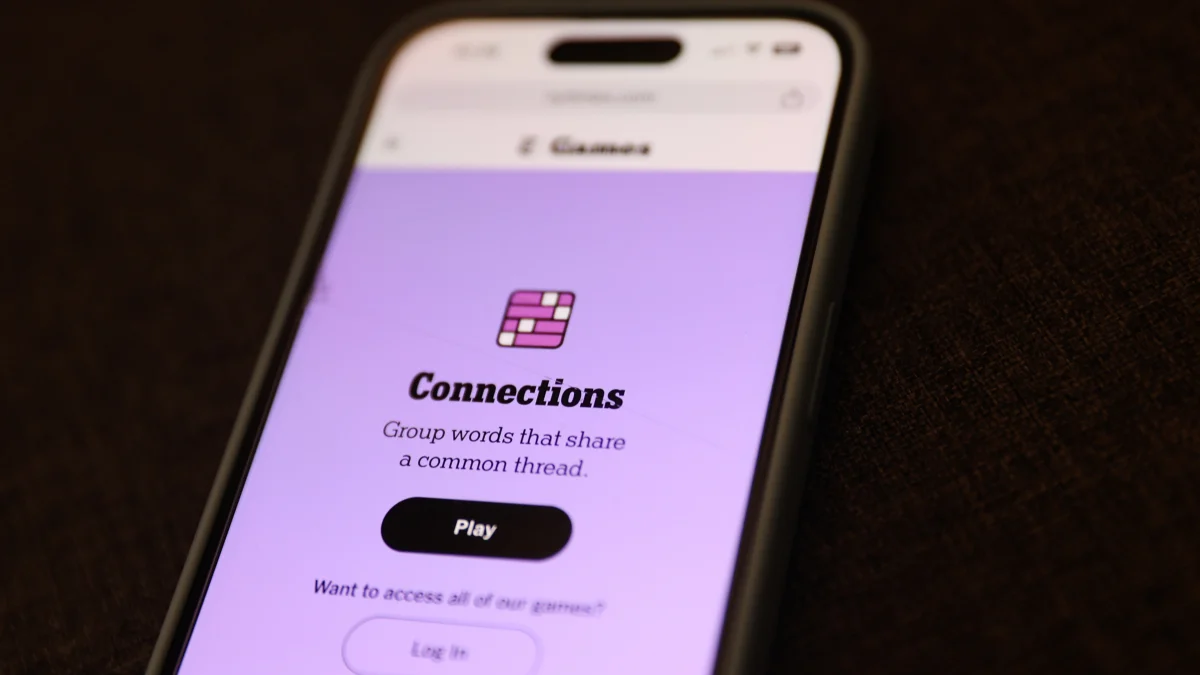
Mashable has reinforced its commitment to serving the daily puzzle community by publishing a new round of spoiler-free hints for the New York Times Connections game. Rather than supplying direct answers, the outlet focuses on unpacking the multiple meanings of words that appear in the puzzle grid, recognizing that Connections frequently relies on polysemy, visual wordplay, and hidden substrings as core mechanics. The approach reflects a broader editorial strategy that treats puzzle assistance as an exercise in semantic literacy rather than simple solution delivery.
Today’s Lexical Landscape Spans Architecture, Nature, and 1960s Fashion
The word definitions provided for the current puzzle illustrate the eclectic range the game draws from. Entries include structural terms such as House—defined as “A home or dwelling”—and Log cabin, described as “A small house made of stacked tree trunks.” Natural elements feature prominently with Sun (“The star at the center of the solar system”), Tree (“A large, tall plant made of bark and leaves”), and Cos lettuce (“A leafy green vegetable”). Verb phrases like Branch out (“To try or discover something new”), Diversify (“To add variety”), Expand (“To grow”), and Grow (“To get bigger or taller”) suggest a thematic cluster around growth and expansion.
Cultural References Extend to Swinging London and Las Vegas
Beyond the literal and botanical, the list incorporates distinct cultural touchstones. Sin City is identified as “A nickname for Las Vegas,” while Carnaby Street appears as “A popular shopping street in Soho London.” Fashion history is represented by Miniskirt (“A very short skirt that sits well above the knee”) and Mod (“A 1960s British youth subculture”), culminating in Twiggy, noted as “A British icon who became known as the world’s first supermodel in the 1960s.” Even Tan line—”A visible mark on the skin that shows a dark tone after time in the sun”—and the minimalist Stick figure—”A simplistic drawing of a human”—round out a set that demands lateral thinking across domains.
Why This Matters
The New York Times Connections puzzle has cultivated a dedicated daily audience that increasingly turns to trusted media brands for structured guidance without spoilers. Mashable’s long-standing vertical—covering Connections, Wordle, and Strands—positions it as a go-to resource for players seeking to improve pattern-recognition skills rather than simply win. By publishing word meanings alongside newsletter sign-up prompts and a dedicated games hub featuring Mahjong, Sudoku, and free crosswords, Mashable is deepening reader engagement across its puzzle ecosystem while driving recurring traffic and newsletter subscriptions.
Frequently Asked Questions
- Does Mashable reveal the actual Connections answers in this article?
- No. The article explicitly states it is focused on “meanings than hints” and provides definitions for words that may appear in the puzzle without disclosing the grouping solutions.
- What other NYT puzzles does Mashable cover daily?
- Mashable provides daily hints and answers for Wordle and Strands in addition to Connections.
- Where can readers find previous days’ Connections solutions?
- The article links to “yesterday’s Connections” solution, and Mashable maintains an archive of past puzzle coverage.