Key Highlights
- Prime Video’s The Love Hypothesis adapts Ali Hazelwood’s bestselling BookTok novel, starring Lili Reinhart and Tom Bateman in a fake-dating romance set within Stanford’s STEM academia.
- The film captures beloved book details like the “unicorn socks” and Chapter 16 intimacy, with strong comedic chemistry between leads during early fake-dating sequences.
- Critics note a missing emotional core: the adaptation lacks the interior yearning and angst that define the fake-dating trope, leaving the third-act romance feeling unearned despite solid performances.
From Beaker to Screen: Adapting a BookTok Phenomenon
Remember making elephant toothpaste in science class? You’d combine water, yeast, soap, hydrogen peroxide, and food coloring, and watch a tower of colorful foam erupt from a beaker. Not long after, the foam would subside, leaving nothing but soapy water and the fond memories of a brief foray into the world of chemistry. Watching The Love Hypothesis is a lot like that. Adapted from Ali Hazelwood’s novel of the same name, a BookTok favorite, The Love Hypothesis details the fake dating romance between biology PhD student Olive Smith (Lili Reinhart) and professor Adam Carlsen (Tom Bateman). It’s full of chemistry, both figurative and literal, and like the elephant toothpaste, it’s a bubbly blast that’ll have your insides fizzing. Yet despite this pure fun, not to mention two solid leading performances, The Love Hypothesis is missing one key ingredient that would truly make its experiment stick the landing: yearning.
Fake Dating Meets STEM Academia
Like Hazelwood’s book, itself reworked from her Reylo fanfiction, The Love Hypothesis cannily deploys several beloved romance tropes within the world of STEM academia, with fake dating chiefest among them. Stanford PhD candidate Olive is a ball of sunshine who’s as sweet as the sugar bomb coffees she loves to order. She cares deeply about her research into pancreatic cancer, as well as her found family: fellow students Anh (Rachel Marsh), Jeremy (Nicholas Duvernay), and Malcolm (Jaboukie Young-White). While Olive has harbored a crush on Jeremy, she also knows that he’s interested in Anh, and vice versa. However, Anh refuses to date Jeremy because she doesn’t want to hurt Olive. For Olive, that leaves her one choice: pretend to be dating someone else so Anh thinks she’s over Jeremy.
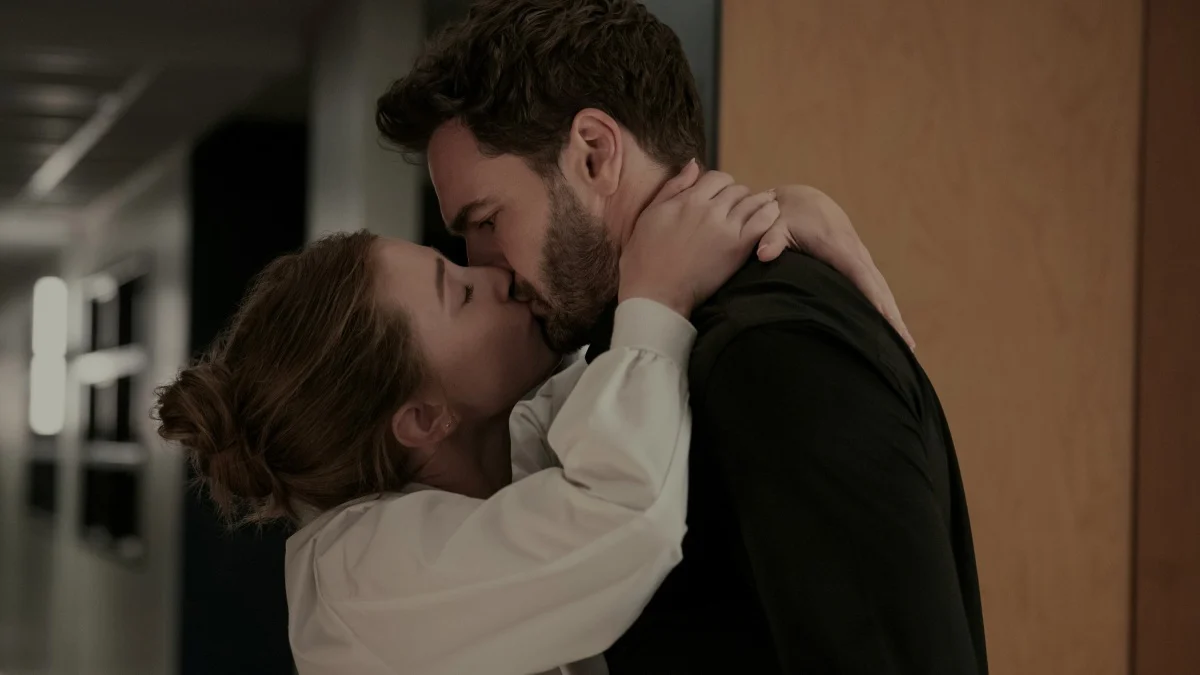
Olive’s lie spirals until she kisses the first man she can find in front of Anh. Unfortunately for her, that man happens to be the brilliant but intimidating Dr. Adam Carlsen. Due to his demanding nature and bluntness verging on rudeness, he’s earned the nickname “Dr. Evil.” That he only ever dresses in black does nothing to lessen the supervillain vibes. (One music cue tied to Adam sounds like a riff on “The Imperial March,” a riff on The Love Hypothesis‘ Star Wars roots.) The pair’s kiss could result in disaster. Surprisingly, though, Adam agrees to help Olive with her fake dating ruse. (Notably, he was never her professor, so The Love Hypothesis avoids those power dynamic issues.) This way, Anh and Jeremy will get the chance to get together. The arrangement also benefits Adam. Stanford believes he’s a flight risk and might not renew funding for his research. If they know he has a serious girlfriend, they may reconsider. So begins Olive and Adam’s fake relationship, which, as decreed by the laws of rom-coms, winds up being not so fake after all.
Faithful Details and Charismatic Leads
Avid The Love Hypothesis fans, you’ll be happy to know that the film, directed by Claire Scanlon (Set It Up), captures several of the book’s beloved details, including the unicorn socks Olive wears during her and Adam’s steamy first night together, aka the infamous Chapter 16. You’ll also be overjoyed to see how Reinhart and Bateman bring the Adam-Olive pairing to life. Reinhart falls right into step alongside the leading ladies of rom-coms past, tempering Olive’s klutzy quirks — she sweats a lot! — with her deeper desire to prove herself and maintain a lasting community, two needs that stem from a tough upbringing in the foster care system. Bateman, on the other hand, delivers almost every line with a clipped precision, which only makes the moments when Adam softens up around Olive all the clearer.
The two are a delightful pair, especially in classic fake dating scenarios where they have to pretend to truly love each other. A very public coffee shop date leads to squeal-worthy moments of cringe comedy, as do Olive’s attempts to loudly fake laugh and flirt with an utterly confused Adam. However, somewhere between these disastrous first “dates” and the intimacy of the much-anticipated Chapter 16 sequence, The Love Hypothesis‘s romance loses steam.
The Missing Element: Yearning and Interiority
The Love Hypothesis could have used more yearning. A key component of any fake dating story is the moment the characters realize they may actually have developed real feelings (shout out to To All the Boys I’ve Loved Before). Cue the yearning, and with it, the angst that if they act on their feelings, they may irreparably damage the genuine connection they’ve developed. It’s a delicious trademark of the trope, yet it’s sorely lacking in The Love Hypothesis.
The film sees Olive and Adam growing closer via a heart-to-heart about Olive’s late mother, as well as a lode-bearing montage of fake dates and Adam helping Olive with an important presentation. But The Love Hypothesis rarely lets us in on their true feelings, never giving Olive or Adam a moment of interiority to consider their burgeoning romance. (Given that Hazelwood’s book keeps us inside Olive’s head the whole time, this omission feels especially glaring.) Instead, the movie expects us to make the leap because it expects us to be familiar with fake dating stories in general. “He’s starving,” Malcolm remarks while watching Adam’s passionate goodbye kiss to Olive. Yet that level of being romantically famished is hard to find elsewhere in the film. By the time Chapter 16 rolls around, Olive and Adam’s sex feels inevitable, but not earned. The same goes for the confessions of love in the third act, itself a wildly disjointed conclusion featuring such a sinister turn, you may get whiplash.
Why This Matters: Adaptation Challenges in the BookTok Era
The reception of The Love Hypothesis highlights a growing tension in streaming-era romance adaptations: the challenge of translating first-person interiority and fan-favorite tropes from page to screen. Hazelwood’s novel thrived on BookTok precisely because of its deep access to Olive’s internal monologue—the yearning, the scientific metaphors for emotion, the gradual thaw of a guarded protagonist. Director Claire Scanlon’s choice to externalize the narrative through montages and comedic set pieces sacrifices the psychological scaffolding that made the fake-dating premise emotionally resonant. For Prime Video, the film represents a test case in whether algorithm-driven IP acquisitions can sustain franchise potential when core emotional mechanics are lost in adaptation. The movie’s strong opening sequences suggest a viable rom-com engine, but the third-act collapse raises questions about whether future BookTok adaptations will prioritize visual fidelity to “aesthetic” details (unicorn socks, Chapter 16 staging) over the narrative architecture that made the source material viral.
Frequently Asked Questions
- When does The Love Hypothesis premiere on Prime Video?
- The Love Hypothesis premieres September 23 on Prime Video.
- Who stars in the film adaptation?
- Lili Reinhart stars as Olive Smith and Tom Bateman as Dr. Adam Carlsen, with supporting performances from Rachel Marsh (Anh), Nicholas Duvernay (Jeremy), and Jaboukie Young-White (Malcolm).
- Does the movie follow the book’s plot closely?
- The film captures several beloved book details—including the unicorn socks and Chapter 16 intimacy—but critics note it lacks the novel’s interior monologue and emotional yearning, making the central romance feel less earned despite faithful visual references.