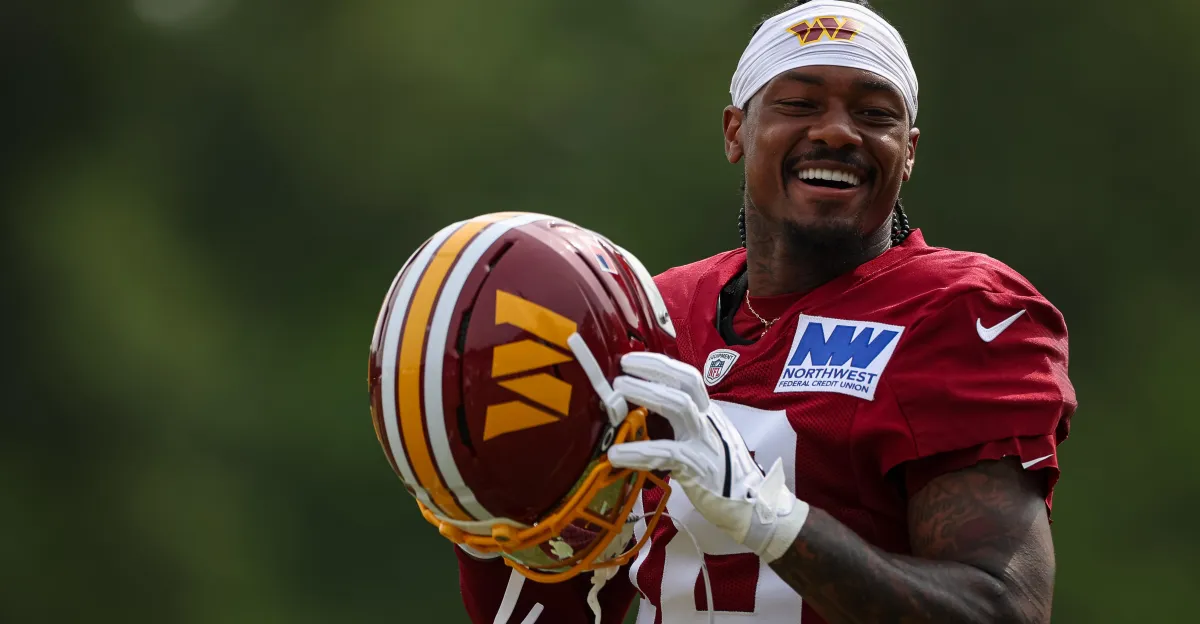
Hogs Haven’s latest Reacts survey asked readers which of six high-profile free-agent acquisitions would have the biggest positive impact on the Washington Commanders’ 2026 season. Stefon Diggs led the voting with 47%, followed by edge rusher Odafe Oweh at 29%.
The results highlight differing views on roster construction, financial investment and how Washington’s offseason moves could challenge lackluster national expectations for the 2026 season.
Stefon Diggs could raise both Washington’s ceiling and floor
Diggs’ 47% share of the vote suggests many Commanders fans see a true perimeter weapon as a major catalyst for offensive improvement. However, he received less than half of the total vote, reflecting debate over whether adding another high-volume receiver would produce the greatest marginal benefit.
With Terry McLaurin established as Washington’s primary receiving target, some fans believe the team could have generated a larger incremental impact by addressing other roster weaknesses. In a fully healthy offense, Diggs and McLaurin would naturally divide the available targets, potentially limiting each player’s individual statistical ceiling.
However, Diggs’ signing, which came one week into training camp, was also shaped by the lessons of the 2025 season. McLaurin missed seven games because of injury, while Noah Brown was sidelined for 13 games. The lack of receiving depth exposed the offense, causing the passing game to stagnate as opposing secondaries focused on Washington’s remaining options.
Diggs is therefore more than a luxury capable of raising the offense’s ceiling. He also provides insurance that raises its floor. Having two 1,000-yard receivers gives Washington a better chance of sustaining an effective passing game if injuries affect the receiving corps again.
When both players are healthy, their presence also creates a difficult schematic challenge for opposing defensive coordinators. Defenses cannot consistently shade safety help toward Washington’s primary passing-game threat when the offense has two proven perimeter targets.
Odafe Oweh and Washington’s $96 million defensive investment
Although Diggs received more support in the survey, Oweh represents the Commanders’ largest financial commitment of the offseason. He signed a four-year, $96 million contract, the most lucrative deal Washington has given an external free agent since Albert Haynesworth received a seven-year, $100m contract in 2009.
According to Over the Cap, Oweh’s $24 million average annual value ranks 17th among edge rushers. It is also well below the league’s top six contracts at the position, which are worth between $40m and $50m per year.
Evaluating Oweh’s impact solely through individual statistics such as sacks could overlook the broader strategic purpose of the signing. Under new defensive coordinator Daronte Jones, Washington is moving toward an aggressive, pressure-heavy scheme designed to dictate matchups and use multiple fronts to create confusion for opposing offensive lines.
Oweh is not expected to carry an otherwise empty pass rush. Instead, he is positioned to become the “lead dog” within a deep and talented rotation. Pairing his athletic ability with a wave of fresh situational rushers could allow Jones to maintain consistent pressure throughout all four quarters.
Oweh’s value will depend partly on how his edge pressure creates opportunities for interior pass rushers, stresses opposing quarterbacks and frees his teammates to make plays. His contract reflects the importance of a foundational edge setter—not an elite one-man wrecking crew—who can activate the tactical elements of Jones’ new defense.
Why the Commanders could defy national expectations in 2026
The survey results also reveal optimism among Washington fans that contrasts sharply with national projections. Major sportsbooks and national media previews have largely discounted the Commanders, with win totals and power rankings influenced by the team’s disappointing 2025 record and offering limited consideration to the coaching changes and major roster overhaul completed this offseason.
There are at least three reasons to believe those projections could underestimate Washington’s trajectory in 2026.
A complete schematic overhaul
The arrival of two new coordinators has reset the team’s strategic identity. Washington’s predictable and easily countered schemes from 2025, particularly on defense, have been replaced by more modern and adaptable systems on both sides of the ball.
National projection models can struggle to quantify the potential improvement that follows when a roster is supported by new coaching ideas and approaches.
A transformed defensive roster
Using Washington’s 2025 defensive metrics as the primary basis for projecting its 2026 performance may be misleading. The defensive coordinator and scheme are new, and more than half of the defensive starters will also be new to the organization this season.
Washington has replaced low-ceiling depth with proven or high-potential veterans and draft picks who fit the new system. That personnel transformation could make last season’s defensive results a poor guide to the unit’s upcoming performance.
Potential regression in injury impact
Washington was among the NFL teams most severely affected by adjusted games lost to injury in 2025. NFL history shows that extreme injury outcomes, whether positive or negative, rarely continue from one season to the next.
A return to league-average health would give the Commanders a natural boost in continuity and performance.
The Reacts survey indicates that Washington’s fan base recognizes the strategic logic behind the team’s offseason additions. Diggs provides stability and redundancy on the perimeter, while Oweh gives Daronte Jones the elite chess piece needed to execute his defensive vision.
National analysts remain focused on Washington’s 2025 results, but the changes in coaching, health and personnel point to a new team built around franchise quarterback Jayden Daniels. Those developments could position the Commanders to surprise skeptical NFL media, analysts and fans in 2026.