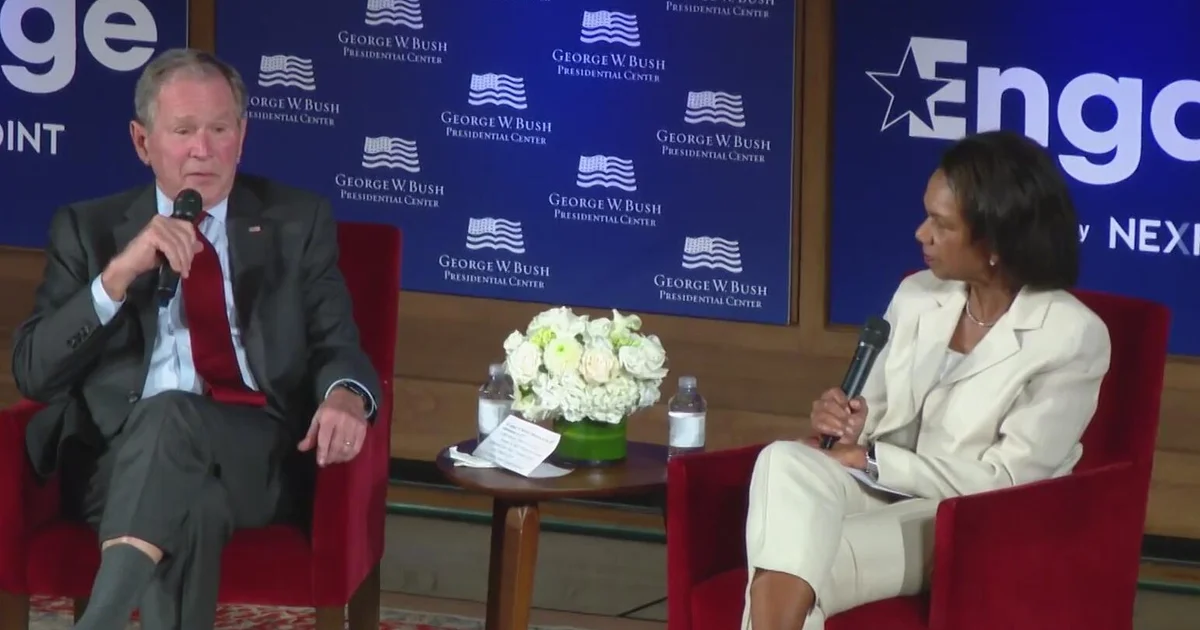
Former President George W. Bush delivered rare public remarks Wednesday as the United States marks 25 years since the September 11 terrorist attacks, warning that a growing isolationist sentiment ignores the core lesson of that day: events overseas directly affect national security at home.
Bush Warns Against Isolationism on 9/11 Anniversary
Speaking at his presidential library in Dallas alongside former Secretary of State Condoleezza Rice, who served as national security adviser during the attacks, Bush said the country periodically turns inward.
“Our nation occasionally goes through isolationist periods, where the attitude is, ‘Well, we’ve got too many problems at home. Therefore, who cares about what happens overseas?'”
“Which really means to me they just don’t pay attention to the lessons of 9/11, because what happens overseas matters to our national security at home.”
Standing With Those Fighting for Freedom
Bush argued that the United States should support people struggling against tyranny, even without deploying troops.
“We don’t have to send troops,”
“We ought to at least stand with them and stand beside them because this is what we went through 250 years ago. And again, it’s a belief that everybody wants to be free and we saw that in Afghanistan.”
Bush launched the war in Afghanistan after the 2001 attacks and supported building a democratic government following years of Taliban abuses. The conflict lasted 20 years, becoming America’s longest war, before the U.S. withdrawal in 2021 returned the country to Taliban control.
Bush pushed back against the view that Afghans do not understand freedom.
“Of course they know the difference,”
“Young girls going to school for the first time in their lives know the difference. Women becoming doctors and professors know the difference between a free society and a tyrannical society. And sadly, these women who begin to realize their full potential no longer have a chance to realize their full potential.”
Recalling the Morning of Sept. 11, 2001
Bush recounted being at an elementary school when Chief of Staff Andy Card informed him of the attacks.
“I became a wartime president,”
“This was a war, and that the job of the president and the country and his team is to rally the nation and to do what’s necessary to protect our people.”
Bush and Rice described the chaotic hours when officials believed every aircraft could be a weapon, ordering all planes to land or risk being shot down. Then-Transportation Secretary Norman Mineta worked to land planes “on a legal pad,” they said, while officials feared United Flight 93 had been downed by the U.S. military. The plane ultimately crashed in Shanksville, Pennsylvania, after passengers fought the hijackers.
“There was this horrible moment where the vice president kept trying to get confirmation as to what had happened, and for about 10 minutes, we thought we’d shot down a civilian aircraft,”
“And that always to me represented just how hard the decisions that you had to take under a lot of pressure.”
Ground Zero Visit and Defining the Response
Bush said he sensed trauma in the attacks’ aftermath but did not grasp the full scale until visiting Ground Zero on September 14, 2001, where he addressed first responders amid the wreckage. He said his highest priority became helping the country return to normal.
“I didn’t want us to lose our soul,”
“I wanted, as we defended our freedoms, I wanted people to remember how precious they are.”
Bush also recalled visiting a mosque shortly after the attacks, driven by reports of harassment against Muslim women, particularly in Michigan.
“It became clear to me that this is an ideological struggle, which is what I viewed it as, and we forego one of the most important parts of our ideology, which is the freedom to worship the way you want to worship,”
“All of a sudden, the enemy has won a victory, and so that was part of my thinking.”
Bush and Rice described shifting to a “Sept. 12” mentality, moving onto the offense to prevent further attacks.
“People now don’t understand the heaviness of the days after 9/11 in trying to protect the country,”