Superfluid Bug Allows Attacker to Drain Over $100,000 from GoodDollar Reserves
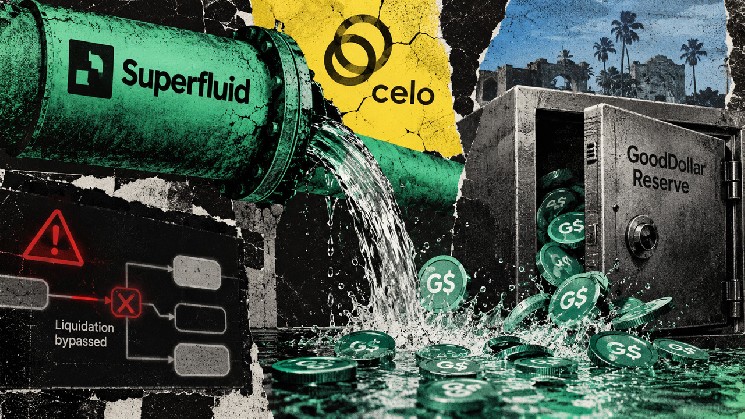
A vulnerability in Superfluid’s Celo deployment enabled a malicious application to bypass liquidation safeguards and mint excess G$ tokens, resulting in the drainage of more than $100,000 from GoodDollar’s reserves. GoodDollar announced on September 9 that 86,588 cUSD was exchanged out of its Celo reserve and an additional $20,857 was taken from its XDC reserve. External G$ liquidity pools were also impacted, though neither project has disclosed the extent of those losses.
GoodDollar’s UBI Model and Reserve Structure
GoodDollar operates as a decentralized universal basic income (UBI) protocol that distributes G$ tokens daily to registered users. The protocol’s reserve is backed by stablecoins, with yield generated through DeFi investments used to support G$ issuance and UBI distributions. According to GoodDollar’s dashboard, the program has over 963,000 unique UBI claimants and has distributed more than 2.3 billion G$ tokens to date, making the reserve central to the token’s economic model and daily distribution system.
Celo Network Holds 28% of G$ Circulating Supply
Approximately 2.4 billion G$ tokens circulate on the Celo network, representing roughly 28% of the token’s 8.7 billion circulating supply. This makes Celo the second-largest network for G$ after Fuse, which holds 4.19 billion G$. Ethereum accounts for about 1.82 billion G$, while the XDC network holds 292.5 million G$.
Superfluid Identifies Celo-Specific Vulnerability
Superfluid’s Security Council confirmed that the vulnerability was isolated to its Celo deployment. A malicious application circumvented a whitelisting requirement, allowing insolvent G$ balances to remain active instead of being liquidated. These excess balances were then exchanged against assets in the GoodDollar Reserve and other liquidity pools.
Superfluid detected insolvent accounts on September 3 and traced the liquidation failure to the Super App bug the following day. The team deployed a hotfix, reinstated Super App whitelisting on Celo, and closed the affected accounts. The council stated that other Superfluid networks were not exposed to the same flaw.
GoodDollar Activates Emergency Safeguards
GoodDollar reported that its Celo and XDC reserves were not fully depleted, crediting monitoring alerts, emergency pauses, and existing protocol safeguards. Claiming, G$ transfers, and identity verification have resumed on Celo. However, reserve operations on both Celo and XDC remain paused, bridging is suspended, and liquidity in external pools remains limited. GoodDollar has advised users against swapping G$ until liquidity improves, warning that thin markets could produce significant slippage and prices that diverge from normal levels.
Unexplained XDC Reserve Loss Raises Questions
Meanwhile, the $20,857 loss from the XDC reserve remains unexplained. Superfluid stated the underlying vulnerability existed only on Celo, yet GoodDollar reported an outflow from its XDC reserve. Neither project has disclosed how the excess G$ reached or affected the XDC network.
Incident Reports and Recovery Plans Underway
GoodDollar said it plans to address the excess G$, restore liquidity, and reopen the remaining paused functions. Both GoodDollar and Superfluid are preparing separate incident reports that should provide a fuller accounting of external-pool losses and explain how the Celo exploit produced an outflow on XDC.