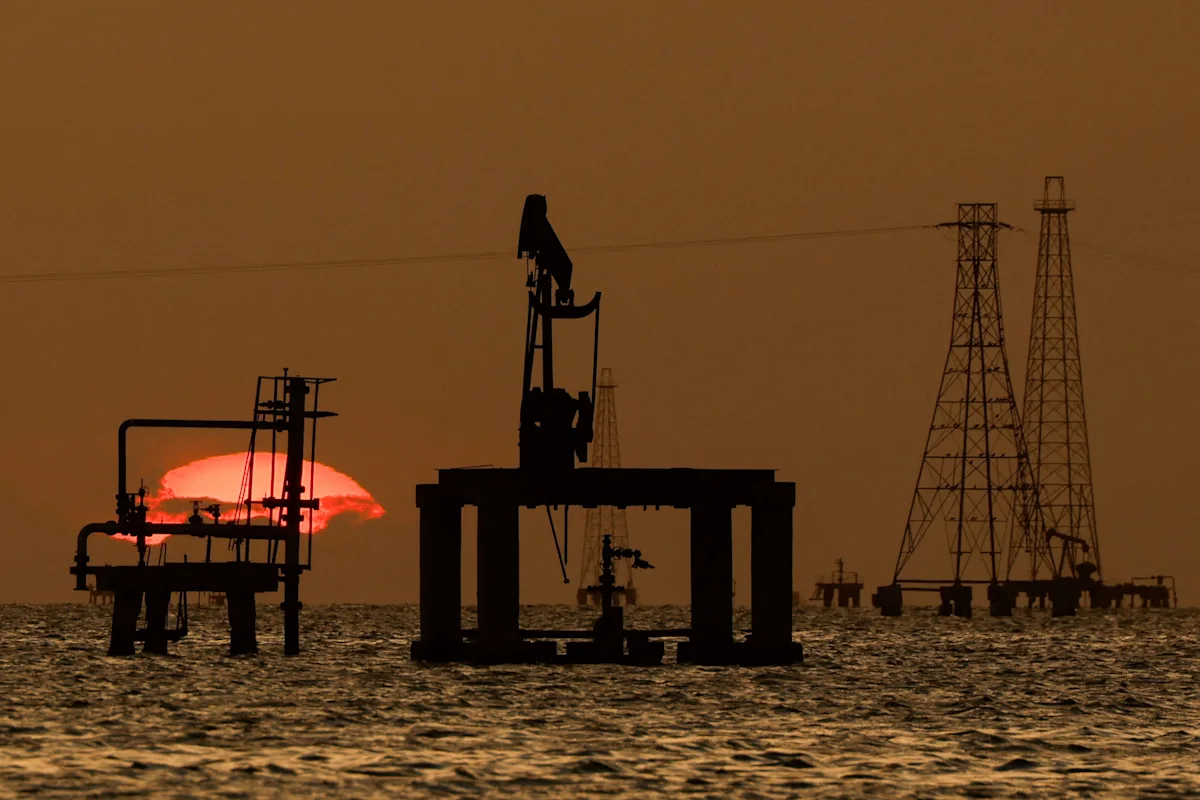
Oil prices surged in midafternoon trading Tuesday after the United States launched a new round of airstrikes on Iran, as investors assessed the risk of renewed conflict in the Persian Gulf and potential disruption to energy supplies.
Brent crude futures (BZ=F), the international benchmark, rose more than 4% to above $94 a barrel. US West Texas Intermediate crude futures (CL=F) climbed 4.5% to approach $90 a barrel.
US airstrikes target Iran’s Revolutionary Guard sites
The US military said Tuesday that it had launched renewed airstrikes against several sites in Iran linked to the country’s Islamic Revolutionary Guard Corps, according to US Central Command. Regional media and other local reports said explosions were heard near the cities of Bandar Abbas and Chabahar.
President Trump said the strikes were retaliation for alleged attempts by the IRGC to place mines in the Strait of Hormuz. The United States has spent weeks attempting to clear the waterway to support the safe passage of vessels. Trump also cited attempted Iranian strikes on locations inside Jordan.
“If the failed Nation of Iran retaliates for this very justified attack, they will be hit again at a much harder and higher level, but it will not be the biggest attack of them all, that is waiting in the wings and, when it is over, there will be very little left of the Islamic Republic of Iran!” Trump said on Tuesday.
An Iranian spokesperson and other leaders have said through state-affiliated media that Iran would retaliate. Potential targets include US military bases and American economic interests in the region.
Oil tanker attacks heighten Strait of Hormuz concerns
The US strikes followed attacks on two oil supertankers attempting to leave the Strait of Hormuz early Tuesday. One tanker was owned by a Saudi Arabian shipping company and the other by a South Korean company. Both vessels were hit by projectiles, according to a maritime risk consultancy.
No group has claimed responsibility for the tanker attacks. They occurred after a weekend escalation in US-Iran hostilities, including a series of US airstrikes on Iran’s Larak Island, a small landmass inside the Strait of Hormuz. US Central Command has said the Iranian military was preparing rockets capable of carrying sea mines into the waterway.
Iran’s military responded over the weekend with drone strikes inside Jordan and the United Arab Emirates. Iran also said it had seized a bulk carrier near the port of Bandar Abbas, inside the Strait of Hormuz.
The weekend fighting marked the first significant return to direct military action in roughly a month. It renewed concerns about the global energy system, even as Persian Gulf oil production has recovered to about two-thirds of prewar levels, according to Goldman Sachs. Much of the region’s oil is being exported through pipelines to the Red Sea and the Gulf of Oman.
Before the war, the Strait of Hormuz carried roughly one-fifth of global oil trade.
A view of a new anti-US billboard featuring President Trump alongside a slogan reading “Great Victory, Strait of Hormuz,” outside a train station in southern Tehran, Iran, on Sept. 1, 2026, amid new tensions between Iran and the US. (Morteza Nikoubazl/NurPhoto via Getty Images) · NurPhoto via Getty Images
Pipeline plans could reduce reliance on the strait
US Treasury Secretary Scott Bessent said Tuesday that the Strait of Hormuz would soon be “worthless” because of existing pipeline capacity and plans by the United Arab Emirates, Saudi Arabia, Iraq and other Gulf nations to build routes around the waterway.
“That will be bypassed in two years,” Bessent said in a fireside chat at the G20 finance chiefs meeting in Asheville, N.C. “In two years, the Strait of Hormuz will be like a worthless piece of water.”
Conflict threatens inflation and Treasury markets
The latest strikes come at a sensitive time for US economic and political leaders. Investors are turning their attention to the Federal Reserve’s September meeting after Fed Chairman Kevin Warsh identified inflation as the central focus of monetary policy.
Any further escalation could increase inflationary pressure through higher energy prices. Market-implied odds of a Federal Reserve interest-rate hike in September have risen to about 70%.
Politically, the White House is two months away from critical midterm elections for the Republican Party. The war, now in its sixth month, continues to lose support among US voters, according to several major polls.
News of the airstrikes and rising oil prices pushed the yield on two-year US Treasurys up about five basis points, reflecting expectations for a tighter fiscal path ahead for the Federal Reserve. Ten-year and 30-year Treasury yields rose four and two basis points, respectively, on Tuesday.
Jake Conley is a breaking news reporter covering US equities for Yahoo Finance. Follow him on X at @byjakeconley or email him at [email protected].
Click here for in-depth analysis of the latest stock market news and events moving stock prices
Read the latest financial and business news from Yahoo Finance