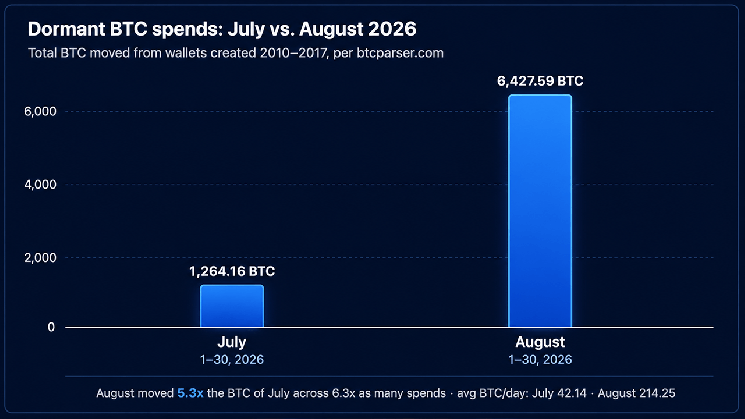
Bitcoin activity from dormant wallets surged in August after a month marked by hardware wallet security concerns, with 6,427.59 BTC moved from addresses created between 2010 and 2017.
The renewed movement began after Bitcoin.com News reported on July 30 that losses linked to the Coldcard firmware exploit had reached approximately 2,000 BTC. During the same month, hardware wallet manufacturers Safepal and Trezor disclosed data breaches that exposed customer information, including names, email addresses, phone numbers, and shipping addresses.
Although no direct connection can be established, the movement of vintage bitcoin by early adopters may reflect heightened caution and a broader effort to reassess and reorganize storage arrangements.
August dormant Bitcoin activity surpassed July totals
In the first 10 days of August, dormant bitcoin spending had already exceeded July’s total. Wallets created between 2010 and 2017 recorded 30 spends in July, moving a combined 1,264.16 BTC.
Across the last 30 days of August, dormant wallet activity averaged approximately 214.25 BTC per day—5.3 times July’s average of 40.78 BTC per day. Btcparser.com recorded 188 distinct spends involving the 6,427.59 BTC moved during the period.
Eight transfers came from ancient wallets created in 2010 or 2011. Two transfers from 2010 wallets moved 50 BTC, while six movements involving 2011 wallets transferred 155.57 BTC.
Dormant bitcoin movement discovered by btcparser.com throughout Aug. 1 through 30. Spends from 2014 wallets saw the most activity.
Wallets dating from 2012 through 2017 accounted for most of the activity, with 2014 wallets showing the greatest movement. Addresses created in 2014 were involved in 94 transfers that moved approximately 3,286.26 BTC between Aug. 1 and Aug. 30.
Wallets created in 2016 ranked second, with 985.38 BTC changing hands across 29 movements. The 2013 cohort ranked third, recording 16 distinct transfers totaling 845.48 BTC.
Wallets from 2012 moved 233.41 BTC, while addresses created in 2015 transferred approximately 415 BTC. Wallets from 2017 recorded 456.47 BTC spent across 26 movements.
Two 2014 wallet clusters showed different patterns
The 2014 total did not represent one broad wave of dormant bitcoin movement. Instead, it divided into two distinct clusters with notably different behavior.
The first cluster comprised 64 addresses created between Jan. 27 and Feb. 4, 2014. Together, they moved 1,672 BTC. The coins were not transferred all at once; they trickled out across 11 separate days between Aug. 3 and Aug. 13, followed by several later transfers. Individual movements ranged from 0.31 BTC to 33 BTC.
The second cluster followed a sharply different pattern. Twenty-five addresses created between Nov. 30 and Dec. 26, 2014, moved 1,514 BTC in nearly uniform lots of approximately 50 BTC. Of those addresses, 22 were swept on Aug. 19 within roughly one hour.
The two 2014 clusters reveal interesting patterns.
The level of coordination makes it unlikely that several unrelated holders independently moved decade-old coins on the same afternoon. Instead, the pattern points to a single custodian or key holder carrying out a scripted batch sweep.
The wallets appear to have been funded together in late 2014. Possible explanations include an exchange cold-storage reorganization, an escrow release, or a bulk paper-wallet distribution, although the blockchain data does not establish which scenario applies.
Bitcoin’s dormant holders leave their motives unknown
The deeper story may extend beyond technical vulnerabilities to a loss of confidence strong enough to prompt early adopters to reconsider passive custody. The coordinated movement of old bitcoin addresses suggests that larger holders may be proactively consolidating legacy holdings and increasingly treating aging keys as operational liabilities rather than digital trophies.
The holders’ true motivations remain unknown. For now, the blockchain movements themselves are the only evidence available to explain the renewed activity.
Source: cryptonews.net