More than four decades ago, after months of setbacks in the war against Saddam Hussein’s Iraq, thousands of young Iranian troops launched a surprise offensive that changed the course of the conflict.
Rather than consolidate that victory, Iran’s then-supreme leader, Ayatollah Ruhollah Khomeini, pushed for more. He wanted to topple the Iraqi dictator, who was receiving growing support from Washington, and show future enemies that war with Iran would come at a heavy cost.
Iran’s war debate echoes its conflict with Iraq
The Iraq war played a pivotal role in shaping the modern Iranian state. Khomeini’s decision transformed the conflict into a six-year war of attrition that killed hundreds of thousands of people, making it one of the bloodiest wars in the region’s modern history.
Decades later, Iran is again confronting the question of whether to continue fighting or reach an agreement.
The revolutionaries who led the offensive now dominate positions of power in Tehran. They view the current US-Israeli war, like the conflict with Iraq, as an imposed war whose outcome will be determined not by which side is strongest, but by which side can endure the longest.
Meanwhile, a more moderate faction sees an opportunity to consolidate Iran’s gains through negotiations that have made little progress.
After six months of war, the deadlock has left the Islamic Republic deeply divided, while its ultimate arbiter, Supreme Leader Mojtaba Khamenei, remains in hiding.
Tehran’s rival political factions continue to publicly insist that Iran has emerged victorious from the war. Yet a profound ideological divide remains over what victory should mean for the Islamic Republic.
Pragmatists push for a deal with Washington
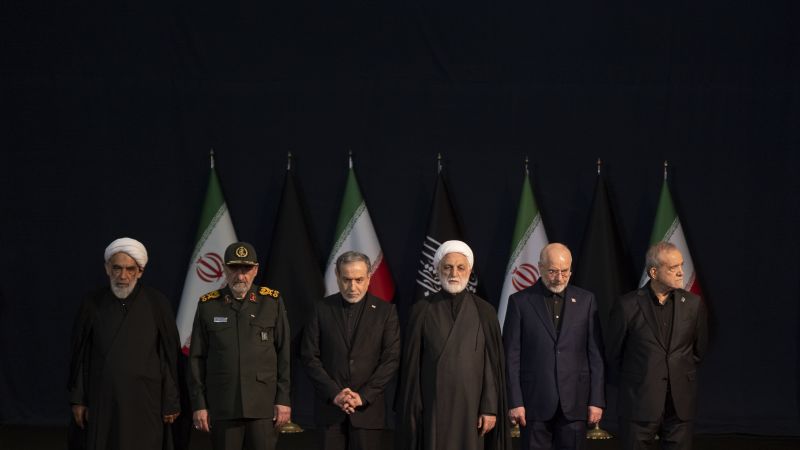
On one side are pragmatists and technocrats led by President Masoud Pezeshkian, Parliament Speaker Mohammad Bagher Ghalibaf and Foreign Minister Abbas Araghchi.
They support a conclusive agreement, citing an economy battered by war, an exhausting US naval blockade and damage to the country’s infrastructure.
They have publicly warned that the opportunity to resolve the conflict from a position of strength is narrowing. They represent Iranians who believe ending the 47-year confrontation with Washington is the clearest way to ease the country’s domestic crises and preserve the Islamic Republic by ending its international isolation.
“The war must end at some point,” Pezeshkian said this month. “It would be better to end it today, while we are in a position of strength and dignity, and the entire world acknowledges our victory.”
Hardliners reject negotiations with the United States
On the other side are hardline conservatives whose ideology is rooted in distrust of Washington, which they believe is determined to destroy the Islamic Republic. For more than half a century, they have warned about US intentions, and Trump’s war has strengthened their position against moderates.
Hardliners also accuse current officials of being “Western-oriented” and of trying to steer public opinion toward an agreement by overstating the country’s domestic problems.
“They see the US as a deeply untrustworthy actor… and (have) been burnt so many times by Trump himself that they think that this is exactly what will happen again,” Sanam Vakil, the director of the Middle East and North Africa program at London’s Chatham House think tank told CNN.
“In their minds, by not losing (the war), they’ve won, and they’re not just trying to win out with a better deal from Washington, but they’re looking for internal longevity in their competition with their opponents.”
Hardliners regard Pezeshkian as a weak president who came to office by chance after his hardline predecessor died in a helicopter crash. His signature alongside Trump’s on the June ceasefire agreement has further isolated him and given conservatives more power to blame him for the devastated economy and the failed agreement with Washington.
The divisions are so severe that hardliners have accused officials of deliberately mishandling the economic crisis to push an exhausted public into accepting a deal. Some claim the government has engineered fuel shortages to make an agreement unavoidable, while others have gone further by accusing moderates of staging a coup.
“Economically, are we really in a dead end, or are you just projecting a dead end?” asked hardline lawmaker Mohammad-Manan Raisi. “It has all been blamed on the war, while it is not all related to the war.”
Past US agreements fuel Iran’s distrust
Hardliners point to previous failed agreements with the United States, including the 2015 nuclear deal signed with the Obama administration and later abandoned by Trump. They also cite two instances in which the United States attacked the Islamic Republic during negotiations.
This faction is betting on the Islamic Republic’s ability to endure. Its members argue that confrontation, backed by armed regional proxies, missiles, drones and Shia religious belief, has protected Iran more effectively than the diplomacy promoted by “Western-oriented” politicians.
“Hardliners concluded they will achieve no deal with Trump and perhaps they’re now just living in the war between the wars,” Vakil said. “They think that they can wear Trump down and they can play for time to weaken him by extending economic pain.”
A hardline lawmaker accused those supporting a US agreement of opposing former Supreme Leader Ayatollah Ali Khamenei, who was killed in US-Israeli strikes at the start of the war.
“They want to prepare public opinion to accept an agreement and a humiliating peace,” Kamran Ghazanfari told parliament on Thursday, referring to those in favor of diplomacy with the US.
“Yet the enemy has repeatedly shown that no matter how many concessions we make to it, no matter how much we retreat before it, it will never be satisfied and will continue to demand other things from us, and it will settle for nothing less than our complete surrender.”
Mojtaba Khamenei remains silent amid political split
As Iran’s pragmatists engage in a high-stakes diplomatic contest with Washington, hardliners’ opposition to a deal has intensified amid Trump’s erratic strategy and uncertainty over his commitment to a potential agreement.
“Trump is not helping. He says he wants to make Iran great again then threatens Iran in the next tweet, and that fans the flame of paranoia within the Iranian system,” Vakil said.
Conservatives, who have influence over newspapers, state broadcasters, street protesters and elements of the military, believe Trump is using diplomacy to prepare for another military campaign. They also believe that “every time they go down the road of diplomacy” with Trump he “betrayed them,” she added.
Mojtaba Khamenei has remained silent amid the division. He appears to understand that taking a position on negotiations with an unreliable Trump could damage his office as he works to establish its legitimacy.
On Friday, he praised the government’s performance under pressure but urged officials to address the country’s weaknesses without discussing them publicly at length, warning that doing so could embolden Iran’s enemies and demoralize its allies.
With no one to restrain them, hardliners are continuing their campaign against an agreement with the United States.
“Our martyred Imam (Ali Khamenei) warned them dozens of times – how do they not understand?” said Ghazanfari about his domestic opponents. “They speak in a way that reeks of nothing but capitulation and surrender.”
Additional reporting by Aida Karimi