
Saffron Cresswell on Life-Changing Accident and New Para-Canoeing Career

Just a week before leaving the spinal unit, Cresswell attended the Spinal Games at Stoke Mandeville Hospital. The four-day event is designed for people with spinal injuries who are still in hospital or within a year of their accident, giving participants the chance to try a range of sports.
Cresswell embraced the opportunity.

“You name it, she tried it.” “I got six out of six bull’s eyes and won the archery out of 110 people,” she says.
“It was a great stepping stone to coming home. And I think I kind of held on to that when I came home initially because the first while was really tough at home.”
Cresswell left hospital on 8 October. By December, she had begun wheelchair racing and went on to compete in 10K races and a half-marathon. She also tried wheelchair tennis and basketball.
However, none of those sports captured her enthusiasm.
“I was worried I would never find a sport that I wanted to put my whole energy into,” she says. “I think I knew that horses were my hobby that got to turn into my sport and my career and lifestyle so I didn’t know if that would be possible to find something like that.”
Finding a new focus in para-canoe
Cresswell was introduced to para-canoe after speaking with Olympic canoe athlete Deborah Kerr at an event organised by the Women’s Sport Trust charity. Kerr encouraged her to “have a go”.
On 23 December last year, Cresswell did exactly that. Winter was “not the time to start a water sport”, and she was “not a natural”.
“My coach was too scared to let me off the bank in case I capsized,” she laughs. “And that probably stayed, I don’t think I left the bank for about a month.”
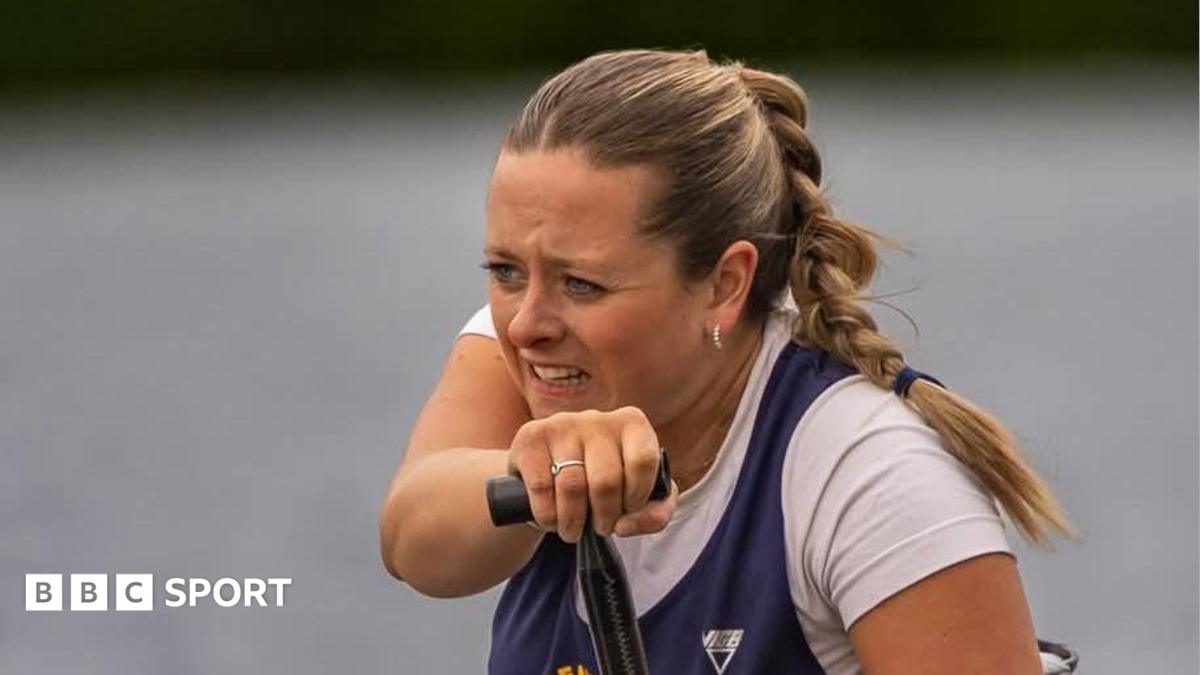
What began as a one-off taster session developed into training twice a week, then eventually five days a week on the water. Her programme includes four-hour paddling sessions and gym work three days a week.
One of the greatest challenges has been remaining upright in the canoe.
“I don’t have any feedback of any part of my body if I am losing balance,” she explains. “So I’m strapped into a seat because I’ve got no core function, but I can’t actually feel that seat. So I basically feel like I’m floating.”
“So my only thing I’ve got to know if I’ve lost balance is my head and my eyes. So that took a while to start to hone in and they always say, deaf people hear better than anybody else, don’t they? And I think it’s a bit the same.”
“It’s like, I’ve now tuned into how to balance myself without the use of the rest of my body. But I’d say the balance aspect is a big part of it alongside the technical, constant skill-based stuff that needs to be improved.”
Cresswell believes the technical demands of para-canoe are similar to those of equestrian sport, which helps explain why she has connected with the discipline.
Rapid progress towards the world championships
By any standard, Cresswell’s progress has been remarkable. She has even surpassed her own expectations.
“World Championships was definitely not the plan. It was a quiet goal after a while that if I could get the time, I might be able to go,” says Cresswell, who is also undertaking media work alongside her training.
“The time I needed to achieve was, I think, one minute 26 seconds. And anyway, I’m now down to one minute 18. So I’ve kind of over-achieved on that one, which has just been through repetition, practise, finding new ways to do things.”
Cresswell has been selected to represent Great Britain at this month’s Canoe Sprint and Para-Canoe World Championships in Poznan, Poland.
Having raced only once previously in the UK, she is keeping her competitive ambitions realistic.
“Honestly, stay up and get through the start and finish line,” she says, explaining that she capsized before the start of a race she was due to compete in in April.
For Cresswell, the immediate priority is gaining an international classification. The process involves medical tests to assess an athlete’s impairment, as well as demonstrations of how much of the body can be used while paddling.
International classification would make her eligible to earn points at events that could lead to qualification for the 2028 Paralympic Games in Los Angeles.
From spinal injury to international competition
When she was in hospital, Cresswell could not have imagined this path.
“I certainly wouldn’t have imagined I was going to do para-canoe – I didn’t even know [that] was a sport when I was in hospital,” says Cresswell, who will compete in the VL1, a canoe with a support float, and the KL1 kayak category.
“But to be honest, I think what actually is more kind of crazy in my head is I couldn’t even imagine January me doing this.”





No Comments