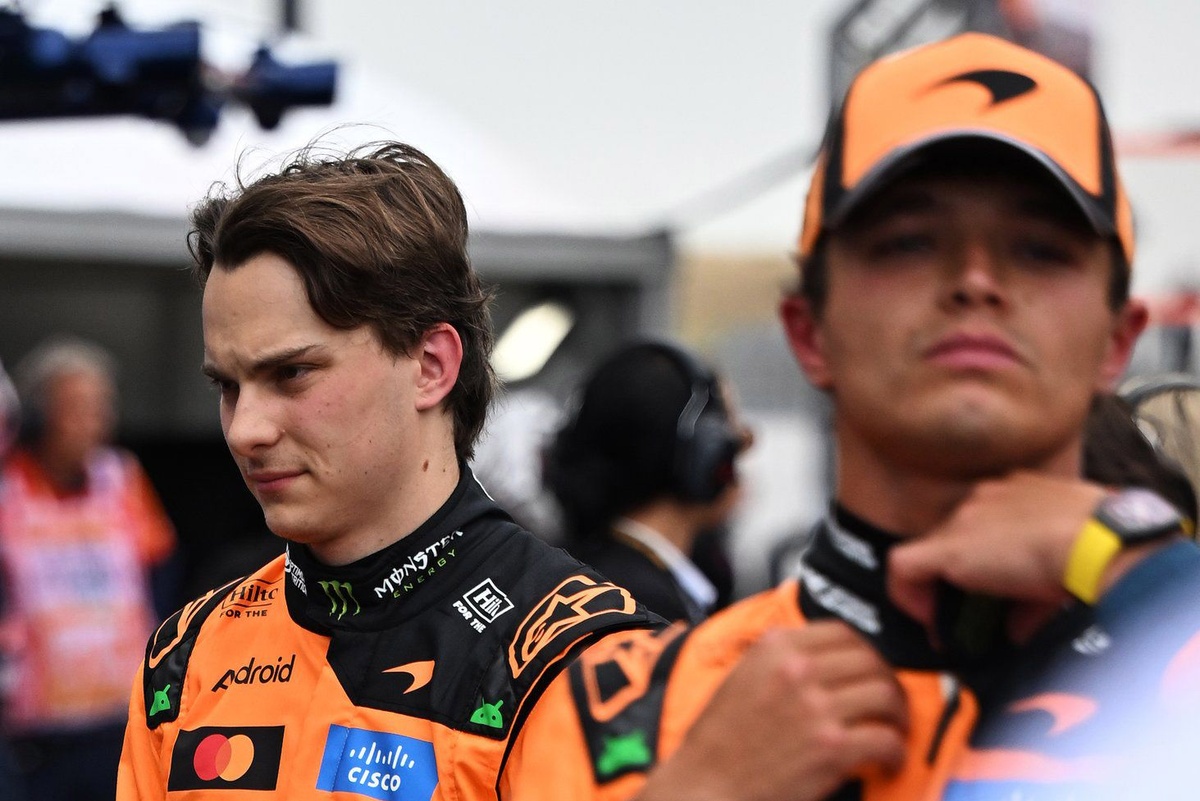
Oscar Piastri’s struggles at McLaren have continued into the 2026 Formula 1 season, with qualifying pace, rear-tyre management and the MCL40’s aerodynamic characteristics limiting his challenge for race wins.
Piastri won the 2025 Dutch Grand Prix at Zandvoort, extending his lead over McLaren teammate Lando Norris to 34 points. Red Bull’s Max Verstappen was 104 points adrift and appeared to be out of contention.
However, Piastri did not win another grand prix during the remainder of the season and eventually dropped to third in the championship. His decline prompted unfounded speculation that McLaren was sabotaging his title bid.
Piastri trails Norris in 2026
Beyond podium finishes at Suzuka and Miami in the spring, Piastri has not seriously challenged for victory during a difficult 2026 campaign. More concerning for the Australian is that Norris has outperformed him, winning at the Hungaroring and Zandvoort, as well as the Miami sprint.
Piastri’s problems have been most apparent in qualifying and have carried into the races. Norris has beaten him 22-7 in qualifying since last season’s Dutch Grand Prix. Piastri has six pole positions, nine fastest laps and nine grand prix victories, but he has not looked likely to add to that total so far this year.
Why the McLaren MCL40 is challenging for Piastri
Part of the problem is linked to the McLaren MCL40’s design concept. Piastri has traditionally struggled on low-grip circuits, where his relatively conventional driving style can create spikes in rear-tyre surface temperatures as the tyres slide.
Norris has shown greater adaptability between the two drivers. By overlapping the brake and throttle while approaching corners on a shallower trajectory, he encourages the front tyres to help rotate the rear of the car as they reach peak lateral grip. That approach requires a strong feel for front-end grip and confidence that the rear axle will respond as expected.
Piastri’s more linear brake and throttle inputs tend to produce greater rear-end movement when grip levels are low. That weakness has been amplified by this year’s cars, which generate less overall downforce.
McLaren has also struggled to produce efficient rear downforce because it chose the shortest wheelbase permitted under the regulations. The decision delivered straightforward weight savings but left the team with less floor area for adding strakes and slots to manage airflow.
Photo by: Simon Galloway / LAT Images via Getty Images
Small losses caused by rear-end slides can accumulate throughout a lap, depending on the circuit layout. Piastri then needs to use more electrical energy than Norris to regain speed, which can leave him with a lower state of charge and cost him top speed on the straights.
Rear-tyre degradation remains a concern
Recent upgrades have returned McLaren to race-winning contention after an underwhelming start to the season. Piastri failed even to make the grid in Australia and China because of power-unit problems, but the rear axle’s behaviour remains a concern, particularly during races, when he generally experiences more tyre degradation than Norris.
The issue was visible at the most recent Dutch Grand Prix. Norris defeated championship leader Kimi Antonelli’s Mercedes in a straight fight, while Piastri was held back by a slow pit stop and rear-tyre problems. He finished sixth, 32 seconds behind his teammate.
“In general I’ve been much happier with the car this weekend, which has been good,” Piastri said in Zandvoort.
“I feel like it’s been back into the normal kind of rhythm of having strengths in some corners, weaknesses in others, rather than just trying to find time everywhere, which has been nice.
“We still probably lack a little bit of downforce compared to some of the others, or at least some balance characteristics. I think we rely a lot on the grip from the new tyres to help our balance.
“Maybe we pay the price a bit more when the tyres get worse, but that’s just a guess.”