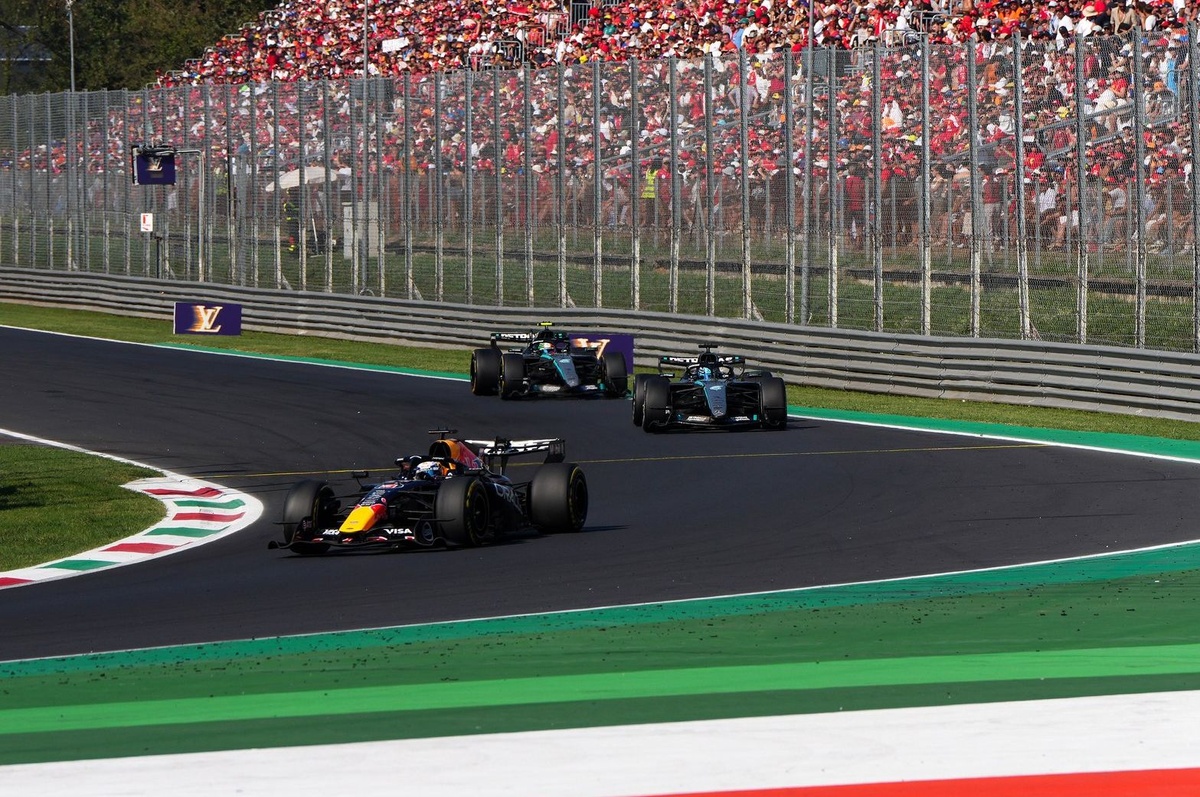
The 2026 Formula 1 regulations have fundamentally altered race dynamics across the calendar, but the Italian Grand Prix at Monza delivered the most dramatic evidence yet. A new phenomenon, dubbed “yo-yo racing”, defined the 53-lap contest. Cars could easily complete overtakes using the extra grunt from battery deployment, yet struggled to break away or hold position once that energy depleted.
Slipstream and Energy Management Create Pack Racing
Monza’s long straights amplified the tow effect, which further boosted the effectiveness of the electric overtake mode. This allowed intrinsically slower cars to keep pace with the leaders, resulting in tight packs where drivers hounded each other without being able to pull clear. The dynamic was most obvious with Max Verstappen. Despite lacking the power unit performance to genuinely challenge the Mercedes cars for the win, the huge slipstream effect combined with 2026’s energy deployment needs meant he stayed glued to George Russell. The Briton was unable to break away, only to become a sitting duck whenever the Dutchman found a way past.
“To be honest, [I didn’t enjoy it] a lot when people just drive by you like you’re a turtle,” Verstappen said. “With the overtake mode, it looked quite promising, but as soon as I got in the lead, it was very hard to defend. Even when we had the VSC, we boxed, had better tyres, I’m overtaking cars, but as soon as they can hang in that overtake mode, it’s just too powerful for us to actually defend against that.”
Oscar Piastri and Lewis Hamilton, who had lost touch with the lead pair before the mid-race virtual safety car, formed a secondary pocket, as did Lando Norris and Pierre Gasly. On an oval, veterans might trade the lead deliberately for maximum efficiency; on an F1 road course, that cooperation is far harder. The time Russell and Verstappen cost each other battling at the front opened the door for Kimi Antonelli to mount a spectacular comeback through the field.
Team Principals Highlight Regulatory Impact
McLaren team boss Andrea Stella explained the core dilemma facing quicker cars starting behind slower ones.
“Somehow with these Formula 1 [regulations], it’s not easy to get an overtake completed and move on,” McLaren team boss Andrea Stella explained. “If you see how much it took for Lando to pass Gasly and then start to close the gap to the cars ahead.
“We see that there’s certainly been quite a lot of entertainment, but to some extent there were also some issues for a quicker car to be able to compete if you don’t start at the front of the grid.”
Ferrari team principal Fred Vasseur echoed the frustration regarding energy management.
“The race pace was probably okay-ish. The main issue was top speed and overtaking. It was quite impossible for us to attack or to defend. When we were attacking someone, we were draining the battery, and next straight line we were losing the position.”
Monza 2026: A Benchmark for New Regulations
Stella described the Italian GP weekend as one of the busiest of the year for his crew, as engineers and drivers grappled with optimizing strategy and set-up for this energy-hungry style of racing.
“Very, very busy for everyone, drivers and engineers, with managing the power unit and the battery on a circuit like Monza,” he added. “This becomes the dominating element of racing. We see that jointly with the slipstream a faster car actually can struggle then to pull away from a slower car.
“This could make a [difference per lap] of as much as half a second, the combination of the slipstream and the fact that you have a car behind that you start to use the boost to defend [against] and then you lose a lot of pace.
“Monza 2026, I think, will be remembered as the most relevant race with the new regulations. It required a high quality from an execution point of view. I think we did, but overall we were not in contention for the victory because Mercedes had a step advantage on everyone else.”
Antonelli Defies the Trend with Masterclass Drive
Eventual winner Kimi Antonelli was the only driver to buck the pack-racing trend. Starting 19th on the grid, he marched up the order, running as high as sixth after the Lap 6 restart. While Mercedes’ superior energy deployment played a role, the fact that Antonelli moved through groups while teammate Russell remained stuck behind Verstappen at the front underscores the driver’s own credit. The 20-year-old Italian showcased aggressive yet meticulous overtaking skills and precise car placement.
“The differentiator today was the ability going through the traffic,” said Antonelli’s team boss Toto Wolff. “And we’ve seen it with other great ones in the past. Lewis, who did it at some of the races, and that’s what Kimi has shown today. There’s just no stopping [him]. When a driver and a car are one, then there’s nothing that can stop them.”