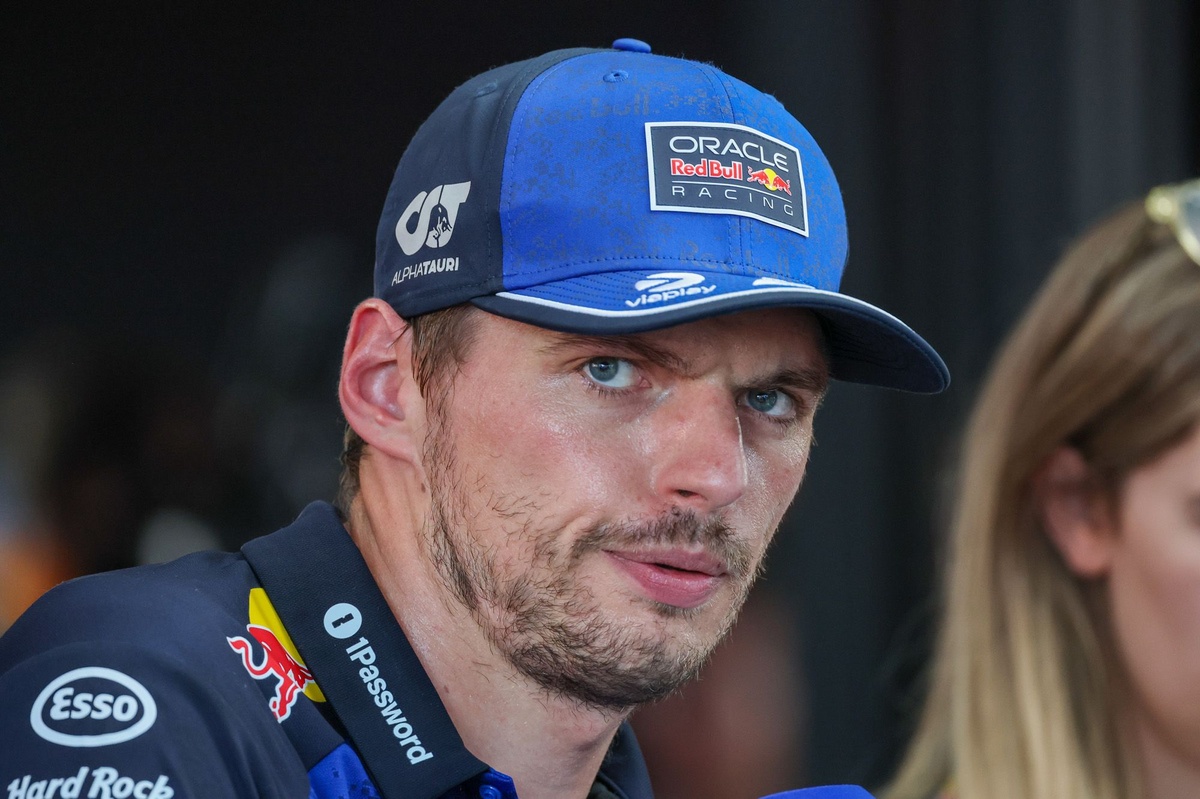
Max Verstappen secured a hard-fought third place at the Italian Grand Prix, reaching the iconic Monza podium a day after describing his Red Bull RB20 as fragile. Despite the strong result, the four-time world champion emphasized that the fundamental handling issues plaguing the car persisted throughout the race.
Rear Axle Issues Continue to Hinder Performance
Verstappen revealed that the rear-end instability he flagged on Saturday—referring to a phenomenon he calls “car degradation” where rear components deteriorate during a session—remained a significant factor on Sunday.
“It was still there, nothing changed. It’s just not good. You struggle on the bumps, the kerbs, and especially in the low-speed,”
the Dutchman said in the post-race press conference.
“It’s still like the rear axle is just not very compliant. So, for sure, it was again not ideal today and costing us performance, but it is what it is.”
Mercedes Power Unit Efficiency Proves Decisive
Beyond the chassis issues, Verstappen identified a straight-line deficit caused by the Mercedes power unit’s superior energy deployment compared to the Red Bull Ford Powertrains unit. This disadvantage was amplified at Monza’s high-speed layout.
“I think it was quite clear during the race that we just can’t keep up with the deployment of the Mercedes-powered cars, and that is, of course, very tough on a track like Monza,”
he said.
The power deficit forced Verstappen into aggressive defensive driving, particularly at the second chicane where he repeatedly re-passed rivals around the outside after losing positions through Curva Grande.
“[I didn’t enjoy it] a lot when people just drive by you like you’re a turtle,”
he said.
“But, yeah, just send it back around the outside. The car is good on the brakes, so that helps. I had good confidence to attack the braking zones. Two times I managed to do that in Turn 2 and 4. That is enjoyable, but at the same time also frustrating. I just try to maximise everything that I can.”
Overtake Mode Masks Deficit Temporarily
Verstappen noted that the additional energy deployment available when running within one second of the car ahead allowed him to stay with the leading Mercedes cars longer than expected. However, once the gap exceeded that threshold, his challenge faded.
“Of course, with the overtake mode it looked quite promising, but as soon as I got in the lead, it was very hard to defend. And that has been my problem a bit throughout the whole race,”
he said.
“Even when we had the VSC, we boxed, had better tyres, I’m overtaking cars, but as soon as they can hang in that overtake mode, it’s just too powerful for us to actually defend that, even on better tyres. So, it took me a while even to clear the McLarens.”
Positive Turnaround After Difficult Zandvoort Weekend
Despite the ongoing limitations, Verstappen framed the Monza podium as a significant recovery following a crash at his home race in Zandvoort and a difficult Friday practice session in Italy.
“For us to be on the podium after a very difficult weekend in Zandvoort, where the car was not really to my liking, [is positive],”
he concluded.
“We managed to have a strong turnaround from Friday to Saturday and the car was definitely in a better window. But we still have a few bits and areas that we know we need to be better at, plus, the obvious deployment on the straights.”