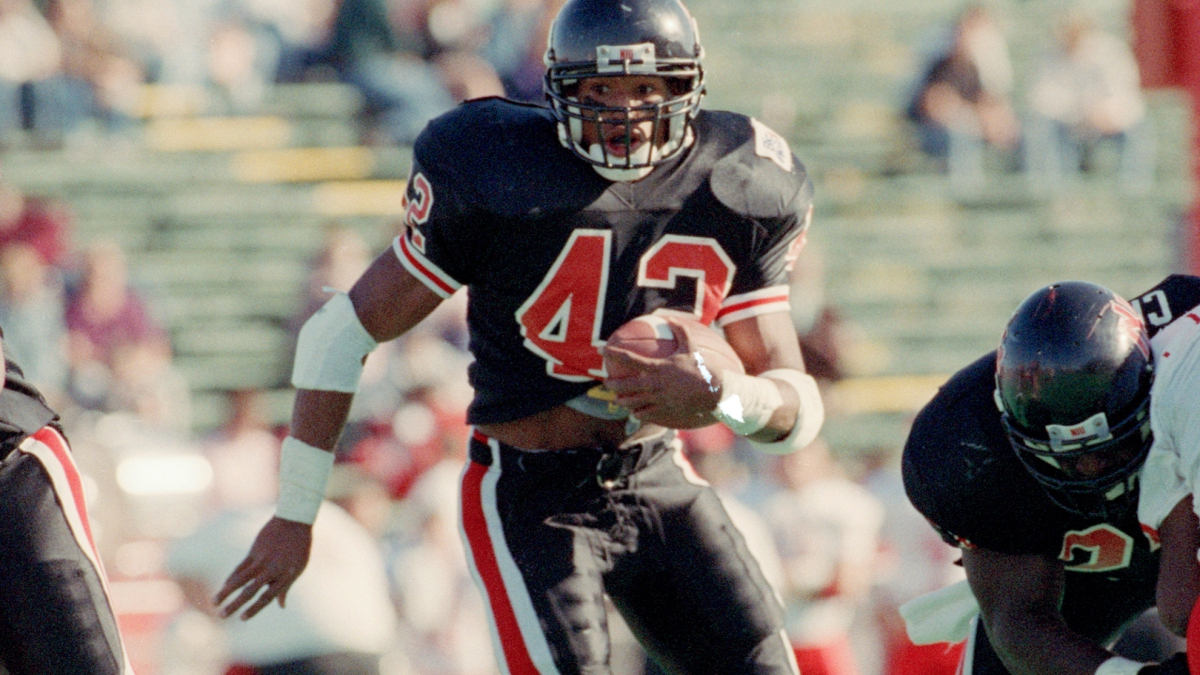
Former NFL running back LeShon Johnson has been sentenced to five years in federal prison for operating a large-scale dogfighting enterprise, marking a dramatic fall from grace for the player whose professional career ended more than two decades ago.
Federal Sentencing Details
Johnson received a 60-month prison term followed by three years of supervised release and a $30,000 fine after being convicted on six felony counts related to dogfighting. The sentencing concludes a case that drew significant attention due to Johnson’s background as a professional athlete and the unprecedented scale of the operation.
Justice Department Condemns Operation
Associate Attorney General Stanley E. Woodward Jr. emphasized the severity of the crimes.
“LeShon Johnson will face justice for building another particularly egregious and violent dog fighting scheme,” Associate Attorney General Stanley E. Woodward Jr. said.
“As Johnson was well aware, dog fighting is a felony in all 50 states. To anyone attempting to build violent and illicit business schemes: you can run, but you can’t hide from the Department of Justice.”
Record-Breaking Seizure of 190 Dogs
Federal authorities seized 190 dogs from Johnson’s property, which the Justice Department described as the largest number ever taken from a single individual in a federal dogfighting case.
Prosecutors established that Johnson had been running a major breeding and trafficking operation since at least 2007 under the name “Mal Kant Kennels.” Evidence presented at trial showed Johnson advertised dogs as “champions” and “grand champions,” labels referring to animals that had won three or five fights respectively.
He also sold puppies from bloodlines associated with fighting success and charged stud fees for breeding rights.
“The defendant operated a business which promoted and profited from animal cruelty,” U.S. Attorney Christopher J. Wilson said.
Prior Convictions and Pattern of Behavior
The current conviction is not Johnson’s first offense involving animal fighting. He previously pleaded guilty to dogfighting offenses in Oklahoma in 2004 and had operated another kennel known as “Krazyside Kennels,” establishing a pattern of recidivism that factored into the government’s case.
Defense Cites Health Issues, Seeks Leniency
Johnson’s defense team, led by attorney Billy Coyle IV, argued that incarceration was unwarranted due to Johnson’s severe health conditions. The defense presented evidence that Johnson suffers from Parkinson’s disease, severe dementia, and the effects of multiple concussions and traumatic brain injuries sustained during his football career.
Coyle also noted that Johnson has relied on a caretaker for the past two years and had remained fully compliant while on pretrial release.
“The main point was just to show the court that he’d been out on bond for pretrial release for over two years,” Coyle said. “He’s got no infractions whatsoever. He doesn’t drink. He doesn’t smoke. I don’t think the necessity of sending him to prison or jail was necessary.”
The judge ultimately rejected the defense’s arguments and imposed the five-year sentence.
NFL Career Background
Johnson was originally drafted by the Green Bay Packers in the third round of the 1994 NFL Draft. He later played for the Arizona Cardinals and New York Giants. Over his professional career, he accumulated 1,389 yards from scrimmage, scored seven touchdowns, and recorded 43 receptions.
Today, his legacy is defined not by his on-field statistics, but by his connection to one of the largest federal dogfighting seizures ever recorded.