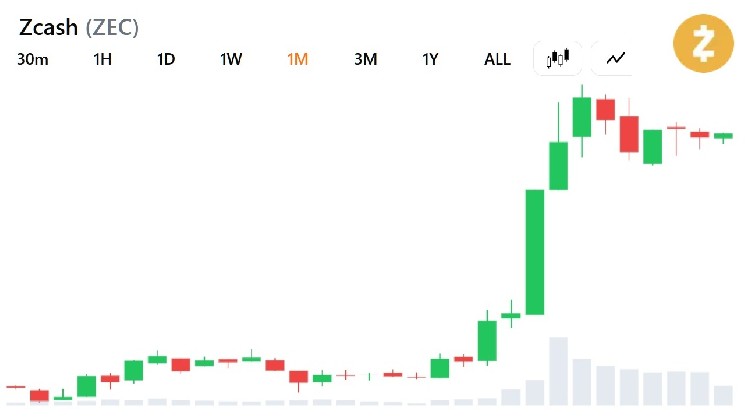
Zcash may have further upside despite rising approximately 19-fold over the past year, according to Grayscale Head of Research Zach Pandl. The asset manager said on Aug. 25 that Zcash could challenge Bitcoin’s network effects with capabilities that were unavailable or less relevant when Bitcoin established its lead.
Grayscale’s “Currencies” sector includes crypto assets primarily designed to function as digital money or stores of value. Bitcoin represents 93% of the category by market capitalization. Grayscale identified financial privacy, development aimed at cybersecurity threats, and cross-chain reach through intents technology as potential advantages for Zcash.
“Zcash offers financial privacy and other attributes that users may find essential in an age of AI,” Pandl wrote, adding:
“We think it is still undervalued and can continue to capture market share.”
$ZEC’s price as of Aug. 29 via Bitcoin.com Markets
Bitcoin’s Market Cap Is 114 Times Larger Than Zcash’s
Zcash remained valued at less than 1% of Bitcoin’s market capitalization after its rally significantly improved Zcash mining economics. Grayscale said the disparity could indicate that investors are underpricing Zcash’s features, while emphasizing that $ZEC remains a smaller, more volatile, and higher-risk cryptocurrency.
As of Aug. 29, Bitcoin ranked first among all cryptocurrencies with a market capitalization of $1.56 trillion. Zcash ranked 11th at $13.74 billion. ZEC’s market capitalization was approximately 0.88% of Bitcoin’s, leaving $BTC about 114 times larger.
Grayscale calculated how ZEC could perform if it captured a larger share of Bitcoin’s market capitalization over five years. Based on estimated ZEC supply, the scenarios imply prices of $1,622 at a 2% share, $4,054 at 5%, and $8,109 at 10%. These figures are hypothetical scenarios, not price forecasts.
Potential ZEC prices at different shares of Bitcoin’s market capitalization. Source: Coin Metrics and Grayscale Investments; Aug. 24, 2026.
AI Surveillance Could Strengthen the Case for Financial Privacy
Artificial intelligence could make financial surveillance more effective by connecting public addresses with exchanges, counterparties, wallet behavior, and transaction histories. Grayscale’s Aug. 19 analysis of Zcash’s financial privacy argued that AI and blockchain adoption could trigger another wave of public concern about financial confidentiality.
Intents technology allows a wallet to coordinate cross-chain transactions based on a user’s desired outcome, such as converting another digital asset into ZEC. This could allow users or AI agents to access Zcash’s privacy features without requiring merchants to accept ZEC directly.
In some respects, Zcash resembles Bitcoin through its proof-of-work security model and fixed supply of 21 million coins. Unlike Bitcoin, however, the network supports shielded transfers that conceal transaction details using zero-knowledge proofs. These transfers illustrate how privacy coins use cryptographic techniques to obscure details such as the sender, recipient, or transaction amount.
Market access expanded on Aug. 25 when Grayscale’s Zcash ETF began trading on NYSE Arca under the ticker ZCSH. The fund moved from OTCQX quotations to NYSE Arca, giving investors spot ZEC exposure through a publicly traded vehicle without requiring them to purchase the cryptocurrency or manage wallets and private keys directly.
Privacy Use and Network Development Add Momentum
Grayscale said in March that privacy and growing network momentum could help ZEC compete with BTC. Its March 18 comparison of Zcash and Bitcoin cited increasing use of shielding technology, along with new capital supporting wallet development and Zcash mining.
Pandl wrote:
“Zcash, a privacy-focused digital currency, is the Bitcoin competitor with the best shot at capturing market share over time, in our view.”
Network development also brings security and execution risks alongside its potential benefits. During the first quarter, the Zcash Foundation patched two Zebra vulnerabilities, including a critical remote denial-of-service flaw and a high-severity potential chain-split flaw.