

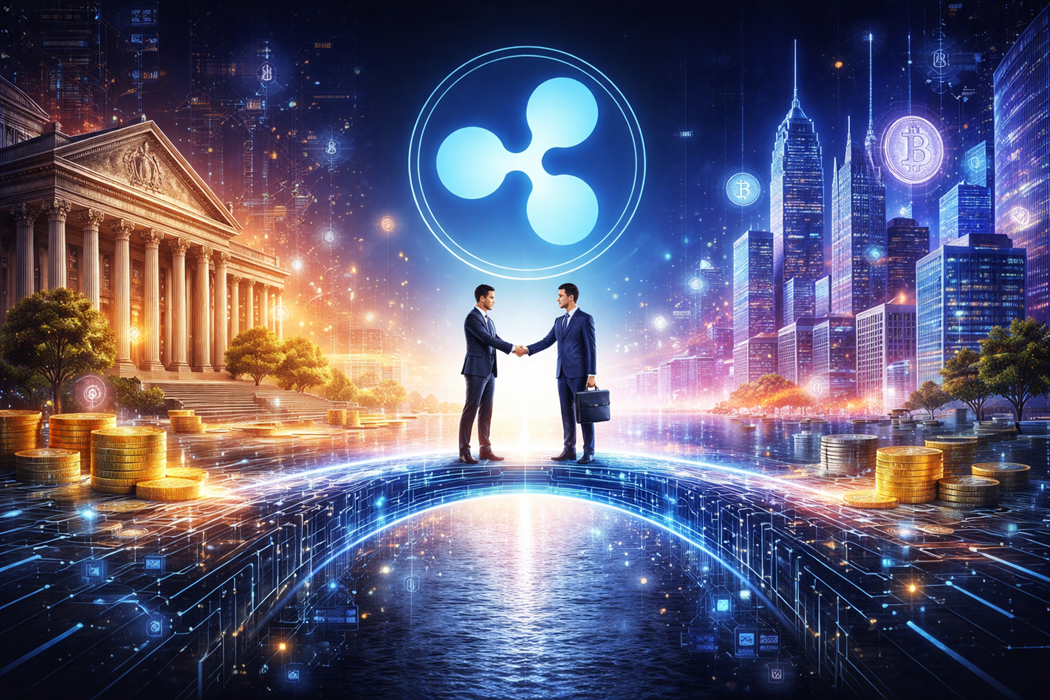
- Garlinghouse dodged the bank purchase question and positioned Ripple as a bank-friendly bridge builder.
- He sold RLUSD as “almost overregulated” and said more U.S. regulatory clarity is drawing banks into the market.
Ripple CEO Brad Garlinghouse appeared at the Economic Club of New York on February 18th. And there was a question that he still had to answer: Does Ripple want to buy a bank itself at some point or will it just stick with partnerships?

There was no clear answer. Garlinghouse dodged. He used the moment to discuss Ripple’s line towards banks, the RLUSD approach and the topic of regulation in the USA.
Will Ripple buy a bank?
The moderator built the Ask about Ripple’s institutional positioning: BNY Mellon as custodian, plus a “conditional” OCC charter. And then pretty directly: Buy, integrate or continue to partner?
Garlinghouse immediately made it clear that he would not allow himself to be pinned down on this. “I’m going to sidestep part of your question,” he said. And then even more clearly: “And I will skip the question of whether we will ever buy a bank.”

The dodging itself was almost expected. What was more interesting was where he went instead: Ripple wants to continue to act as a bridge builder so that banks and large institutions can get in without it looking like a “crypto adventure” for them.
He called his own strategy “contrarian” and recalled how unpopular it was for a long time:
“Ripple pursued a contrarian and controversial market entry strategy early on – and that’s exactly what made us unpopular in the crypto scene. At the very beginning, Ripple said: Banks are our customers. If we want these technologies to have the greatest impact for the greatest number of people, then banks are the touchpoint where people actually live out their relationships with financial services.”
Garlinghouse contrasted this with the “anti-bank” and “anti-government” ethos of the early scene. Ripple consciously tried to mediate between TradFi and DeFi, with the aim of ultimately making “cheaper, better, more robust and faster” services possible. Not against banks. With you.
Ripple USD: “overregulated” as a selling point
When it came to stablecoins, he became more specific. Ripple launched RLUSD “13 months ago” and is now “around fifth place” among the largest stablecoins. That was a success, he said.
But the key point for him is less ranking – more trust in supervision. Trust license with the New York Department of Financial Services, plus an OCC “conditional approval” charter. Garlinghouse called it “so to speak, over-regulated.” And he meant this explicitly in a positive way, as a selling point for institutions:
“We think that positions us uniquely – as ‘almost over-regulated’, so to speak. But that’s exactly what we want because we work with institutions. We want them to see us as someone who goes above and beyond what’s necessary and ensures that this level of oversight is in place so that there are no questions left unanswered – like: Is the stablecoin really backed on a one-to-one basis? Are there regular confirmations of what those covers look like?”
Regulation and adoption in the USA
Later it was about legislation and what it changes in practice. Garlinghouse said Ripple has already seen how stablecoin rules give banks more security. He cited the Genius Act as an example.
He argued similarly with the Clarity Act: If there is a clearer definition of what a crypto asset is from a regulatory perspective – currency, security, commodity – then the barrier to entry drops. And big banks are more likely to move. Not because of marketing. Because of legal clarity.
He was fundamentally optimistic about tokenization, but not euphoric. He warned of “technology in search of a problem” rather than “problem in search of a technology.” He cited Larry Fink and BlackRock as prominent examples, which relied on tokenization “on a large scale.” He shares the thesis that a large proportion of assets could be tokenized – but not as a one-size-fits-all. More industry by industry. With real industry expertise.
The bottom line is that the bank purchase question remains open: quite obviously intentional. Garlinghouse didn’t want to slam a door. And no burping. Instead, he repeated Ripple’s line: bank-friendly, compliance-first, bridging TradFi and DeFi. Typical Garlinghouse.


No Comments