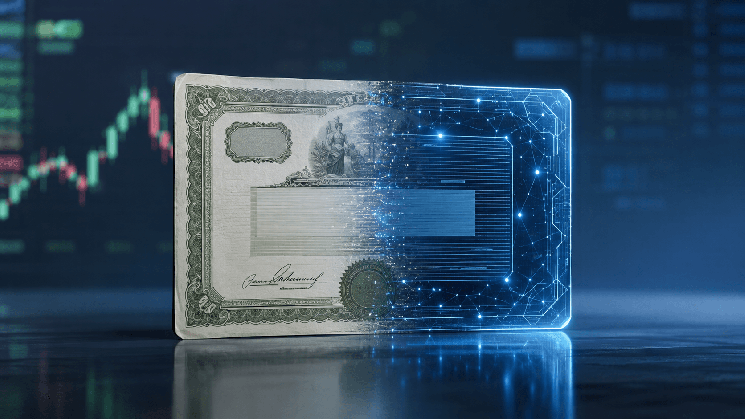
Tokenized stocks are blockchain-based representations of shares or economic interests in publicly traded companies. Instead of recording ownership solely in traditional brokerage and securities databases, all or part of an investor’s position can be represented by a digital token that moves across blockchain infrastructure.
That does not mean Apple, Nvidia or another publicly traded company suddenly becomes a cryptocurrency. A stock remains a security whether ownership is represented by a paper certificate, a conventional electronic record or a blockchain token. The SEC defines a tokenized security as a security represented by a crypto asset whose ownership record is maintained wholly or partly through one or more crypto networks.
The key issue is not simply whether a token tracks a stock’s price. Investors must determine what legal rights the token represents and which entity stands behind it.
How Does a Stock Become Tokenized?
There is no single structure for tokenized stocks. The SEC broadly distinguishes between issuer-sponsored tokenization and products created by third parties.
With an issuer-sponsored structure, a company or its authorized agent can integrate blockchain technology directly into the official shareholder record. A blockchain transfer can then correspond to a change in the master record identifying the security’s owner.
In simplified form:
- Traditional stock: Investor → broker → clearing and custody infrastructure → ownership record
- Tokenized stock: Investor → digital token → blockchain infrastructure → legally recognized ownership or economic claim
The second structure works differently. A third party may hold conventional shares through a broker or custodian and issue tokens that give investors economic exposure to those shares.
For example, Ondo Stocks currently offers more than 440 tokenized stocks and ETFs to eligible investors outside the United States. Its products are backed by stocks, ETFs and cash held through U.S. financial institutions, while the blockchain tokens can be transferred on networks including Ethereum, Solana and BNB Chain.
Coinpaper has previously covered the expansion of Ondo’s tokenized equity products, including stocks and ETFs brought onto Solana.
However, owning a third-party token is not automatically the same as being the registered shareholder of the original company.
Do You Really Own the Underlying Stock?
This is one of the most important distinctions for investors. A token may represent different types of rights, including:
- Direct ownership of the underlying security
- An economic interest in shares held by a custodian
- A claim against the token issuer
- Exposure to the price performance of a stock without direct ownership
Rights can therefore vary significantly. Depending on the structure, token holders may receive the economic benefit of dividends without having traditional shareholder voting rights. They may also rely on a custodian, broker, token issuer or another intermediary to maintain the assets backing the token.
SEC Commissioner Hester Peirce has stressed that placing a security on a blockchain does not change its legal nature. She has also warned that third-party tokens can create additional counterparty risks and may provide rights that differ from direct ownership of the underlying asset.
Investors should therefore examine the legal structure instead of assuming that every token displaying an Nvidia or Tesla ticker is equivalent to a conventional brokerage share.
Funds Can Move Onchain Too
Tokenization is not limited to individual stocks. ETFs, money-market funds and other investment funds can also issue blockchain-based shares.
In July 2026, Aviva Investors launched a tokenized share class of its U.S. Dollar Liquidity Fund on the XRP Ledger. Aviva said investors in the tokenized version retain the same investment objective, risk profile, liquidity characteristics and regulatory protections as investors in the conventional fund.
Coinpaper has covered the Aviva tokenized fund as an example of regulated asset managers moving traditional financial products onto blockchain infrastructure.
Other institutional experiments focus more deeply on market infrastructure. DTCC, which plays a central role in U.S. securities clearing and settlement, successfully processed production trades using DTC-tokenized assets in July 2026 and plans to launch its tokenization service in October.
The development is significant because tokenization is moving beyond crypto companies issuing wrappers around stocks. Traditional Wall Street infrastructure is beginning to test blockchain technology as part of the securities lifecycle itself.
Coinpaper has also tracked DTCC’s tokenization rollout.
Why Put Stocks on a Blockchain?
The appeal of tokenization is less about making stocks resemble crypto and more about changing how financial assets can move. Potential benefits include:
- Longer trading windows: Blockchain systems can operate beyond traditional exchange hours.
- Faster settlement: Tokens could transfer and settle through the same digital infrastructure instead of relying on multiple reconciliation layers.
- Programmability: Tokenized securities can interact with smart contracts and other financial applications.
- Fractionalization: Digital infrastructure can make smaller ownership units easier to administer.
- Global distribution: Subject to securities laws, tokenized assets can connect with wallets and financial platforms across jurisdictions.
- Collateral mobility: Tokenized securities could be transferred or pledged more efficiently.
The NYSE is developing a separate digital-securities platform designed to support tokenized U.S. equities and ETFs with 24/7 trading and blockchain-based settlement, subject to regulatory requirements. Coinpaper’s coverage of the NYSE plan shows how the concept has expanded beyond experimental crypto markets.
There are limits, however. Blockchain technology may make the transfer layer faster, but it cannot eliminate securities laws, corporate actions, custody requirements, identity checks or investor protections.
Are Tokenized Stocks Legal in the United States?
Tokenized stocks are still securities. That is the simplest rule for investors to remember.
The SEC’s 2026 framework explicitly treats digital securities, including tokenized traditional securities, as securities under federal law. What is changing is the infrastructure surrounding them.
On Sept. 1, the SEC proposed a major modernization of transfer-agent rules that specifically recognizes the use of blockchain technology in securities offerings and share transfers. Transfer-agent rules had not been substantially modernized since the late 1970s and early 1980s.
The proposal does not mean every tokenized stock is automatically approved for U.S. investors. Product structures, exchanges, broker-dealers, custody arrangements and investor eligibility can still differ substantially.
Nevertheless, the direction is becoming clearer: regulators and traditional market operators are preparing for securities that can exist and move on blockchain infrastructure.
For investors, the biggest change may ultimately be almost invisible. The underlying economic asset could remain the same Apple share, ETF or money-market fund, while the systems used to record ownership, transfer the asset and settle the transaction increasingly operate onchain.