

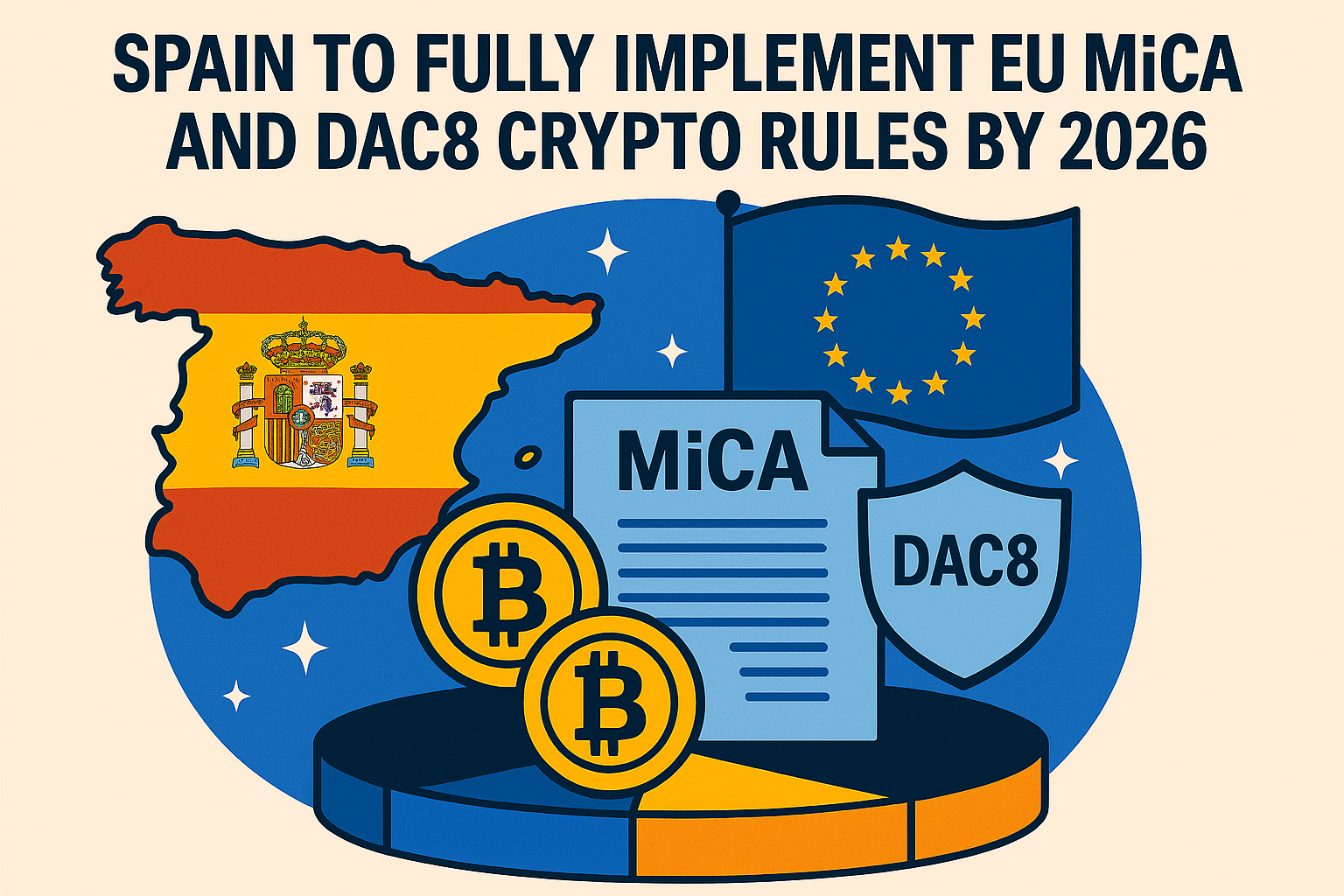
- Spain is using the maximum allowable deadline of July 2026 to fully implement the European Union’s Markets in Crypto-Assets Regulation (MiCAR).
- However, the tax reporting requirement according to the “Directive on Administrative Cooperation 8” (DAC8) takes effect in January.
This makes Spain one of the laggards when it comes to implementing MiCAR – despite the rapid growth of the industry. EU crypto regulation is being introduced to unify regulation for crypto service providers and token issuers in the EU.

They regulate, among other things, licensing, investor protection with particular attention to small investors, as well as the transparency requirements and disclosure obligations of crypto companies.
Over 60 companies, including Banco Bilbao Vizcaya Argentaria and Cecabank, are on the list of the Comisión Nacional del Mercado de Valores CNMV, the Spanish financial regulator responsible for the crypto industry, waiting to exercise its control function.
Tax reporting requirement in January

But that won’t happen until mid-2026 when companies will be required to have full licenses. Until then, the market remains fragmented and legally inconsistent, i.e. practically unregulated.
The tax reporting requirement according to DAC8 should come into effect in Spain as early as January, but nevertheless late in the EU comparison. The directive requires trading companies to automatically report crypto holdings and transactions to tax authorities.
This ends the lack of tax transparency for centrally held crypto assets. The tax offices receive extensive executive powers – including the seizure of digital assets in the event of tax debts.
Why the delay?
With a market that was already worth over $40 billion in 2024 and is currently forecast to grow to $90 billion by 2033, Spain is a heavyweight in the EU.
So why was MiCAR implementation postponed until the last possible moment when Spain has one of the most active EU crypto markets?
Informed circles in the Spanish financial administration indicated that “political coordination” and “administrative delays” played a role.
In any case, the long lead time compared to the rest of the EU gives crypto companies the chance to prepare well for the new requirements.
The MiCAR implementation is also a turning point for crypto investors: their anonymity is over, even if self-custody is still possible. MiCAR gives service providers the opportunity to operate in a uniform EU internal market – legally secure and with enforceable protection, even for small investors.



No Comments