

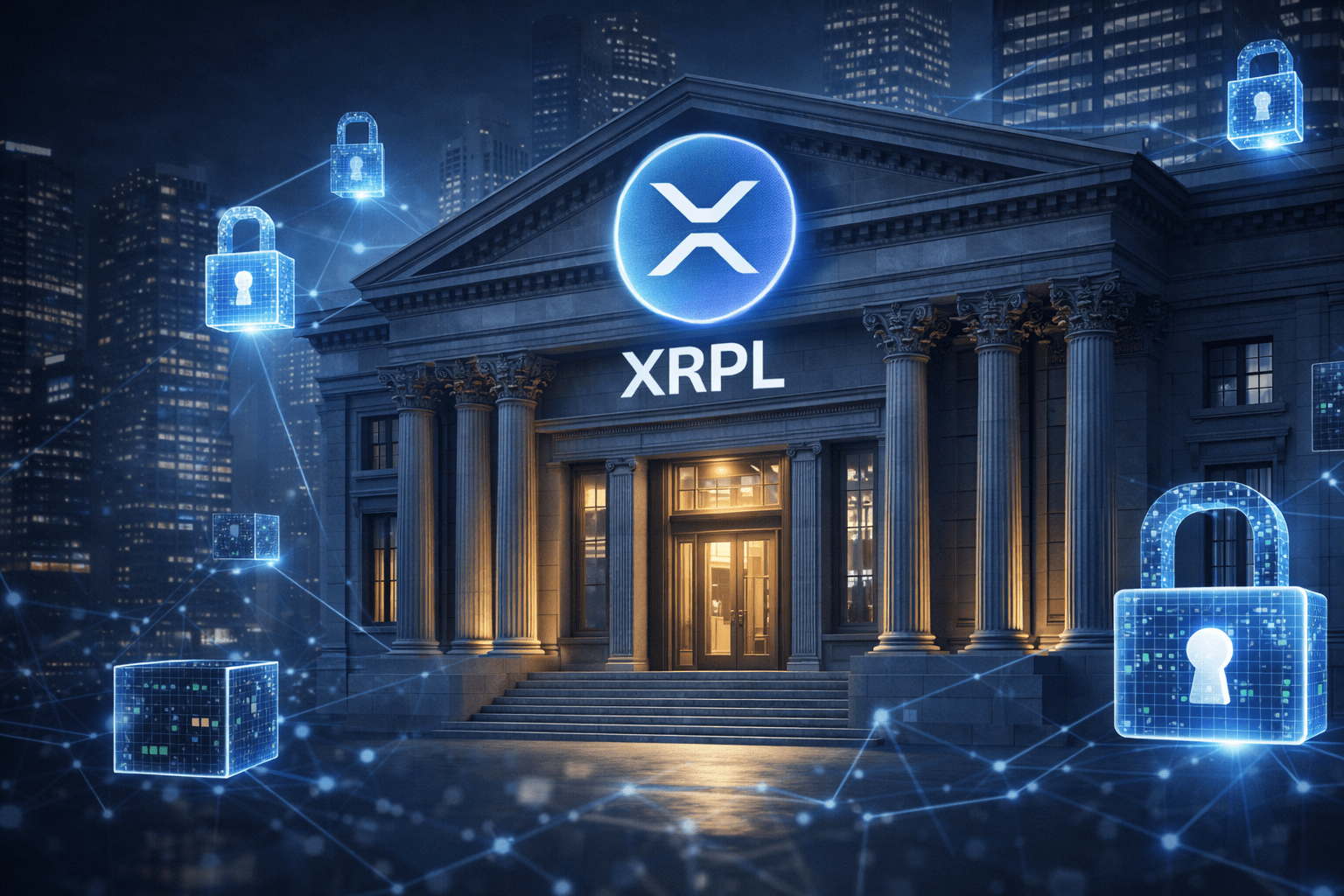
- The XLS‑80 additional module for the XRP Ledger is a significant technological advance. The new “permissioned domains” enable clearly defined segments in a public ledger for the first time.
- This gives banks, financial service providers and tokenization projects access to an open, yet compliant infrastructure – a balancing act that many blockchains have failed to achieve so far.
Permissioned domains are based on the previously introduced credentials framework XLS-70. This allows onchain proof of identity such as KYC and AML credentials to be integrated directly into the transaction flow.

With XLS‑80, operators can now define domains in which only wallets with certain, predefined credentials are allowed to operate. The XRP ledger remains completely public, but clear access restrictions apply within a domain.
This mechanism creates a hybrid structure that both meets regulatory requirements and preserves the benefits of an open network.
Foundation for liquidity and tokenization
The introduction of permissioned domains is a prerequisite for the upcoming permissioned DEX, which is expected to be activated in mid-February. For the first time, institutional players can operate regulated trading venues directly on the XRPL without having to resort to private or isolated blockchains.

For tokenization projects – for example in the RWA area – an environment is created in which assets can be traded securely, traceably and in compliance with regulatory requirements.
Companies like Billiton Diamond, which are already planning triple-digit million dollar tokenizations, will benefit directly from this new infrastructure.

Technical implementation and governance issues
XLS‑80 introduced new ledger objects and transaction types, including PermissionedDomain, PermissionedDomainSet, and PermissionedDomainDelete. Domain operators can define up to ten credential types that are required for access.
Wallets with these proofs are automatically recognized as authorized. Despite the technical elegance, governance remains a critical point: the security and integrity of the domains depends largely on the trustworthiness of the credential authors and the operators.
Risks such as compromised credentials or inadequate monitoring must be mitigated through clear processes and audits.
Importance for the DACH region
For the DACH region, where clear regulation and compliance traditionally play a central role, the activation of permissioned domains is a strategic milestone.
Swiss banks like UBS and Julius Baer, German FinTechs and Liechtenstein providers such as LCX thus receive an infrastructure that meets institutional requirements without giving up the advantages of a global public ledger.
With the combination of openness, compliance and scalability, the XRP ledger could become a preferred tool for tokenization, regulated trading venues and institutional applications.



No Comments