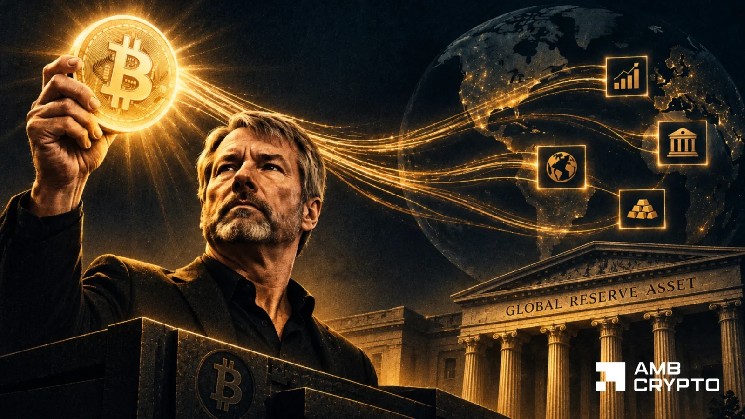
Michael Saylor Positions Bitcoin as ‘Digital Capital’ and Potential Global Reserve Asset
Strategy executive chairman Michael Saylor continues to advocate for Bitcoin (BTC) as a long-term store of value, recently outlining an investment thesis that frames the cryptocurrency as “digital capital” and a potential new global reserve asset.
Why Saylor Calls Bitcoin an Open Global Reserve Asset
According to Strategy, Bitcoin combines qualities found across traditional assets—scarcity, portability, divisibility, global liquidity, independent verification, and the ability to transfer ownership without a central issuer. Saylor argues that instead of viewing Bitcoin mainly as a payment network, investors should consider it as a store of wealth and potential hedge against the loss of purchasing power.
However, Saylor made clear that in no sense did he argue that Bitcoin must replace the dollar, banks, or traditional financial markets. Instead, he believes Bitcoin could capture a portion of the monetary premium held in assets such as gold, real estate, equities, bonds, and collectibles.
In a previous report published by AMBCrypto, Saylor called Bitcoin “digital monetary energy” and stated:
Bitcoin is the engineering solution to the problem of money.
Four-Year Investment Horizon and Historical Returns
Beyond theoretical frameworks, Saylor highlighted a four-year investment horizon by analyzing Bitcoin’s rolling historical returns through September 4, 2026:
- Median one-year total return: approximately +97.7%
- Median two-year total return: approximately +272.2%
- Median three-year total return: approximately +481.7%
- Median four-year total return: approximately +1,301.7%
Volatility remains significant. Bitcoin’s worst one-year period lost 83.6%, while the worst four-year period still returned approximately +32.6%.
According to the Strategy report, Bitcoin has delivered a 62.8% annualized return over the past 10 years and 37.2% since Strategy’s “Bitcoin Standard Era” began in August 2020.
Yet as of September 4, 2026, Bitcoin was 36.1% below its all-time high, with a historical maximum drawdown of roughly 93.1%. Strategy itself sold 6,916 BTC in 2026 alone, though a recent purchase of 4,603 BTC on August 31 suggests renewed buying momentum.
Bitcoin’s Reality Test: Tug-of-War Between Long-Term Buying and Short-Term Selling
At press time, Bitcoin was trading at $77,106.64 after a modest 24-hour drop but a hike of over 22% in the past month. The asset remains caught between strong long-term accumulation and short-term selling pressure.
Market dynamics reflect mixed signals: U.S. CPI met expectations overall, but hotter core inflation raised concerns about higher-for-longer rates, pushing BTC to $76,700 before recovering toward $80,000 and falling back into the $77,000s.
While Spot Bitcoin ETFs saw three consecutive weeks of inflows and long-term investors continued accumulating, weak spot demand, Binance’s two-year-high BTC holdings, and rising futures selling are adding downward pressure.
CryptoQuant summarized the shift in market psychology:
Investor sentiment has shifted from FOMO to loss aversion.
Key Takeaways
- Saylor does not suggest Bitcoin must replace the dollar, banks, or traditional financial markets.
- Bitcoin is caught in a tug-of-war between strong long-term buying and short-term selling pressure.