

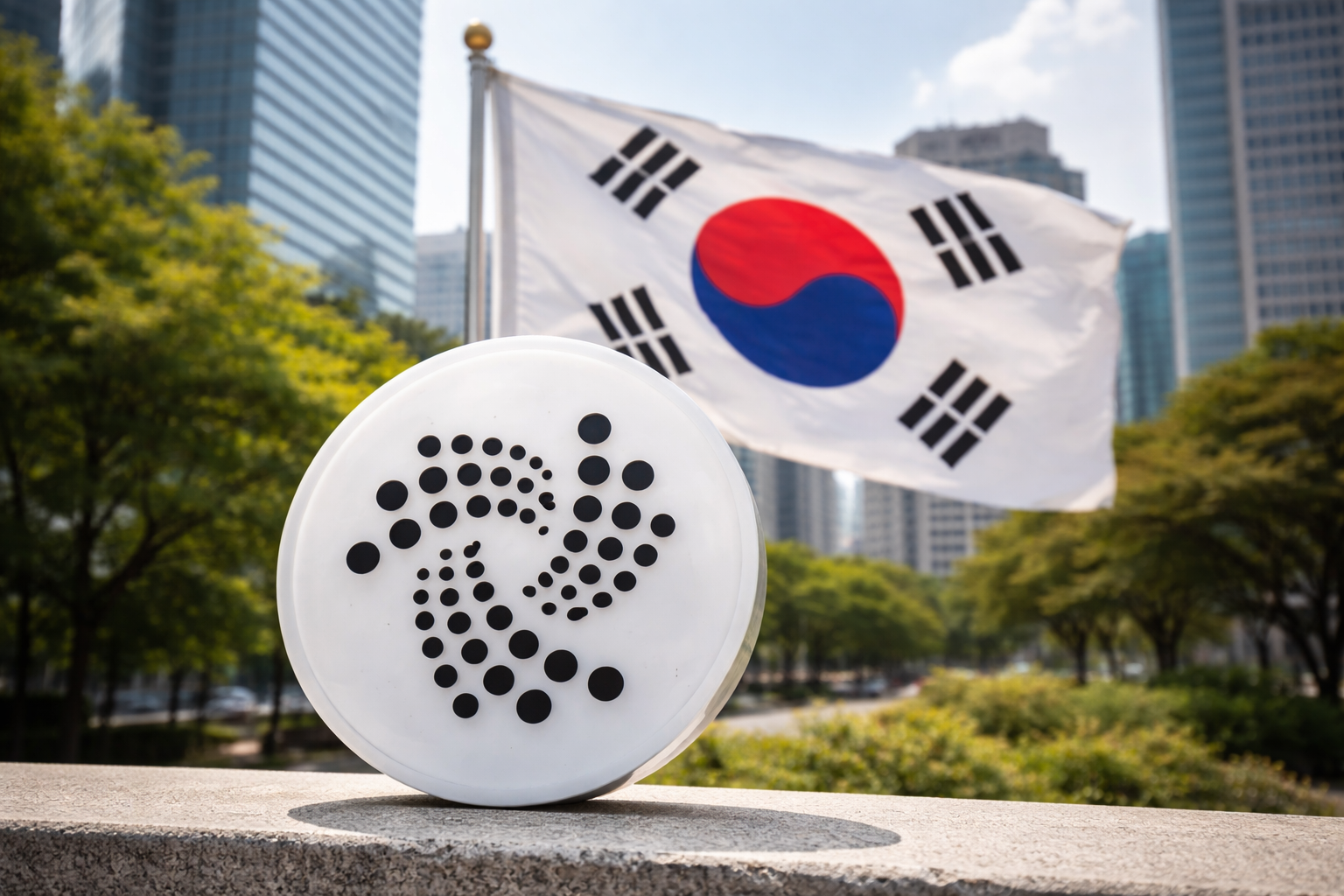
- IOTA presents TWIN to banks and institutions in Seoul and promotes cross-border verifiable trading documents plus the KRW stablecoin use case on IOTA.
- Schiener relies on tokenization for faster financing and gives examples from Rwanda, Kenya and UK-Poland.
IOTA presented itself to institutions and banks in Seoul and presented the trade infrastructure initiative TWIN there. At the newly launched World Crypto Forum on February 11th, co-founder Dominik Schiener outlined how commercial papers and data can be secured so that they can be verified across borders.
IOTA is pushing Korea

“IOTA is building something like a highway. If we use blockchain, we can verify the origin and authenticity of data and that can help cross-border companies enormously,” said Schiener on the forum. He added: “Every country wants to export more.”
At the same time, the IOTA Foundation wrote on Monday via X that Schiener spoke in a panel about how TWIN could help make a KRW stablecoin practically usable “via the IOTA network”.
Local reporting described TWIN as an international collaboration organization that “securely connects” documents and data from global trade – between countries, institutions and companies. The actors involved include IOTA, the World Economic Forum and the Tony Blair Institute for Global Change.
Schiener explained the goal of making trade financing and document flows more efficient via tokenization. “If we tokenize trade documents, invoices and the like, trust increases and trade barriers can disappear,” is the line echoed in the reporting. This is the central mechanism in the narrative: not speculation, but provability and standardization of documents as a lever for financing and settlement.
Case studies: Rwanda, Kenya, UK-Poland
As a specific example, Schiener cited a company from Rwanda that is active in tantalum mining and incurs high financing costs in a classic bank setup.
“We work with a mining company in Rwanda that specializes in tantalum. As a local company, they often face around 20% interest from banks for trade financing,” he explained. “Using blockchain, we have tokenized warehouse receipts and ownership rights, allowing them to receive instant funding as a stablecoin, backed by a trusted asset.”
He attached this to a payment argument that is less technical than operational: time. “Africa is often cut off from the SWIFT network, so it can take days for funds to arrive,” said Schiener. “With stablecoins, payments can be made instantly – even on weekends.”
From Kenya, he reported on a completed experiment on data security in the public sector: There, “34 government systems” were connected via IOTA to secure and verify data. And he drew a line to Europe: In a UK-Poland case, the persistence of paper-based documents still has real risks.
“The UK still has the problem that some trade documents are on paper. Errors can lead to deliveries failing,” said Schiener. “If trade documents are stored digitally on the blockchain at customs, this can be solved – and more goods can be cleared faster, reducing costs and increasing revenue.”
In addition to the official program, IOTA relied on an institutional format in Yeouido, the financial district of Seoul. On
At the end, IOTA emphasized that a new TWIN/IOTA video had been shown on site, brochures had ended up in the participants’ documents and Schiener interviews had taken place “across the venue”. The message was unmistakable: Korean institutions were consciously aware of TWIN “for the first time”.
Schiener concluded his statements with a specific Korea anchor. “Korea also wants to expand trade,” he said. “We want to work with the KRW stablecoin to increase liquidity and cross-border payments across our trade network.”


No Comments