
IOTA in Seoul: Schiener positions IOTA as an infrastructure for global trade

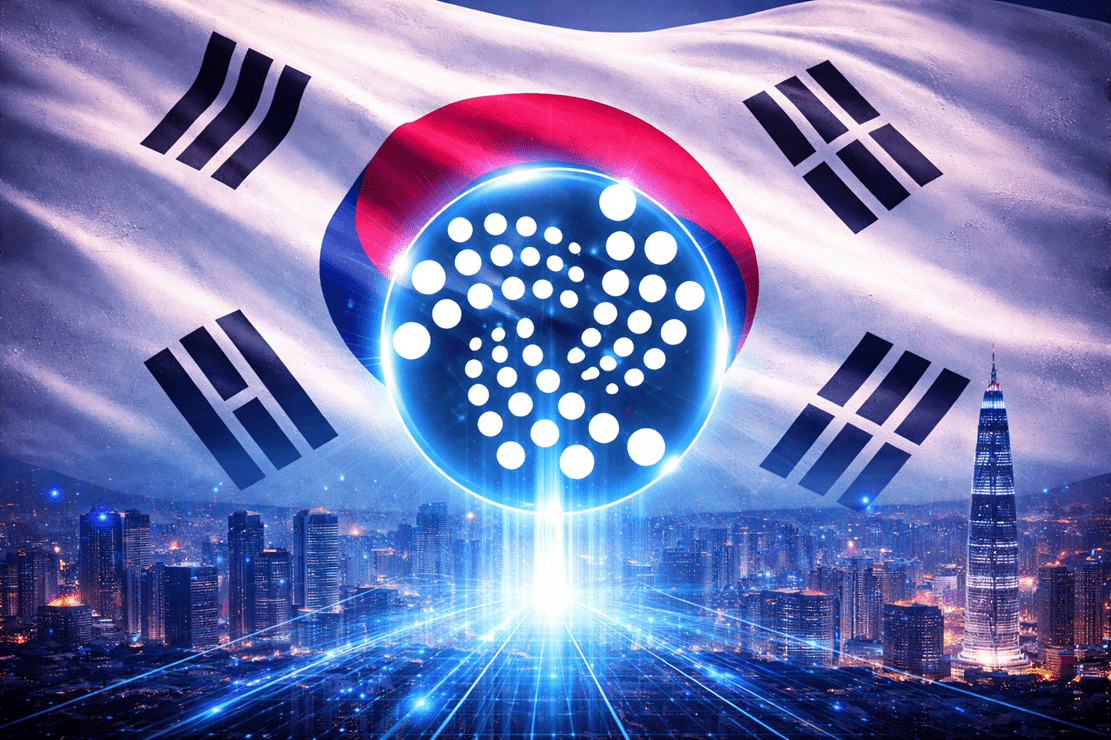
- IOTA refers to a Maeil mention by co-founder Dominik Schiener in the context of the World Crypto Forum (WCF) in Seoul.
- Schiener wants to explain “how trade data can be moved quickly and precisely across borders.”
On Monday, IOTA pointed out on X that co-founder Dominik Schiener was mentioned in the South Korean business newspaper Maeil Business Newspaper in the context of the World Crypto Forum (WCF).
The post marks a continuation of the Korea initiative that IOTA aggressively announced at the beginning of January: more mainstream presence, less crypto internal communication and a clear focus on cross-border trade data as an area of adoption.
In the Maeil report, the WCF is classified as a meeting point for international industry representatives. It says there:
“The first World Crypto Forum, where global heavyweights discuss the future of digital assets, is taking place in Seoul. In keeping with the motto of a ‘fusion of finance and digital assets’, it is about digital financial models in which stablecoins and real-world assets (RWA) are merged with blockchain networks. 68 speakers are traveling from North America, Europe, Africa, Asia and the Middle East.”

What is striking is the common thread: stablecoins, payment infrastructure, tokenization and “real-world” data flows. Maeil lists, among others, a16z, Solana, Chainlink, Binance and Grayscale as participants and anchors Schiener in a thematic block that does not sell “narratives” but rather addresses concrete integration questions.
About IOTA, the presentation says that Schiener wants to explain “how trading data can be moved quickly and precisely across borders.”
Grateful to see @domschiener featured today in Maeil Economy, one of Korea’s leading financial newspapers, alongside other upcoming participants including a16z, Grayscale, and more.
We’re excited to take part in WCF! Our operations in Korea are just getting started. pic.twitter.com/BM1w4G0Or6
— IOTA (@iota) January 19, 2026

IOTA brings Korea into focus
The tone is consistent with what IOTA announced at the beginning of January. As CNF reported, in the context of Korean media presence it said:
“We are excited to start 2026 in The Economist Korea’s spotlight, showcasing Dominik Schiener and positioning IOTA as the core infrastructure for the digitalization of global trade.”
At the beginning of the year, the IOTA Foundation stated that South Korea had already made great progress in the area of digitalization, but identified a possible use case in global trade:
“The biggest bottleneck remains cross-border trade, where international processes continue to rely on paper and manual trust mechanisms. This is exactly where IOTA and TWIN come in: a neutral, public infrastructure that connects these systems openly, securely and globally across borders.”
Schiener himself announced at the beginning of January that he would “spend significantly more time in Korea this year and push forward the introduction of IOTA among financial institutions, logistics companies and the government.” The WCF now provides a stage for this and at the same time a signal that IOTA wants to advance its adoption narrative in South Korea in 2026.


No Comments