Key Highlights
- Moderate Senate Democrats led by Kirsten Gillibrand and Ruben Gallego pledged renewed bipartisan talks on the CLARITY Act after a 49-50 procedural vote failure.
- Prediction markets assign less than a 30% probability of passage within two years, while JPMorgan analysts see a narrow but existing legislative window.
- SEC Chair Paul Atkins and CFTC leaders committed to fast-tracking rulemaking to provide regulatory certainty regardless of legislative outcome.
Moderate Democrats Vow Renewed Push After CLARITY Act Stalls
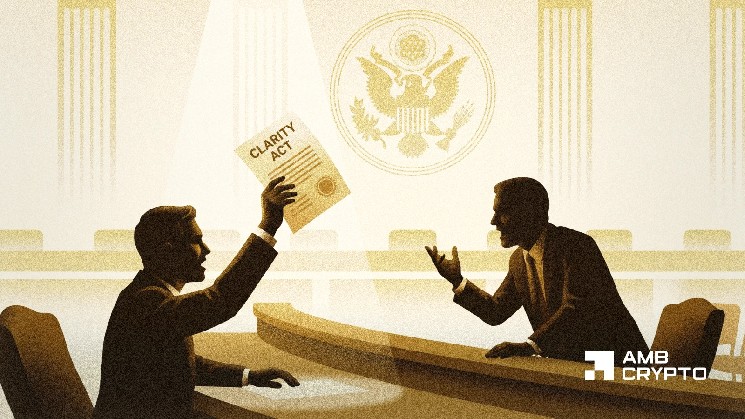
A coalition of moderate Senate Democrats, spearheaded by Senators Kirsten Gillibrand and Ruben Gallego, signaled determination to revive the stalled CLARITY Act following a procedural defeat that underscored deep partisan fractures over digital asset regulation. The legislation, which has been under negotiation for approximately two years, failed to advance on a 49-50 vote after Democrats uniformly blocked the procedural step required to proceed. Notably, seven moderate Democrats who were anticipated to support the measure withheld their votes, citing insufficient ethics provisions as the primary objection.
This week was a setback, but not the end of that important work. We remain committed to working in a bipartisan fashion to get this legislation passed.
According to reporting by Eleanor Terrett, the commitment to new talks follows intensive behind-the-scenes efforts to reignite negotiations and potentially fast-track the crypto legislation before the current congressional session concludes. However, the path forward remains highly uncertain, with prediction market platform Kalshi assigning less than a 30% probability of enactment over the next two years.
Industry Skepticism and Analyst Perspectives
The Democrats’ recommitment has been met with pronounced skepticism from segments of the crypto industry and pro-crypto analysts. Nate Geraci, a prominent industry observer, characterized the renewed bipartisan rhetoric as “all talk” devoid of substantive action, drawing a sharp contrast with the regulatory posture of the previous administration.
All talk at this point…There was no ‘working in a bipartisan fashion’ on crypto during the Biden admin. It was purely anti-crypto & regulation by enforcement. So it’s all talk. Actions speak louder than words.
Despite the legislative impasse, JPMorgan analysts maintain that the bill is not definitively dead, identifying a narrow window for potential passage. This assessment reflects the complex legislative calculus where bipartisan cooperation remains theoretically possible but politically fraught, particularly given the ethics provisions that drove Democratic opposition.
Regulatory Agencies Pivot to Rulemaking
In a significant development for market participants, both the Securities and Exchange Commission and the Commodity Futures Trading Commission have pledged to accelerate rulemaking initiatives to establish clear regulatory frameworks for the digital asset sector. This administrative pivot aims to provide a degree of certainty that the legislative process has thus far failed to deliver.
I have been unequivocal: with or without legislation, we will act decisively within the SEC’s statutory authority to deliver certainty for American investors.
SEC Chair Paul Atkins’ declaration underscores the agency’s intent to utilize existing statutory authority to address regulatory gaps. The CFTC has echoed this commitment to expedited rulemaking. However, industry participants face a critical unresolved question: whether the next administration will uphold, modify, or reverse these forthcoming regulatory frameworks, introducing a new layer of policy uncertainty.
Why This Matters
The CLARITY Act’s stall represents more than a single legislative failure; it encapsulates the broader struggle to define a coherent federal framework for digital assets in the United States. With Congress deadlocked, the locus of regulatory action has shifted decisively to the SEC and CFTC, placing immense importance on the rulemaking agendas of Chair Atkins and his CFTC counterparts. For market participants, the immediate practical impact is a reliance on administrative rulemaking rather than statutory clarity—a dynamic that introduces durability risks should political winds shift after the next election cycle. The narrow legislative window identified by JPMorgan suggests that the lame-duck period or early next session may represent the last best chance for a comprehensive statutory solution before regulatory policy becomes entirely dependent on executive branch interpretation.
Frequently Asked Questions
Why did the CLARITY Act fail to advance in the Senate?
The bill failed on a 49-50 procedural vote after all Democrats, including seven moderate senators expected to support it, voted against advancing the legislation. They cited insufficient ethics provisions as the reason for their opposition.
What is the likelihood of the CLARITY Act passing in the near future?
Prediction market Kalshi assigns less than a 30% probability of passage within the next two years. JPMorgan analysts believe the bill is not dead but face a narrow window for enactment.
How will the SEC and CFTC respond to the legislative stall?
Both agencies have committed to fast-tracking rulemaking to provide regulatory certainty. SEC Chair Paul Atkins stated the SEC will act decisively within its statutory authority “with or without legislation” to deliver clarity for investors.