

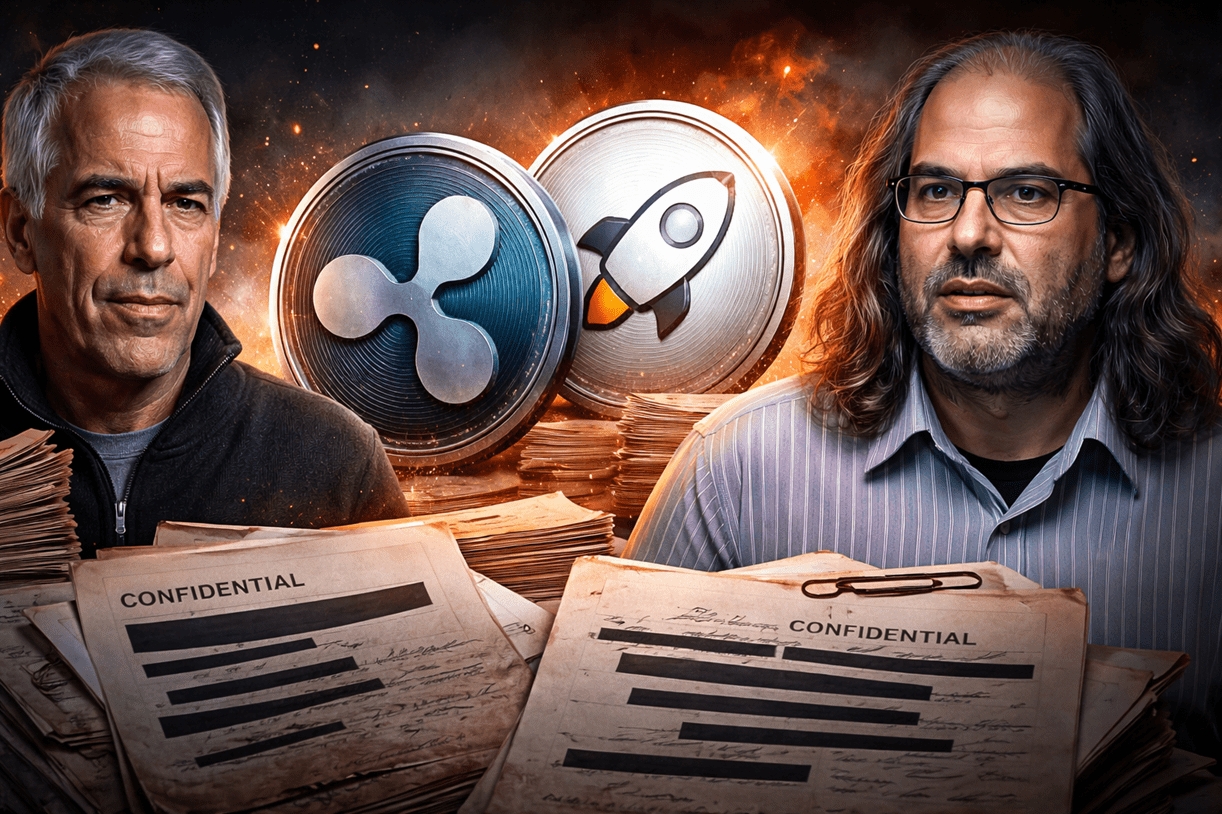
- In the US DoJ files, Ripple/XRP and Stellar (XLM) appear in an email from 2014, which has sparked speculation in the XRP community.
- Ex-Ripple CTO David Schwartz has rejected the conspiracy theories and stated that he is not aware of any reliable evidence of connections, meetings or agreements.
The investigative files in the Jeffrey Epstein case published by the US Department of Justice on January 30, 2026 contain passing mentions of Ripple/XRP and Ripple (XRP) in an email exchange from 2014. These mentions have caused a great stir and all sorts of speculation and interpretations in the XRP community on X.
Ex-Ripple CTO denies conspiracy theories

Specifically, the files contain an email dated July 31, 2014, in which Blockstream co-founder Austin Hill discussed the rivalry between Ripple and Stellar and warned against supporting both at the same time. The files suggest that Epstein had no involvement in the financing or development of these projects.
And that’s exactly what Ripple’s former CTO David Schwartz said via X on January 31, 2026 confirmed. The trigger was a post that claimed that there must be collusion or NDAs, that Epstein and his team (along with Adam Back’s Bitcoin project Blockstream) could have conspired against Ripple.

Schwartz responded clearly: “I know of no connections between Jeffrey Epstein and Ripple, XRP or Stellar. I am also not aware of any evidence that anyone at Ripple or Stellar has met Epstein or anyone close to him.”

He added: “There are some indirect points of contact between Epstein and people who are involved with Bitcoin in different ways – but that would probably be the case with most very rich people.”
When a user asked about the origin and relevance of the document, Schwartz classified the content more narrowly. According to his account, it is “an email from Austin Hill to Jeffrey Epstein,” in which Hill explained why, in his view, support for Ripple or Stellar makes someone an opponent.
What is important is not so much “Epstein” as the recipient, but the logic behind it: it is “quite likely” that Hill and others have expressed “similar views to many other people”.
When asked what was meant by “two horses in the same race,” Schwartz said: Hill meant that he thought Ripple and Stellar were bad for the ecosystem and that “anyone who supports XRP or XLM is an opponent/enemy.”
At the same time, Schwartz also wrote that he expects even more revelations: “I hate to be a conspiracy theorist, but I wouldn’t be at all surprised if this is just the tip of a huge iceberg.” At the same time, he criticized the camp mentality, which, in his view, continues to have an impact today: “The sad thing is: we are really all in the same boat and this attitude is damaging to everyone in this area.”
Epstein’s overtures to Bitcoin
The release of the nearly three million U.S. Department of Justice documents revealed Epstein’s extensive, if peripheral, involvement in the early cryptocurrency sector. The documents confirm that Epstein was among the early backers of Bitcoin infrastructure, most notably through an investment in Blockstream in 2014 that grew from $50,000 to $500,000 through an MIT Media Lab fund.
Epstein claimed in a 2016 email to have had contact with the “founders of Bitcoin,” although there is no evidence of this (or whether he only meant developers from that time). In 2011, the Epstein team sought to establish contact with Gavin Andresen, an early Bitcoin developer who took over management of Bitcoin source code maintenance from creator Satoshi Nakamoto in 2010. Andresen likes to dismiss the contact with “No, sorry, I’m busy”.
Based Gavin Andresen, who may or may not be Satoshi, telling Epstein to fuck off. pic.twitter.com/3y095t1LGk
— Autism Capital
(@AutismCapital) February 2, 2026
Correspondence also shows that he had conversations and “philosophical debates” with PayPal and Palantir co-founder Peter Thiel about Bitcoin, although his personal views on Bitcoin deteriorated until 2017, when he dismissed it as “not worth buying.”
Jeffrey Epstein knew about Bitcoin as early as 2011 and invested in BTC and crypto startups, though his interest was more about profit than philosophy.
He was skeptical Bitcoin would ever go mainstream, so he traded in and out rather than holding long-term. pic.twitter.com/iJyXjf6Ajd
— Ki Young Ju (@ki_young_ju) January 30, 2026




No Comments