
- With the “Ecodesign for Sustainable Products Regulation” ESPR, digital product passports will become mandatory for the manufacturing industry in the EU.
- All producers of material goods must now ensure transparency, traceability and sustainability in almost all of their products.
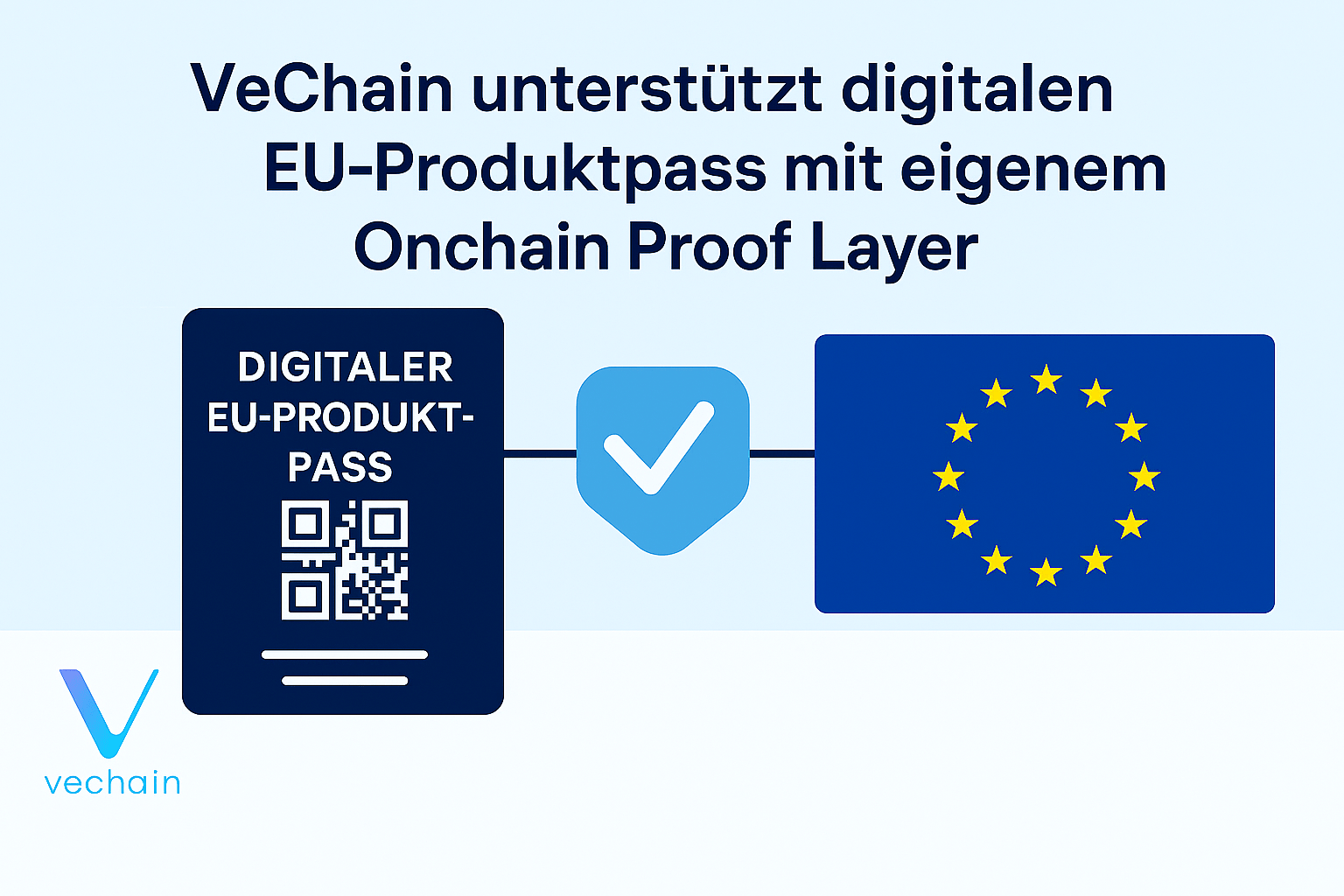
Against this background, VeChain, Rekord and the British Advanced Manufacturing Research Center AMRC have now presented a turnkey production environment for the EU’s digital product passports, which is intended to make it much easier for companies to enter the DPP era. It combines blockchain technology, standardized data models and industrial validation and is one of the first scalable platforms for the new EU requirement.
Infrastructure for ESPR implementation
The system is based on the VeChainThor blockchain, optimized for industrial applications and in this case for the energy-efficient, forgery-proof storage of product data.
Rekord contributes the API-based “trust layer” that maps the complex data models of the ESPR regulation and allows companies to achieve standardized integration into existing systems.

This creates an infrastructure that can process more than a hundred thousand DPP events per month “right off the bat” and thus sets the benchmark for industrial scalability. This means that companies can now introduce digital product passports without in-depth blockchain expertise and at the same time be completely on the safe side from a regulatory perspective.
Role of the AMRC
The University of Sheffield Advanced Manufacturing Research Center (AMRC) plays a key role in validating infrastructure in manufacturing environments. As one of Europe’s leading digital manufacturing research centers, the AMRC tests the platform in industrial scenarios, optimizing processes and ensuring that the results meet the needs of large manufacturing companies.
The close integration of research and industry creates a turnkey system that is not only technologically sophisticated, but also practical and suitable for companies of all sizes.
Importance for EU industry
With the gradual introduction of the digital product passport requirement this year, the pressure on manufacturers to modernize their data structures and supply chain processes is growing. However, many companies are only at the beginning of this transformation.
With the instruments now presented, all new regulatory requirements can be implemented quickly and reliably and at the same time new potential in the circular economy, quality management and consumer protection can be tapped.


