


- Since the Fusaka upgrade, L1 performance, blob capacity, and rollup efficiency have increased significantly.
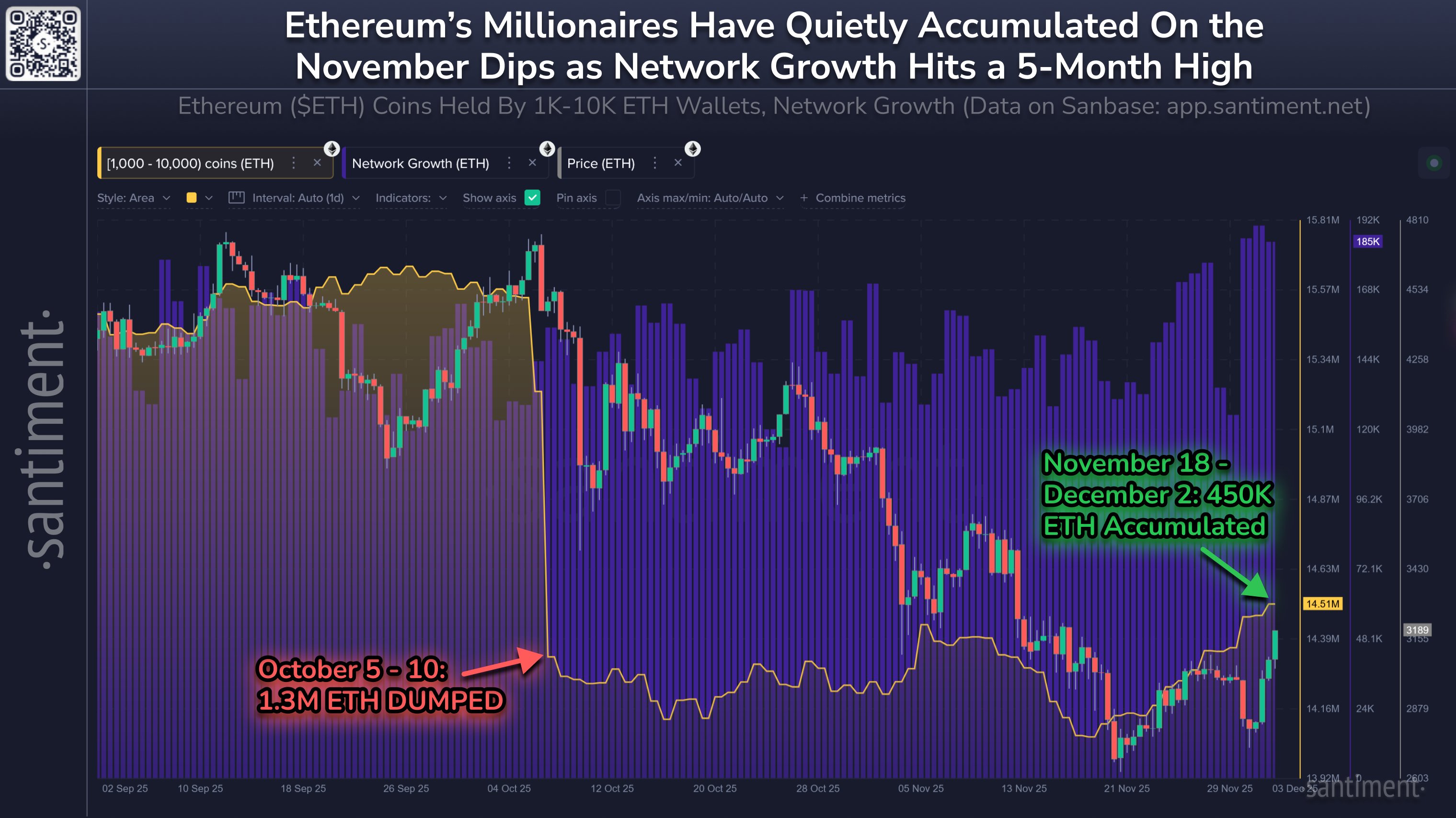
- Increased buying activity caused network activity to rise, and the Ethereum price followed suit with an increase.
Ethereum has completed the Fusaka upgrade on mainnet, completing an important step in its L1 rollup roadmap. The release strengthens base layer throughput, increases blob capacity, reduces rollup costs, and introduces the only fork switch blob parameter to scale data capacity in controlled phases.
Fusaka update brought PeerDAS as a new scaling layer

PeerDAS allows Ethereum to achieve block consensus without requiring a node to process more than a trivial amount of data. PeerDAS, as introduced by Vitalik Buterin, is a pragmatic sharding tool that has been anticipated for quite some time.
PeerDAS in Fusaka is significant because it literally is sharding.
Ethereum is coming to consensus on blocks without requiring any single node to see more than a tiny fraction of the data. And this is robust to 51% attacks – it’s client-side probabilistic verification, not… pic.twitter.com/OK81xBteER
— vitalik.eth (@VitalikButerin) December 3, 2025

The design improves data availability, evidence, and resilience to oppositional environments, paving the way for future L2 expansion.
L1 scalability has been limited by advances in ZK-EVM development. The proposer-builder bottleneck remains as builders are forced to process full data sizes. A sharded mempool is also still pending.
Still, Fusaka is a structural leap for Ethereum’s design, and developers are discussing how over the next two years to expand PeerDAS’s scope, improve stability, and expand its presence on both L2 and L1 when it comes to gas.
ethPandaOps has verified that the upgrade was performed cleanly, and team members continue to monitor network activity as data arrives post-fork. Operators have already been asked to report any discrepancies in order to review them as quickly as possible in all customer implementations.
Fusaka is now live and finalized on Mainnet! We’re busy looking at the data now and will update you on how the networking layer looks once we have enough samples!
In the meantime, please report any bugs you see with your nearest friendly client dev! https://t.co/XF6B1v5lGP
— ethPandaOps (@ethPandaOps) December 3, 2025
ETH technical setup suggests $4,300 target
The Ethereum price rose after the upgrade. ETH rose from 3.037 $ on 3.236 $which represents an increase of approx. 5 % corresponds, and was subsequently added to 3.187,59 $ traded. The accumulation of medium-sized wallets containing 1,000-10,000 ETH continued to gain momentum.
This trend was identified by Santiment as a key price driver in 2025 designated. Network activity has also increased, to a record 190,000 new wallets in a single day.
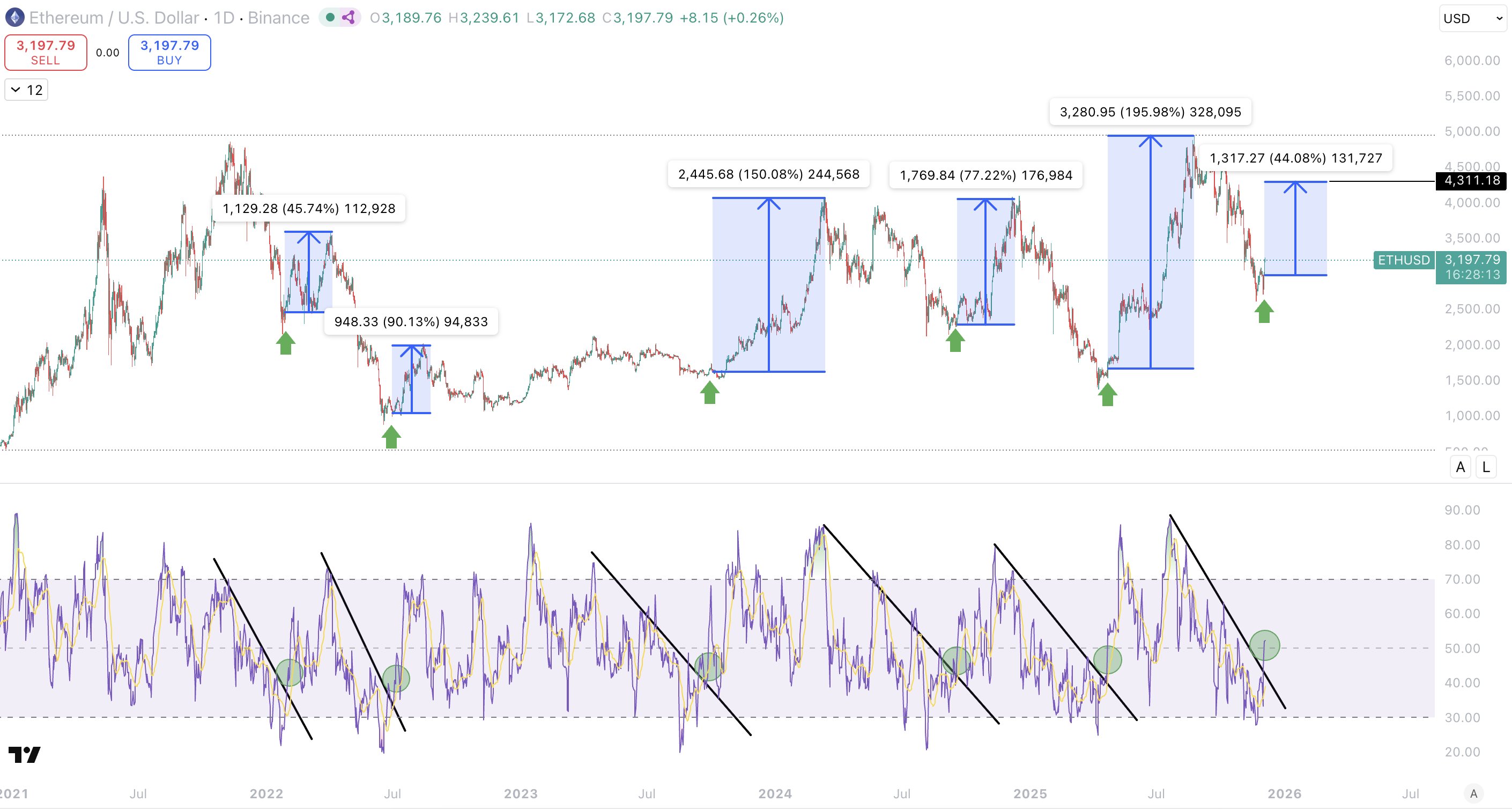
The technical momentum continued to increase, as a market analyst Sykodelic observedthat ETH experiences a recovery every time the 1-day RSI returns from overbought territory to oversold territory and breaks out of its downtrend.
In the last five years this has regularly led to an increase of at least 45 %what ETH is heading towards again 4.300 $ would bring.
German authorities shut down illegal crypto mixer
As Ethereum advances on its technical roadmap, law enforcement agencies from Switzerland and Germany have, in a joint operation, shut down a criminal-run crypto mixer and taken control of the domain, three servers, €25 million worth of Bitcoin and 12 terabytes of data. This increases regulatory pressure on the entire crypto system at a time when the Ethereum infrastructure is entering a new phase of scaling.





No Comments