
- At the last ECB press conference in 2025, President Lagarde only briefly discussed key interest rates – and they will remain as they are for the time being.
- Regarding the digital euro, which is due to come in 2026, she said the ball is now in the political institutions’ court because the ECB has done its job.
The introduction of the is expected digital euro in the second half of 2026. This also corresponds to the planning for euro-backed stablecoins that fall under the European Regulation on Markets in Crypto Assets (MiCA).
President Lagarde said it is crucial to promote further integration of capital markets by completing the Savings and Investment Union and the Banking Union according to an ambitious timetable and quickly adopting the regulation introducing the digital euro.
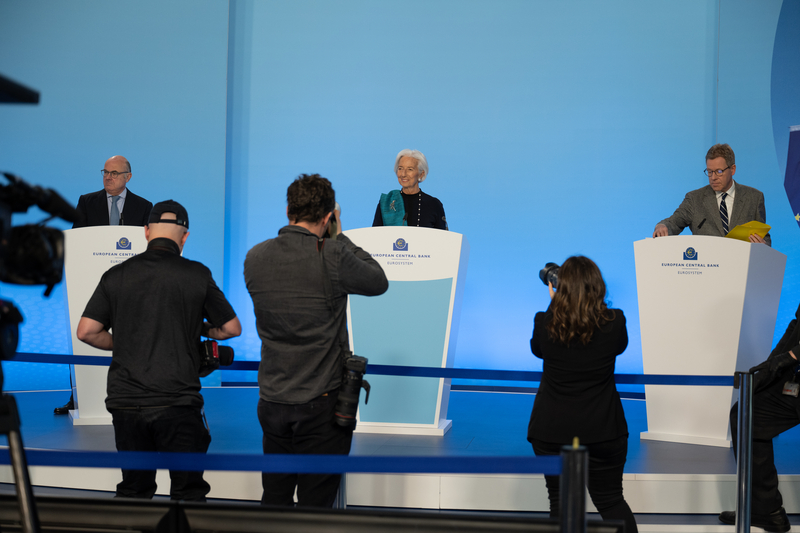
When asked whether the European Central Bank (ECB) could become a global model for assessing the importance of central bank digital currencies, Lagarde replied:

“Our goal is not to be a role model. Our goal is to ensure that in the digital age there is a currency that represents the stability anchor for the financial system.
Right now, that anchor is central bank money, which essentially has a material form: it’s the banknotes you have in your wallet. But in the digital age, it must be a digital expression of that sovereignty and a digital anchor to the purpose of the financial system we have.
So that’s what we’re aiming for, in addition to making sure it’s user-friendly, cost-effective, fast, efficient and private, that it can work online and offline.”
Advertisement
In the further course of the question time following the press conference, stablecoins were also discussed. They have gained significant traction around the world, but many experts see them as a threat to Europe’s monetary sovereignty and are calling for greater support for stablecoins. When asked about her position on this, Lagarde replied:
“We are fortunate in Europe to have something called MiCAR. This is the legal framework within which instruments such as stablecoins operate, can be monitored and are considered secure. So we believe that an instrument that is compliant with MiCAR represents an alternative form of payment that has its advantages and could have a business case for those issuing stablecoins.
Regarding MiCAR, however, Lagarde stated that the ECB was basically not responsible for it:
“If it complies with MiCAR, if it is organized correctly, if it has the right one-to-one guarantee for users, then I don’t need to have an opinion. The regulators need to have a look at it, those who control that the reserve actually exists.”
She also commented on the possible risks of stablecoins:
“What worries me is the situation of the multi-issuance currency for stablecoins, because without going into the details of the structure, the reserves, the settlement mechanisms and the repayment mechanism in Europe, as organized under the MiCAR, will be exposed to other currencies under which the stablecoin is issued, which could pose a threat and a burden to the provisions of the MiCAR applicable in Europe. So I think that in this particular area we need to pay very close attention to what potential risks to that system itself and for the holders of stablecoins.”
ECB board member Piero Cipollone once again commented on the digital euro. He pointed out a point that has generally barely been noticed by the public:
“A digital euro can ensure the continuity of payments during cyberattacks or power outages that disrupt traditional banking infrastructure.”


