Key Highlights
- Deutsche Bank will launch institutional crypto custody for Bitcoin, Ether, and select stablecoins in Europe before year-end under the EU’s MiCA regime, pending a BaFin licence expected in October.
- The bank will manage private keys in-house using hardware-based protection, multi-person approvals, and segregated warm and cold storage, targeting corporates, asset managers, hedge funds, and sovereign institutions.
- Germany’s largest lender enters a competitive European custody landscape already served by Standard Chartered, BBVA, DZ Bank, and Landesbank Baden-Württemberg, but brings globally systemically important bank (G-SIB) scale and existing client relationships.
Deutsche Bank Commits to Regulated Crypto Custody Under MiCA
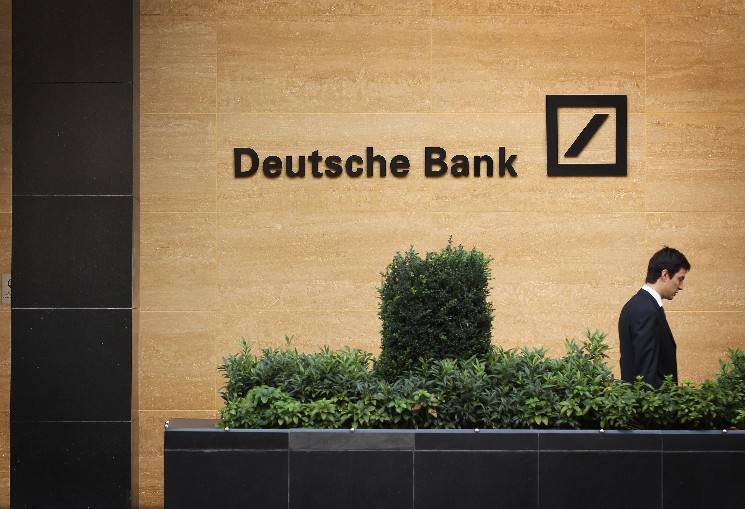
Germany’s largest bank confirmed Wednesday it will begin safeguarding bitcoin and ether for institutional clients in Europe before the end of 2025, marking the most significant entry yet by a globally systemically important bank into regulated digital-asset custody. The announcement, made a day after the U.S. Senate failed to advance the Clarity Act, underscores a divergent regulatory path: while U.S. market-structure legislation stalls, Deutsche Bank is moving forward under the European Union’s Markets in Crypto-Assets (MiCA) framework.
Gerald Podobnik, co-head of Deutsche Bank’s corporate bank, framed the move as complementary rather than disruptive. “digital assets are not a replacement for the traditional financial system but an important complement to it,” Podobnik said in a statement. “We see them as new rails that can coexist with existing market infrastructures while benefiting from the trust, security and safeguards that regulated financial institutions provide.” He added, “Our aim is to offer clients a secure and regulated gateway to this evolving market.” A bank spokesperson told Cointelegraph the firm expects to receive its MiCA custody licence from Germany’s BaFin in October. Bitcoin traded at $75,547 Wednesday afternoon, little changed over 24 hours, according to CoinGecko.
Asset Scope and Technical Architecture
At launch, the service will cover “a selected range of digital assets, including Bitcoin and Ether, as well as selected stable coins or e-money tokens, including USDC and EURC, EURAU,” the bank said. Circle issues USDC and EURC. EURAU is the euro-denominated stablecoin of AllUnity, a joint venture between Galaxy, Flow Traders, and DWS—the asset manager majority-owned by Deutsche Bank—which received a BaFin e-money licence in July 2025. “Tokenized financial instruments are also included in the roadmap,” the release added.
The first clients will be corporates, asset managers, hedge funds, custodians, brokers, and sovereign institutions served by the corporate and investment banks. Critically, Deutsche Bank will manage the wallets and private keys itself, with keys secured behind hardware-based protection, multi-person approvals, and separate warm and cold storage. For Ido Sofer, founder and chief executive of key-management firm Sodot, that in-house approach signals strategic intent. “When you hear a bank is launching their own custody solution and they’re hiring blockchain engineers and so on, that means that they’re saying, okay, I want to go all in. I want to have those in-house capabilities and I want this as a business line,” Sofer said on the On The Margin podcast in April. “It really shifted from this is an experiment to this is a growth vector in the business line.”
Three-Year Build and Competitive Landscape
Deutsche Bank applied to BaFin for a digital-asset custody licence in June 2023 and named Swiss technology provider Taurus as its partner that September. In July 2025, Bloomberg reported the bank was targeting a 2026 launch and had engaged Bitpanda’s technology unit alongside Taurus. Wednesday’s release names neither firm, stating only that the service “will use selected external technology and infrastructure providers for defined technical components.”
The bank arrives late to its immediate neighbourhood. Landesbank Baden-Württemberg announced institutional custody with Bitpanda in 2024; DZ Bank’s meinKrypto platform received MiCA authorisation in December 2025; and Standard Chartered and BBVA already operate regulated custody in Europe, as CoinDesk noted. What Deutsche Bank brings is scale: it is one of the banks the Financial Stability Board classifies as globally systemically important, and its clients have been asking who should hold the keys since a wave of exchange hacks last summer.
Why This Matters
Deutsche Bank’s entry signals a maturation of institutional crypto infrastructure in Europe. By operating under MiCA—the world’s first comprehensive crypto-asset regulatory regime—the bank offers a regulated alternative to offshore or unlicensed custodians, addressing a primary barrier for pension funds, insurers, and sovereign wealth funds. The decision to retain private keys in-house, rather than outsourcing to a specialist like Fireblocks or Copper, reflects a business logic older than blockchain: a custodian that controls the keys controls the client relationship and the cross-sell opportunities that follow. As Sofer noted, “It’s gonna be hard for you to leave.”
However, the release carries a blunt risk disclosure: “Digital assets involve material risks, including price volatility, fraud, cyber incidents and failures of market participants,” it says. “Crypto-assets are not covered by a deposit-guarantee scheme comparable to the protection applicable to eligible bank deposits.” That trade-off—regulated custodial controls without deposit insurance—is the core proposition. Michael Tanguma, co-founder and chief executive of bitcoin custody firm Onramp, argues the market has already accepted it. “Nobody would tell an individual to take all their gold out of the bank and park it underneath their mattress,” Tanguma said in an August interview. “It’s a misnomer and fallacy to say that self custody is the only way.”
Podobnik left the door open on scope: “The service will be further developed in line with client demand, regulatory requirements and the bank’s risk appetite,” he said. The release adds that timing, geography, and the asset list “may change as a result of regulatory requirements, internal approvals, market developments or client demand.” Sofer’s read is that such hedging is standard boilerplate once a G-SIB commits. “When a bank does something, this is for like five, 10 years, right?” he said. “They don’t say, well, let’s do this for a couple of quarters and re-evaluate.”
Frequently Asked Questions
Which digital assets will Deutsche Bank custody at launch?
The bank will hold Bitcoin, Ether, and select stablecoins or e-money tokens including USDC, EURC, and EURAU. Tokenized financial instruments are on the roadmap for future inclusion.
How does Deutsche Bank’s custody model differ from specialist crypto custodians?
Deutsche Bank will manage wallets and private keys entirely in-house using hardware-based protection, multi-person approvals, and segregated warm and cold storage, rather than relying on third-party key-management providers. The bank argues this integrates the trust and safeguards of a regulated G-SIB with new digital-asset rails.
Are crypto assets held by Deutsche Bank covered by deposit insurance?
No. The bank explicitly warns that crypto-assets are not covered by any deposit-guarantee scheme comparable to the protection applicable to eligible bank deposits. Clients assume material risks including price volatility, fraud, cyber incidents, and counterparty failures.