Scalability remains a perpetual challenge for every Layer 1 blockchain. As competition intensifies, demonstrating network capabilities becomes critical to attracting users. For most blockchains, this means improving fundamentals such as speed, throughput, and finality. Ethereum, however, appears to be pursuing a different strategy.
Ethereum’s Frames Upgrade Introduces Stablecoin Gas Payments
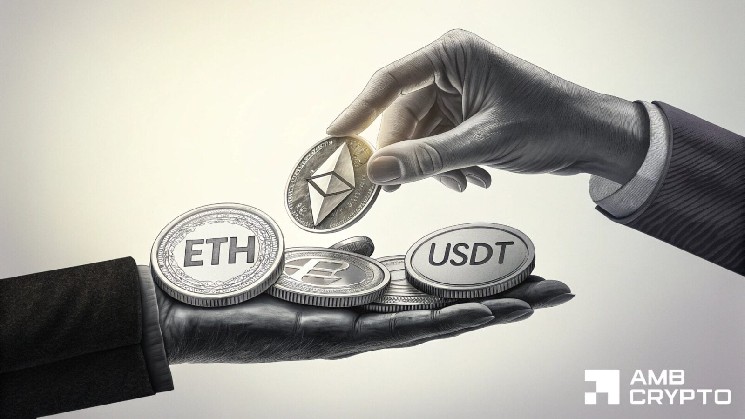
In the Frames (EIP-8141) upgrade shared by Vitalik Buterin on X, Ethereum developers are working on a transaction model that would allow users to pay gas fees with stablecoins instead of $ETH. The update immediately drew market attention, with the reaction being generally bullish.
Fee Market Implications: Decoupling Gas from $ETH
When analyzing the upgrade’s impact on the fee market, the narrative may surprise some observers. The reasoning is purely logical: Ethereum fees are linked to the value of $ETH because they are paid directly in the native cryptocurrency. Every transaction creates demand for $ETH, directly affecting its price. The proposed upgrade changes this dynamic by allowing users to pay fees in stablecoins, which decouples gas costs from the value of Ethereum’s native token.
Stablecoin Dominance Fuels Ethereum’s Utility Narrative
Despite a recent slowdown in stablecoin market capitalization, the sector still hit a record $320 billion in H1. This matters because financial institutions globally continue to view stablecoins as a more efficient tool for cross-border payments and settlements. Naturally, the Layer 1 networks capturing the most stablecoin liquidity are becoming the key utility networks.
The logic is straightforward: the more stablecoins move through a chain, the more relevant that network becomes for overall DeFi activity. Ethereum already holds a significant advantage in this regard. The network hosts nearly 50% of total stablecoin liquidity, totaling approximately $147 billion. Given this substantial concentration, Ethereum’s ‘utility’ narrative is clearly picking up.
EIP-8141 Targets Mass Adoption for Next DeFi Cycle
This context likely explains the thinking behind EIP-8141. As the analyst pointed out, the ultimate goal is “mass adoption.” The stablecoin market is growing, use cases are expanding, and Ethereum already hosts over 50% of this segment. Enabling users to pay gas fees in stablecoins could make Ethereum significantly more accessible.
Users would no longer need to buy $ETH solely to cover transaction fees. Instead, they could make payments directly with the stablecoins they already hold. In this context, EIP-8141 is positioned to become a critical layer for $ETH‘s next growth phase. With rising stablecoin adoption, the upgrade will enable Ethereum to capture more utility and potentially facilitate an $ETH-based DeFi cycle in late 2026 and 2027.