The explosive growth of prediction markets has become difficult to ignore. Outlandish bets, rising interest among next-generation traders and ongoing regulatory debates have dominated coverage. But while much of the discussion focuses on whether prediction markets are gambling products or financial transactions, a more fundamental question may be emerging: do these platforms still function as fair markets?
Public markets were originally designed to bring willing buyers and sellers together, help them establish a fair price and coordinate settlement. The market and professional intermediaries such as brokers and custody agents each took a “clip of the ticket” to compensate them for facilitating the transaction. That structure gave buyers and sellers confidence in the fairness of the process.
Crucially, the market also served as a mutual utility. Every participant contributed to price discovery, helping improve the market’s overall efficiency.
The concentration of prediction-market profits
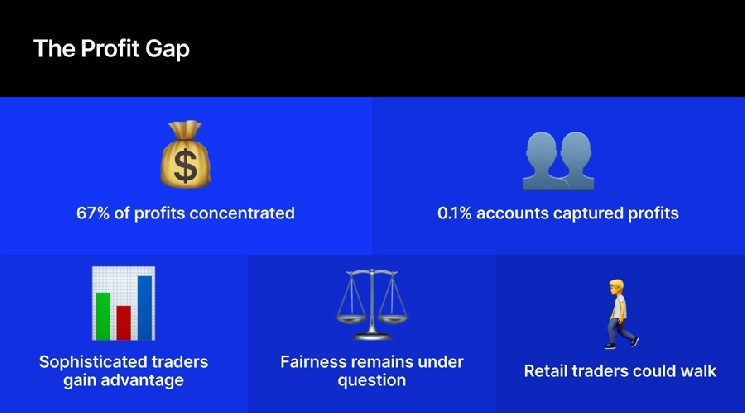
A Wall Street Journal report published earlier in 2026 highlighted how 67% of all profits on Polymarket were being captured by just 0.1% of accounts. The figures were striking because they suggested that only a very small proportion of participants, particularly those with substantial capital or superior information, could consistently expect to win on the platform.
The glib response may be that a fool and their money are easily parted. However, recent history offers a clear precedent for what can happen when dominant participants operate in a limited market and consistently outperform other traders.
Lessons from US horse racing
A similar dynamic has emerged in US horse racing, where computer-assisted wagering (CAW) systems are used by betting syndicates. Superior information processing, preferential order execution and volume rebates have proved lucrative for participants using this strategy.
The situation is compounded by the fact that US horse-racing bets use a totalisator, or “tote”, rather than being placed directly against a bookmaker. This removes the peer-to-peer element that can ultimately act as a “flywheel of fairness”.
As the US horse-betting market became increasingly one-sided, traditional “retail” betting declined sharply. Participants recognised that winning was becoming more difficult.
The issue is now tied up in legal disputes and class-action lawsuits, while the amount wagered through CAW systems has also fallen significantly. Nevertheless, the episode offers a useful insight into what happens when “institutional” behaviour in limited-market environments is allowed to continue unchecked.
Are prediction markets heading in the same direction?
On their current trajectory, prediction markets may be heading toward a similar outcome. The technology available to the most heavily capitalised participants improves every day, as does their understanding of human behaviour.
Prediction markets also appear to operate in a “Wild West” environment, with limited regulation and little evidence of an effective rule book. That makes price manipulation easier.
Whether the problem involves opacity around the underlying market or an operator sending users overt messages that a trade is mispriced, under the defence that this is “content marketing” rather than analysis, it is difficult to see how these products reflect the financial markets or financial-promotion structures that have developed over time.
Prediction markets can serve a valuable purpose at the peer-to-peer level. They can enable trades outside traditional exchanges while allowing transactions to take place within a controlled framework. Their primary function should be to serve buyers and sellers, with the market taking a fair cut for facilitating the transaction.
But if the model becomes a one-sided proposition in which retail punters bet against faceless “hedge-style” liquidity providers equipped with an expanding information advantage, the appeal of the market may prove short-lived.
The risk of losing retail participants
The horse-racing example shows that retail participants will walk away when a counterparty’s efficiency makes the proposition too unattractive. Instead of debating whether prediction markets are gambling or finance, the more important question may be whether they resemble fair markets at all.
For prediction markets to prosper, they must operate like genuine markets. That means preserving enough informational friction to encourage price discovery and giving retail traders a meaningful opportunity to be rewarded for their views.
Source: cryptonews.net