

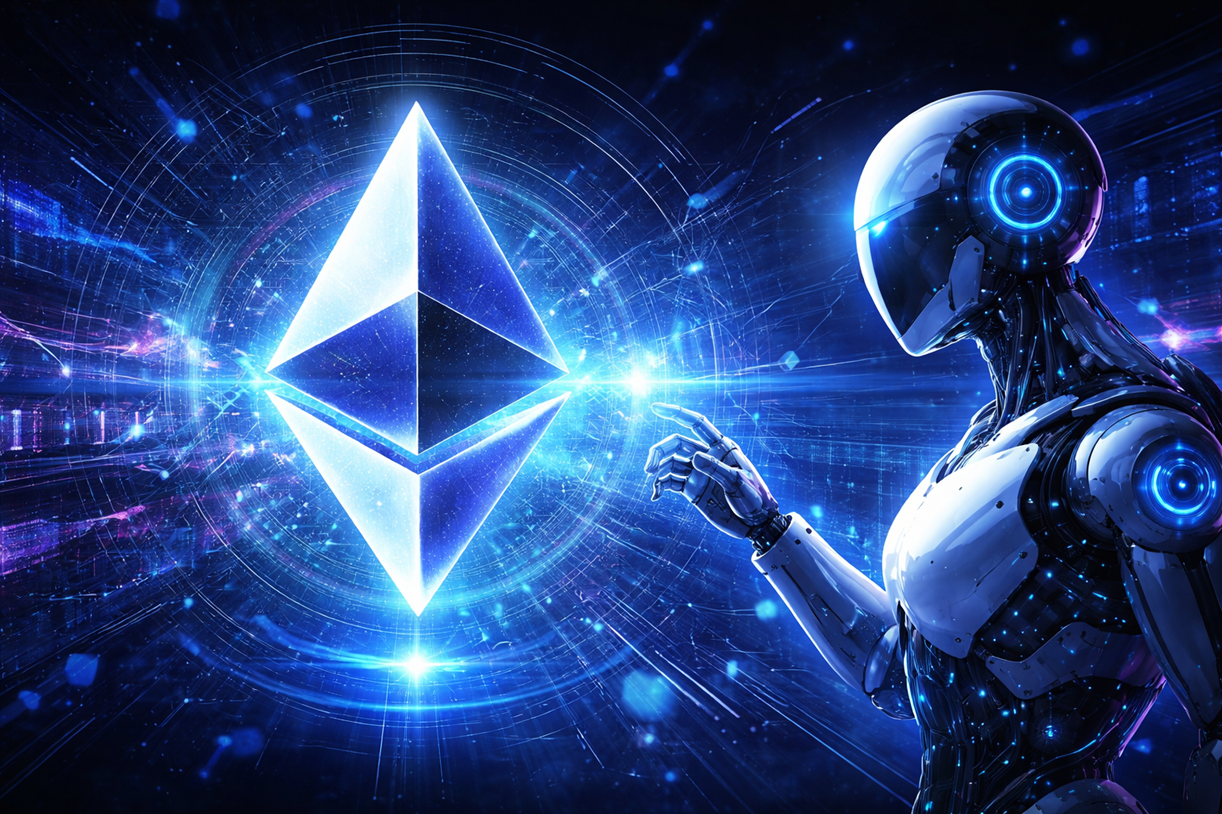
- Garrett Jin sees Ethereum as a “top AI asset”. ERC-8004 is intended to make the identity and reputation of autonomous agents verifiable on-chain and thus accelerate machine-to-machine use cases.
- More agent activity could increase gas/blob fees and potentially burn more ETH via EIP-1559.
BitForex Co-Founder Garrett Jin Names Ethereum in an X-Post as of January 28, the best-positioned crypto asset for AI-driven applications. The trigger is ERC-8004: The standard is intended to make the identity and reputation of autonomous agents verifiable on-chain.
“iPhone moment” for Ethereum?

Jin calls the update an “iPhone moment.” He portrays ETH as an infrastructure beneficiary of the AI wave – in contrast to many classic software companies, which he sees as losers. His point: For agents, in the end it’s less the model that counts – but rather a neutral, trustworthy level for processing and coordination.
“With ERC-8004 nearing mainnet, we believe this marks an ‘iPhone moment’ – a milestone for ETH as a primary beneficiary of the AI wave at the application layer. While most publicly traded software companies are being displaced or at least pressured by AI, ETH stands out as a scarce, core asset for AI-enabled applications.”
Jin criticizes centralized AI as a black box: a lack of transparency and censorship risks are structurally present in closed platforms. Ethereum is intended to solve this problem as a settlement and coordination layer. Its narrative is two-sided: Ethereum provides settlement and coordination; AI creates new, more autonomous use cases that need exactly this level.
“The ETH + AI relationship is not additive. It is deeply symbiotic: Ethereum provides AI with trustworthy, decentralized, tamper-proof settlement and coordination. AI, in turn, provides Ethereum with smarter, more efficient and truly autonomous applications.”

Specifically, it’s about machine-to-machine processes: agents who carry out tasks, initiate payments and conclude contracts. Jin’s alternative to centralized models: Recognition, reputation and behavior should not remain in silos, but should be linked to a portable on-chain identity “via ERC-8004 and similar standards”.
ERC-8004 was first introduced in August 2025 and is scheduled to launch this week. The Ethereum Foundation wrote on Tuesday via X:
“ERC-8004 will soon be launched on mainnet. By enabling discovery and portable reputation, ERC-8004 allows AI agents to interact across organizations, ensuring credibility is carried everywhere. This opens up a global market where AI services can be interoperable without gatekeepers.”
ERC-8004 is going live on mainnet soon.
By enabling discovery and portable reputation, ERC-8004 allows AI agents to interact across organizations ensuring credibility travels everywhere.
This unlocks a global market where AI services can interoperate without gatekeepers. https://t.co/Yrl0rvnSxj
— Ethereum (@ethereum) January 27, 2026
For Jin, this is the base layer of an open agent economy: identity, reputation and validation are kept in separate on-chain registries. The goal is a reputation that is not tied to a single operator, but can be carried between applications.
This is how the ETH price could benefit
Economically, Ethereum could benefit massively. Gas and blob fees, which partially burn ETH via EIP-1559, create deflationary pressure that could ultimately boost the Ethereum price.
And according to Jin, the potential is huge. Autonomous agents have a high frequency, make countless microtransactions and additional calls (identity proofs, coordination, validations). As part of this, he refers to forecasts that AI agents could represent around 15-20% of DeFi volume by the end of 2025; He cites 30-40% quarterly gas growth as a scenario for 2026.
From this he deduces: If agents use the chain more often, fees increase – and with them potentially the burn rate and the ETH price.
At the same time, Jin sees AI as an accelerator for RWA activity: automated valuation, compliance checks, risk monitoring and dynamic pricing could make tokenized real-world assets more efficient and auditable – especially in institutional setups, such as fund structures. From his perspective, AI-driven activities could become the “second largest source of fees after stablecoins” in the long term.
Compared to Solana, Jin positions Ethereum clearly ahead. He sees deficits in Solana in three areas that are central to agent-to-agent interactions: trust, reputation and finality.
“There is no official or ecosystem-driven standardized trust framework comparable to ERC-8004. The network’s historical stability and decentralization continue to be viewed as weaknesses by institutions. The settlement is focused on high throughput rates rather than maximum security and final transaction settlement.”




No Comments