

The historical past and traditions of the tribe who responded to Billie Eilish’s Grammys speech has been revealed after the singer was accused of ‘hypocrisy’.
The 24-year-old gained the ‘Track of the Yr’ award on the ceremony for her tune ‘Wildflower’, taking to the stage along with her brother and longtime collaborator Finneas.
Eilish confirmed her gratitude for the award, however obtained a dig at Immigration and Customs Enforcement (ICE) into her speech, saying: “I truthfully don’t really feel like I must say something however that nobody is unlawful on stolen land.”

The artist was referencing the European colonisation of the Americas between the fifteenth and seventeenth centuries, including: “It’s simply actually exhausting to know what to say and what to do proper now, and I simply really feel actually hopeful on this room, and I really feel like we simply must maintain combating and talking up and protesting, and our voices actually do matter, and the individuals matter.”
“And f**okay ICE, that is all I am gonna say. Sorry!” the artist concluded, in a robust political message.
Nevertheless, some claimed there was a component of hypocrisy to the ‘unhealthy man’ artist’s phrases.
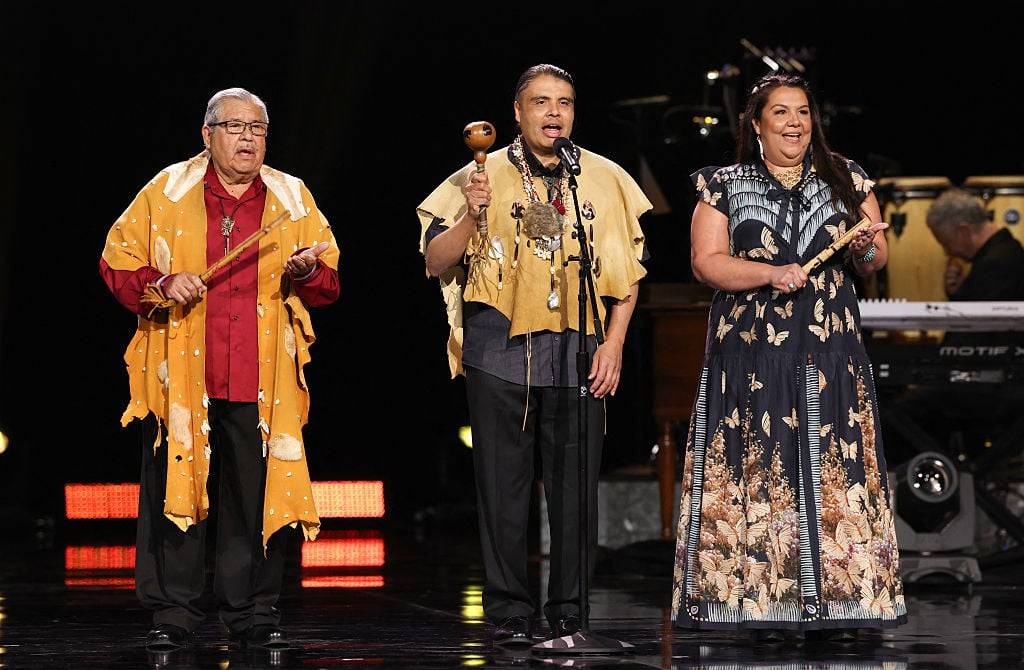
Based on a consultant of the Tongva individuals, Eilish’s reported $3 million (£2.1 million) household house positioned inside the Highland Park neighbourhood of Los Angeles, is on land initially belonging to the tribe.
A regulation agency has since come out and provided to evict the musician from her house, because the speech obtained combined responses from the general public.
The Tongva individuals have since addressed the speech, with a spokesperson telling MailOnline: “Because the First Individuals of the higher Los Angeles basin, we do perceive that her house is located in our ancestral land.
“Eilish has not contacted our tribe instantly concerning her property, we do worth the occasion when Public Figures present visibility to the true historical past of this nation.”
Whereas indicating that they felt ‘appreciation’ for her assertion on the Grammys, they urged her and different huge names to reference their nation when talking out in regards to the US.
They hope that ‘the tribe can explicitly be referenced’, as ‘the higher Los Angeles basin stays Gabrielino Tongva territory’.
Who’re the Tongva?
The Tongva individuals, often known as Gabrielino-Tongva, are the indigenous individuals of the Los Angeles Basin and Southern Channel Islands in California.
They’ve lived within the 4,000-square-mile space for the final 3,500 years or so, with the tradition having sturdy hyperlinks with the land and sea.
There are over 700 residents residing throughout town and county of Los Angeles, in keeping with Gabrielino/Tongva nation – they don’t have a federal reservation of their very own, like different Native American tribes within the US.

Based on the Los Angeles Times, the Tongva individuals known as their territory Tovaangar, which accurately means ‘the world’.
It initially consisted of 5,000 individuals throughout 100 villages and spanned from Palos Verdes to San Bernardino, and from Saddleback Mountain to the San Fernando Valley.
The Tongva additionally name 4 Southern Channel Islands, together with Santa Catalina and San Clemente, house.
Britannica explains they had been one of many wealthiest and most technologically superior tribes within the area.
They lived in homes made out of poles and tule-reed mats and their financial system was largely based mostly on acorns and wild crops, together with fishing and looking.
Whereas they had been initially known as the San Gabriel Indians, or Gabrieleño, named after the Spanish mission to which they had been taken in the course of the interval of colonization, in 2007 they modified their title to the Gabrielino/Tongva Nation.
They’re at present campaigning to realize federal recognition, having already been recognised by the State of California, the California Basic Meeting, and the Los Angeles Metropolis Council.
They wrote on their web site: “With out Federal recognition, we can’t declare and repatriate our ancestors’ stays. We can’t take part in scholarships for Native People. We can’t apply our spiritual traditions with full freedoms.”


