It is bizarre that a film like Coyote vs. Acme nearly disappeared without ever reaching movie theaters. In an era when Hollywood is hungry for familiar intellectual property, a Looney Tunes comedy starring Will Forte, John Cena, and Lana Condor seemed like an obvious candidate for box-office success.
The film was written by Academy Award–nominated screenwriter Samy Burch (May December) and produced by James Gunn, whom Warner Bros. appointed to lead DC Studios. With its family-friendly premise and iconic characters, Coyote vs. Acme appeared positioned to become a major studio release.
Instead, Warner Bros. Entertainment announced in November 2023 that the completed film would be shelved indefinitely so the company could claim an estimated $30 million tax loss.
WB made similar write-downs for Batgirl and Scoob! Holiday Haunt, leaving fans of those franchises frustrated and powerless. Fortunately, Looney Tunes fans have avoided the same fate. Ketchup Entertainment successfully acquired the distribution rights to Coyote vs. Acme, turning the film’s strange journey into a real-life David-versus-Goliath story.
Coyote vs. Acme is, fittingly, an underdog story for the moment.
Credit: Ketchup Entertainment
A Looney Tunes courtroom satire
Directed by Dave Green, Coyote vs. Acme imagines a world similar to Who Framed Roger Rabbit? and 2022’s Chip ’n Dale: Rescue Rangers, where cartoon characters live alongside humans and are often dismissed because of their chaotic behavior.
However, Coyote vs. Acme takes that culture clash into socio-political territory. The result is a slapstick comedy with a satirical edge and unexpectedly serious ideas about corporate power, accountability, and whistleblowing.
The story begins after another failed attempt to use an Acme product to capture the speedy Road Runner. Wile E. Coyote sees a cheesy advertisement for the law offices of Avery, Jones, and Maltese. The names reference classic Looney Tunes animators Tex Avery, Chuck Jones, and Michael Maltese.
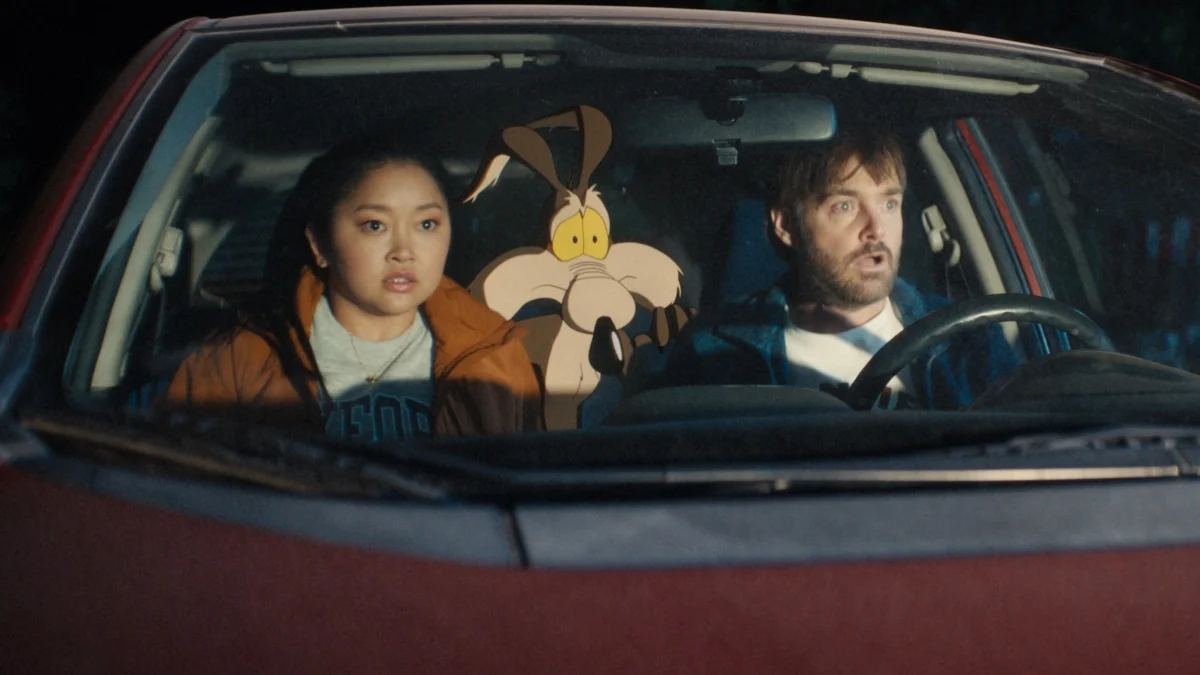
Will Forte plays Kevin Avery, a lawyer who earns his living suing Acme in small-claims court. In his advertisement, he promises cartoon clients quick settlements for their pain and suffering. His partners, Sal Maltese, played by Tone Bell, and Dottie Jones, played by Martha Kelly, are equally focused on easy cases that never need to reach a courtroom.
That changes when Wile E. arrives with extensive evidence that Acme’s products are dangerously defective. Kevin is suddenly faced with a major case, whether he wants it or not.
Condor co-stars as Paige, Kevin’s ambitious niece and a recent law-school graduate. She sees the pile of broken gadgets as more than an opportunity to test her legal skills. Paige also wants to change the way Acme treats its cartoon customers.
Acme manufactures phones and cars for humans, and those products appear to be safe. Why, then, are its cartoon products so consistently dangerous? The question gives Coyote vs. Acme a whistleblower-thriller storyline beneath its comic chaos.

Credit: Ketchup Entertainment
Classic characters in a modern underdog story
The film opens with a refreshing throwback sequence. Inside an Acme factory operating under strict surveillance, Dr. Peter Lorre, a caricature resembling the late Hungarian actor, sends highly confidential information to an unknown outsider.
He manages to get the package out of the building, but he does not escape. A threatening group of men throws him into an Acme hole, a black opening that may be bottomless. He has two choices: jump or be pushed. After warning that the truth cannot remain hidden forever, he jumps and disappears.
The story then moves 30 years into the future. While the main plot follows Kevin as he reluctantly takes Wile E.’s case and faces an arrogant, physically imposing lawyer played by John Cena, the secondary storyline follows Paige as she investigates what Acme may be concealing.
The two storylines bring in classic Looney Tunes characters including Daffy Duck, Porky Pig, Elmer Fudd, and Bugs Bunny, along with Granny, Tweety, Foghorn Leghorn, and others.
Kevin’s determination grows as his relationship with Wile E. deepens. The coyote never speaks, instead communicating through handwritten signs, expressive eyebrows, and an inventive use of paper dolls.
Forte is an ideal scene partner for a literal cartoon character. The comedian has voiced numerous animated characters in shows including Bob’s Burgers, The Great North, Gravity Falls, Haunted Hotel, Rick and Morty, American Dad!, Clone High, and Scott Pilgrim Takes Off. More importantly, his comic style can shift instantly from deadpan to mischievous.
He is perfectly cast as a lovable loser forced to become a reluctant hero. Kevin is endearing enough to inspire belief, but also so spectacularly goofy—as Forte demonstrated in MacGruber—that failure always feels possible.

Credit: Ketchup Entertainment
Why Coyote vs. Acme works
Like Who Framed Roger Rabbit? and Chip ’n Dale: Rescue Rangers, Coyote vs. Acme uses its lovable cartoon characters to offset the darker elements of its crime-driven story. But instead of centering on a jaded private investigator or a washed-up former hero, Burch focuses on a man who has always been too afraid to try.
Kevin’s fear is understandable as Acme’s expensive, intimidating lawyers prepare for battle. Watching him join forces with a group of screw-ups and eccentrics is nevertheless heartwarming. The film argues that sometimes imperfect allies are all we have—and that ordinary people can still fight back against the wealthy, polished, and privileged.
Green gives the Looney Tunes’ trademark slapstick a vivid cinematic life. Daffy goes wild, Porky takes a beating, and Wile E. is repeatedly blown to smithereens with enthusiastic precision. A layer of shadow in the characters’ coloring reinforces the impression that they exist in the same world as the humans and are subject to the same pressures.
That visual approach also makes the courtroom sequences especially entertaining. Like Inherit the Wind and My Cousin Vinny, Coyote vs. Acme embraces the theatricality of legal drama. Forte’s Kevin fumbles brilliantly, while Foghorn Leghorn moves through the courtroom like the Southern country lawyer who has become a familiar figure in the genre.
Burch creates a sharp parody without undermining the stakes. As the squeaking gavel falls, the audience may laugh, but the outcome still matters.
Simply put, Coyote vs. Acme is a very good movie. It may be overlooked by the Academy, and it is unlikely to make blockbuster-level money. But it is not weighed down by excessive fan service or by incoherent action sequences. It is smart, silly, and ultimately inspiring.
This is the kind of film many viewers might have rushed to see after school with friends, and the kind they could enjoy watching with younger family members. It is both timely and timeless, placing beloved characters in a modern world where their absurdity still has meaning.
That a film this entertaining, poignant, and daring was nearly discarded by a major studio for a tax write-off should alarm movie lovers. In that sense, its release becomes an extension of the call to action at the heart of the story.
After the public outcry from fans and filmmakers, Coyote vs. Acme stands as evidence that when corporations put money ahead of art, community, and joy, audiences can still support the underdog.
Coyote vs. Acme opens in theaters on Aug. 28.
Source: mashable.com