‘By Any Means’ Review: Mark Wahlberg’s Miscast Turn Undermines Civil Rights Drama
Paramount Pictures’ By Any Means arrives with the weight of a prestige historical drama but collapses under tonal confusion and a wildly miscalibrated lead performance. Directed by Elegance Bratton and written by Sascha Penn, the film attempts to dramatize the FBI’s controversial alliance with a Mafia enforcer to solve civil rights-era murders in 1960s Mississippi. Instead, it delivers a muddled buddy-cop fantasy that panders to white audiences while squandering a powerful true-story framework.
A Prestige Premise Derails Into Green Book Territory
The film opens with archival footage establishing the terror of 1964 Mississippi, where KKK violence claimed the lives of James Chaney, Andrew Goodman, and Michael Schwerner. Yahya Abdul-Mateen II stars as Special FBI Agent Wayne Strider, a Black Mississippian investigating the firebombing murder of local NAACP leader Vernon Dahmer (Giancarlo Esposito). In these early scenes, Abdul-Mateen is riveting — earnest, intense, and grounded in the peril facing Black families in the South. Nicole Beharie brings quiet gravity as Strider’s wife, and the film initially channels the moral urgency of Mississippi Burning.
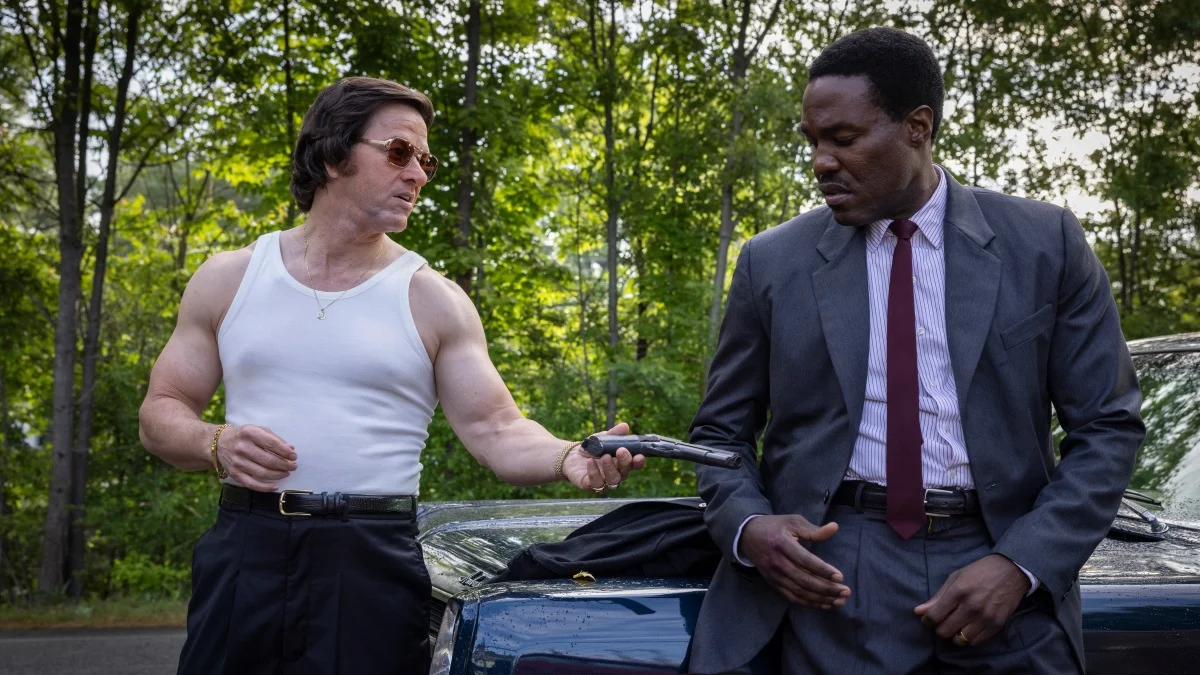
Then the narrative pivots. Enter Gregory Scarpa (Mark Wahlberg), a Colombo crime family hitman and FBI informant dispatched from Brooklyn to extract confessions “by any means necessary.” What follows is a jarring tonal shift into odd-couple buddy-cop mechanics reminiscent of Lethal Weapon — but with the racial dynamics of Green Book. The refined Southern Black agent is lectured by a loudmouthed white New Yorker on the merits of Malcolm X over Martin Luther King Jr., a scene that reduces civil rights philosophy to a plot device for Scarpa’s violence-first worldview.
Wahlberg’s Performance: Prosthetics Over Substance
Mark Wahlberg’s casting is the film’s fatal flaw. Buried under a comically oversized prosthetic nose, a bad wig, and a pot belly, Wahlberg mugs through scenes with a Boston-accented approximation of a Brooklyn tough guy. The makeup is so distracting — matte, untextured, and profile-ruining — that it recalls Johnny Depp’s alienating transformation in Black Mass. Wahlberg reaches for the gravitas of James Gandolfini or Russell Crowe in The Nice Guys but lands in parody. His chaotic charisma, effective in The Departed or Pain & Gain, feels grotesquely out of place in a film about anti-Black terrorism.
The film never meaningfully interrogates the white privilege that allows Scarpa to shoot a police officer and walk away, while Strider faces a drawn gun at a routine traffic stop. That disparity is noted but unexplored, sacrificed to a narrative that ultimately celebrates extrajudicial violence as a necessary corrective to systemic failure — the same logic the film’s KKK villains (led by a chilling Ethan Embry) use to justify their own bombs and burnings.
Historical Speculation Masquerading as Fact
The title card “Based on a true story” should trigger skepticism. As with 2005’s Wolf Creek, the claim serves as marketing hook, not historical contract. Final title cards admit most of the plot is “inspired by the suspicion” that Scarpa may have been involved alongside an “unnamed” Black agent. With such a specious tether to reality, the filmmakers could have crafted a nuanced critique of FBI overreach and moral compromise. Instead, they delivered a vigilante fantasy where the ends justify the baseball bats.
Wasted Talent, Muddied Message
Terence Blanchard’s smoky, saxophone-heavy score underscores the film Bratton could have made — one that aches with purpose. Abdul-Mateen, Beharie, and Esposito deliver performances demanding a better vehicle. David Strathairn is reduced to exposition delivery as Strider’s boss. The climax, in which Strider abandons procedure to embrace Scarpa’s methods, feels less like character evolution than genre capitulation: the cop goes rogue, the system wins, and the audience is assured that violence in service of “good” is acceptable.
The final title cards detailing the real-world aftermath — minimal legal consequences for all involved — only deepen the cynicism. By Any Means wants credit for confronting racism but coddles white viewers with a charismatic antihero who “isn’t that bad” compared to the Klan. That bar was never enough. It isn’t now.
By Any Means opens September 4.