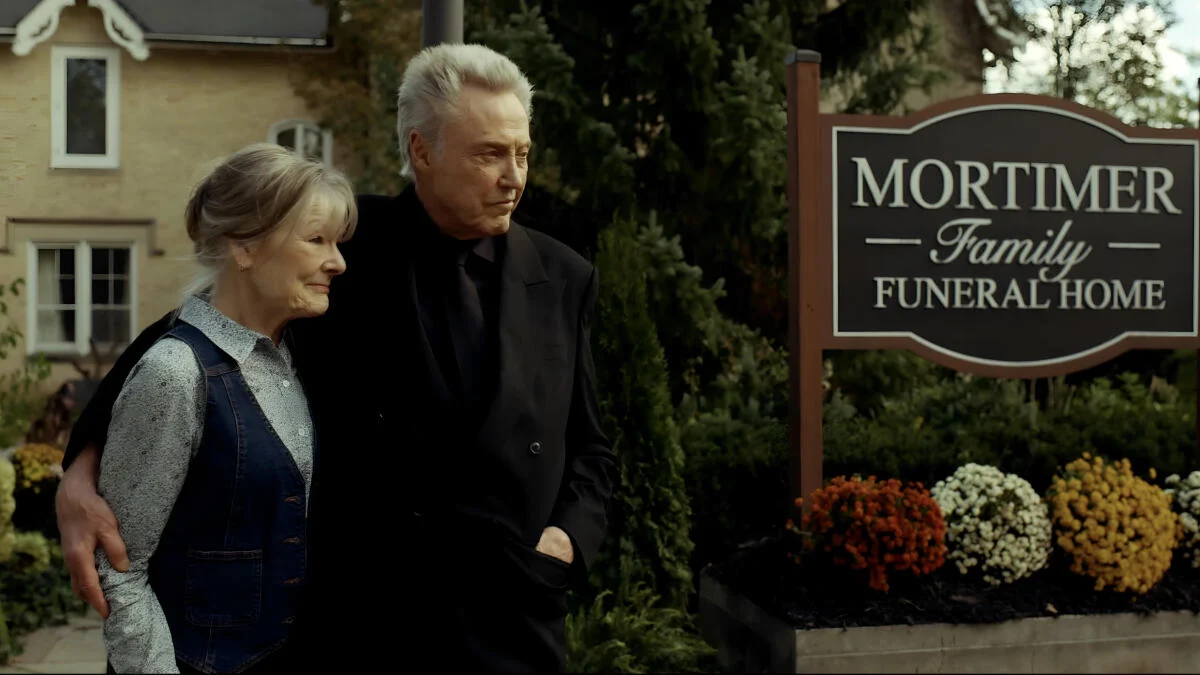
Christopher Walken delivers a performance only he could pull off in Back in Black, the off-kilter dark comedy that premiered at the Toronto International Film Festival. Written by Ron Murphy and Nick Torokvei and directed by Murphy, the film stars Walken as Clyde Mortimer, an undertaker from a long line of undertakers who runs Mortimer’s Family Funeral Home alongside his chipper wife Autumn (Jane Curtin) and their orphaned granddaughter Sam (Ella Ballentine).
A Funeral Home in Crisis
Business is bad in their charming small town because, as Clyde furiously points out, no one is dying lately. He insists that no one dying is no way to live!
The COVID-19 pandemic should have been a boom time for morticians, but the sharp decline in in-person gatherings prevented that windfall. Enter Sam with a plan—and a handy screwdriver.
Dexter Meets Cozy Crime
The opening shot establishes the tone: Sam uses a screwdriver to build a coffin, a telling image for what follows. With the family facing financial ruin, Sam employs her engineering know-how to strategically loosen screws around town, orchestrating a series of fatal accidents at grocery stores, construction sites, and motel swimming pools. To the average observer, it looks like a string of bad luck. But Deputy Donna (Louise Lambert) suspects otherwise, even if her sheriff (Tony Nappo) dismisses her theory.
Silent Protagonist, Loud Heart
The cat-and-mouse element remains a subplot. The main story centers on Sam’s relationship with her grandparents and the romances sparked by the first murder victim’s funeral. Sam meets Kevin (Giamo Alfredi), a needy nephew of the deceased, and Charlotte (Watson Rose), a raven-haired beauty who offers to help prepare the dead.
Sam doesn’t speak. She is the Teller to her garrulous grandfather’s Penn. Ballentine proves a masterful scene partner, using a coyly comic series of countenances to express excitement, doubt, consternation, and pleasure. Walken repeatedly tells her, Shut up.
Far from a denouncement, it comes across as a playful I see you.
Sam doesn’t need words for her grandfather to know her heart, even if he doesn’t know her secrets.
No Comforting Compromise
Murphy refuses to make a joke of murder. Unlike Dexter, where the anti-hero targets other killers, Back in Black offers no such moral safety net. Sam kills whoever is convenient—good people included. The first victim, Dale (Stuart Hughes), is a grocery store manager kind to employees and customers alike. When a sabotaged lock traps him in a walk-in freezer, the audience watches him realize he’s going to die—no colorful hues or playful production design soften the blow, as in Bryan Fuller’s Pushing Daisies.
Subsequent deaths bring loved ones lamenting their losses in front of Sam, unaware of her role. Each kill forces laughter and pain simultaneously, challenging viewers through a morally complicated anti-hero they might root for even while shocked and appalled.
Feel-Good Tone, Deadly Consequences
Despite deadly content, Murphy maintains a small-town feel-good movie tone that makes every kill freshly shocking. The collision of wicked and nice creates a film that is delightfully odd, unapologetically macabre, and a hell of a good time. Sam’s silent, doll-faced killer recalls Mia Wasikowska in Park Chan-wook’s Stoker, but Back in Black is neither as dark nor as dry.
Back in Black was reviewed out of the Toronto International Film Festival. The movie’s theatrical release date is TBD.