When Maura Horton read reports suggesting that as many as one in four NFL players could develop chronic traumatic encephalopathy (CTE), she knew the public conversation would follow a familiar pattern.
People would discuss CTE for a few days, debate whether children should play football and consider what could be done about the long-term effects of repeated head impacts. Then, inevitably, the news cycle would move on. Maura understood why: only .023% of high school players ever take even a snap in the NFL.
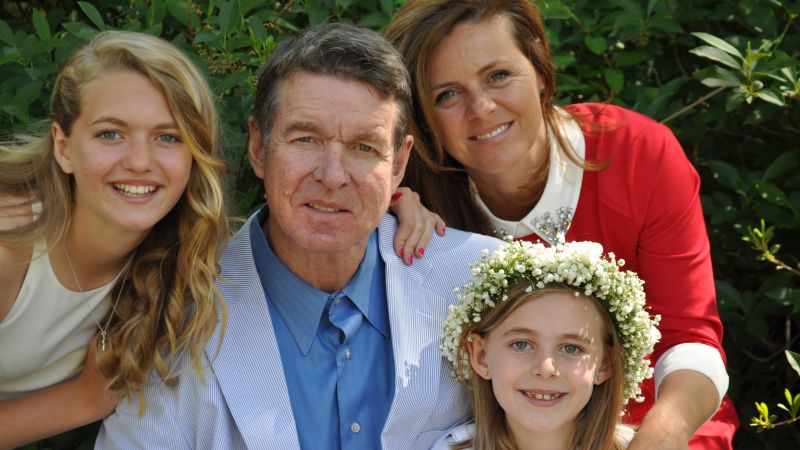
CTE seemed like a tragedy that happened to other people—until it affected Maura’s family. Her husband, Don Horton, was 58 when he died. He was the father of their two daughters, Hadley and Libby.
For Maura, CTE became the “earthquake” that destroyed the future she and Don had planned: a long marriage modeled on her parents’ 60-plus years together, days spent watching Hadley play soccer, Libby building a career with her analytical mind, walks down the aisle and around the block, and the chance to grow old together.
That opportunity to build an ordinary yet meaningful life was rerouted and ultimately destroyed.
CTE can affect athletes far beyond the NFL
Don never played in the NFL. He was an offensive lineman at Wittenberg University, a Division III school known to dedicated football fans for five national titles and 799 wins, but far removed from the professional spotlight.
He was not included as a number in the latest NFL research. Yet Don died in May 2016, and a postmortem examination of his brain confirmed what his family had suspected long before his death.
Maura wants to close the gap between everyday athletes and NFL stars, between the cause of repeated head trauma and its effects, and between the need for help and the ability to obtain a diagnosis.
“I’m always thankful that the reports are published and the research is ongoing,” Maura told CNN Sports. “But there is still so much missing. I want to be a conduit that helps open a dialogue to understanding. No one sees the aftermath. No one understands what it’s like on a day-to-day basis. You see these studies and then no one talks about it again until someone dies.
“But this is an earthquake that shattered my family, and no one understands how shattering it is. I’m 10 years past and it’s still shattering us.”
Don Horton’s symptoms were first diagnosed as Parkinson’s disease
Don was committed to staying fit, but he suddenly struggled to lift weights. Doctors told him he had Parkinson’s Disease. Maura remembers that people tried to reassure her by saying it was one of the more manageable neurological disorders.
“Michael J. Fox,” she said. “Everyone brought up Michael J. Fox.”
But Don’s condition deteriorated quickly and in ways that made Maura question the diagnosis. One day he would be exercising at the gym; the next, he would fall without explanation.
He experienced mood swings, restless sleep, paranoia and hallucinations. Maura wondered whether medication was responsible and began attending his medical appointments, pressing doctors for answers. As she researched the symptoms and watched Don decline, she began to suspect CTE.
Maura eventually sent a direct message to Chris Nowinski, co-founder of the Boston-based Concussion Legacy Foundation. She also spoke with Don about donating his brain to science after his death. At first, he resisted.
Don had devoted his life to healthy living. He avoided junk food, exercised regularly and believed in taking care of his body. His wife was now telling him that a decision he had made as a child might have set him on a path he could not prevent.
Football had shaped Don’s identity as much as his career. After playing, he moved directly into coaching, beginning a football life that took him from several stops in Ohio to New Mexico and Virginia. In 1997, he became the offensive line coach at Boston College, where he spent 10 years with the Eagles before ending his career at N.C. State.
Accepting that the sport that gave him purpose—and that served as a foundation for the hundreds of young men he coached—might also have caused his decline was nearly impossible. It felt to Don as though he were betraying both football and the players he had recruited.
As his health worsened, however, he reluctantly agreed to have his brain studied.
“Mostly,” Maura says, “because he wanted to prove me wrong.”
A family’s life after a CTE diagnosis
Hadley Horton was 18 when she delivered a TED Talk titled “Grief, Joy and the Magic in Between.” Created through TEDEd, the talk centers on Tommy, her beloved Elf on the Shelf, whom she wrote to as a child.
The letters began as holiday messages but eventually became an ongoing correspondence. Tommy became a pen pal and a source of comfort, with Hadley sending notes to the North Pole long after Santa’s seasonal work was finished.
Hadley eventually discovered through the Notes app on Maura’s phone that her mother had been writing as Tommy.
“Through letters and tiny acts of care, she taught me that love doesn’t always announce itself; sometimes it quietly anchors you,” Hadley says in the talk. “When I reflect on Tommy’s impact on my life, I understand that that belief in something bigger than yourself can often times get you through difficult times.”
Maura wants people to understand that statistics represent real families. They represent children who grow up without fathers and spouses whose lives are overturned and never fully restored.
The risk is not limited to NFL players. It can also affect people whose fathers played college football or stopped playing in high school after suffering repeated head impacts.
“It’s like they’re still being parented by a ghost,” she said.
As Maura adjusted to life after Don’s diagnosis and death, she quickly discovered how few resources were available to families facing CTE. The disease is often discussed in terms of what happens afterward—particularly the postmortem brain examination that confirms its presence. But families need support during the illness, while symptoms are unfolding.
When Don was initially diagnosed with Parkinson’s, he and Maura immediately visited the Michael J. Fox Foundation’s website. They found extensive information about medication, care and research into a cure. In a powerless situation, access to practical information gave them a sense of control.
When Maura began suspecting CTE, she found far less guidance. There was the organization founded by Nowinski and another group, Concussion to Empowerment. She attended a family summit but struggled to find advice about medication or treatment.
She also questioned why no doctor had asked whether Don played football when he first reported his symptoms. That information, she believed, should at least have made CTE part of the diagnostic discussion.
Maura realized Don represented thousands of others: former college football players, athletes who stopped after high school, military members and soccer players who repeatedly used their heads as battering rams. Her daughter Hadley played soccer and continues to compete at the collegiate level.
Ten months after Don’s death, the CTE Center and Concussion Legacy Foundation confirmed what Maura already believed: Don had CTE. The disease is graded by severity, with four representing the most severe stage. Don’s condition was between stages three and four.
“He didn’t play in the NFL; he didn’t have a pension plan,” she said. “It wasn’t like he had protection or resources or a community around us to help navigate. It always felt like I was in fight mode. There is so much room for growth. It’s like if you compare it to Mothers Against Drunk Driving, there’s no education component. It’s just, ‘go play flag football.’”
Maura Horton still loves football—but wants families to understand the risk
Maura still loves football. She watches games, supports the former players and coaches who worked with Don, and continues to include the sport in her fall routine.
But when asked what she would tell a young mother deciding whether to let her child play football, she pauses. She considers the desire for children to learn teamwork, build relationships and gain life lessons through sports, then wonders aloud whether another sport might be worth considering instead.
“There are so many choices,” she says. “Because that’s the problem. So much of the conversation centers around the NFL; people can’t conceptualize that it can happen to their family. That’s what really needs to change.
“People think that because they’re not part of that world, it’s not about them. Well, we weren’t either, and it happened to us.”
Source: www.cnn.com