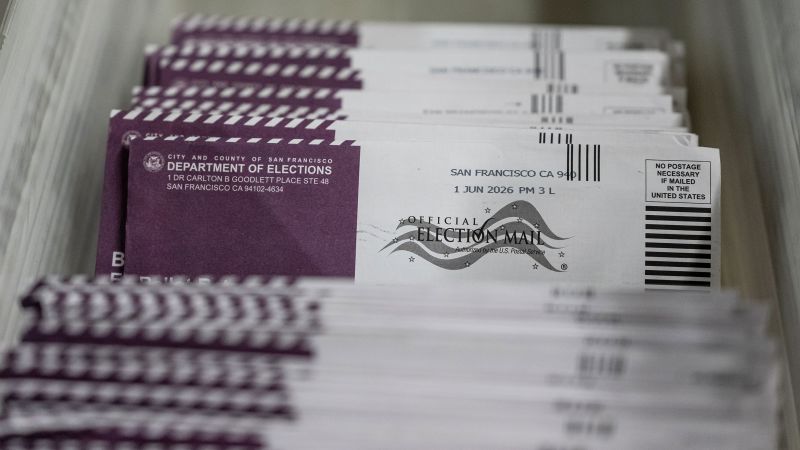
The Supreme Court on Monday rejected President Donald Trump’s controversial plan to change how mail ballots are sent to voters nationwide, blocking a proposal that election officials warned would have caused catastrophic consequences for the 2026 midterms.
In one of the most significant cases on the court’s emergency docket in years, a majority of justices halted a procedure that would have granted the U.S. Postal Service unprecedented authority to withhold potentially millions of mail ballots. Even some Republican election officials cautioned the proposal could trigger chaos and mass disenfranchisement.
The court ruled the administration “is unlikely to succeed on the merits of its challenge” but provided minimal reasoning in its three-sentence, unsigned order. Conservative Justices Samuel Alito and Clarence Thomas dissented.
Major Setback for Trump’s Mail Voting Crusade
The decision marks a significant loss for the president, who has spent years attacking mail voting with false claims of widespread fraud while continuing to vote by mail himself. The administration framed its proposal as a “modest” regulatory tweak intended to protect against alleged fraud. Critics, however, labeled it an unconstitutional power grab the Postal Service was unprepared to execute.
CNN has reached out to the White House for comment.
Kavanaugh Concurs on Timing, Leaves Door Open for Future
Justice Brett Kavanaugh, part of the court’s conservative wing, wrote a concurrence stating he believed the proposal might fall within USPS authority, but that “state and local election officials do not have sufficient time to reasonably implement the rule before the elections.”
His reasoning acknowledged a flood of briefs from election officials arguing there was simply not enough time to implement the order this late in the cycle. The concurrence also suggested Kavanaugh could side with Alito and Thomas to approve similar changes for a future election.
Alito Dismisses Practical Concerns, Cites Postal Authority
In dissent, Alito argued the practical implementation concerns raised by election officials were insufficient grounds for the plaintiff states and voting rights groups to prevail.
“The government has a strong interest in enforcing the rule, and implementing it will also ‘enhance the visibility of Federal Ballot Mail’ in order to better detect election fraud,” Alito wrote. “On the other side of the balance, the plaintiff States invoke the practical effects of implementing the rule close to the midterm elections. I take that problem very seriously, but it is not enough to convince me to deny the application.”
“That Hail Mary pass is unlikely to be successfully completed here,” Alito wrote. “The Postal Service has broad authority to regulate the mail.”
Bipartisan Coalition Warned of Last-Minute Chaos
Beyond the Democratic-led states and voting rights groups that challenged the proposal, a bipartisan coalition of election administrators, former governors, and others warned the justices against last-minute changes to mail ballot procedures. The Postal Service rule required states to upload massive voter datasets to an online portal that was not yet operational. It also mandated changes to ballot envelopes that had already been purchased and, in many states, already mailed to voters.
Officials Celebrate Ruling as Defense of Democracy
The plaintiffs praised the court’s decision late Monday.
“Trump’s attempt to sabotage the 2026 elections has failed,” said Colorado Secretary of State Jena Griswold, a Democrat.
California Attorney General Rob Bonta, also a Democrat, called the high court’s decision a “victory for our democracy and a powerful affirmation of the rule of law.”
The administration argued the changes were necessary to secure ballots and ensure only eligible voters receive them. A coalition of two dozen Democratic-led states and voting groups countered the effort was a power grab by a president who has long falsely alleged widespread voter fraud in mail ballot systems.
Court Prioritizes Voter Harm Over Administrative Burden
In recent emergency docket rulings, the court has often found the Trump administration harmed when lower courts block controversial policies. In this case, however, the court determined that “equitable factors”—the potential harm to voters—outweighed those concerns.
The emergency appeal, filed last week, was the third time the administration raced to the Supreme Court on this policy. In late August, the court allowed the president to proceed on technical grounds related to lawsuit timing. A lower federal court blocked the changes days later.
Under the Constitution, states and Congress determine voting procedures—not the White House or the post office.
Order Required Voter Lists, Barcodes, and Prosecution Threats
The president’s order required states to submit eligible voter lists to the USPS. The agency would then be barred from delivering ballots to anyone not on those lists. It also mandated tracking barcodes on ballot envelopes and “prioritized” federal prosecution of state election officials who send or receive ballots to non-citizens or other ineligible voters.
Whistleblower Warned of Mass Ballot Withholding
While the Supreme Court deliberated, a Postal Service whistleblower issued stark warnings. The whistleblower’s report revealed that if a single ballot had a barcode issue, officials would decline to deliver the entire batch of mailings containing that envelope. The report also described a rushed effort to launch an online data-sharing system that could make the complex plan even more vulnerable to mass disenfranchisement.
No Evidence of Widespread Fraud; Multiple Courts Rejected Plan
Trump has long promoted conspiracy theories about mail voting to discredit the 2020 presidential election he lost. Improper voting remains exceedingly rare, and the administration has never produced evidence of widespread fraud capable of influencing the 2020 outcome or any other contest.
Multiple federal courts rejected the proposal. Over the weekend, U.S. District Judge Carl Nichols, a Trump nominee in Washington, D.C., became the latest to pause the USPS rule for the midterms.