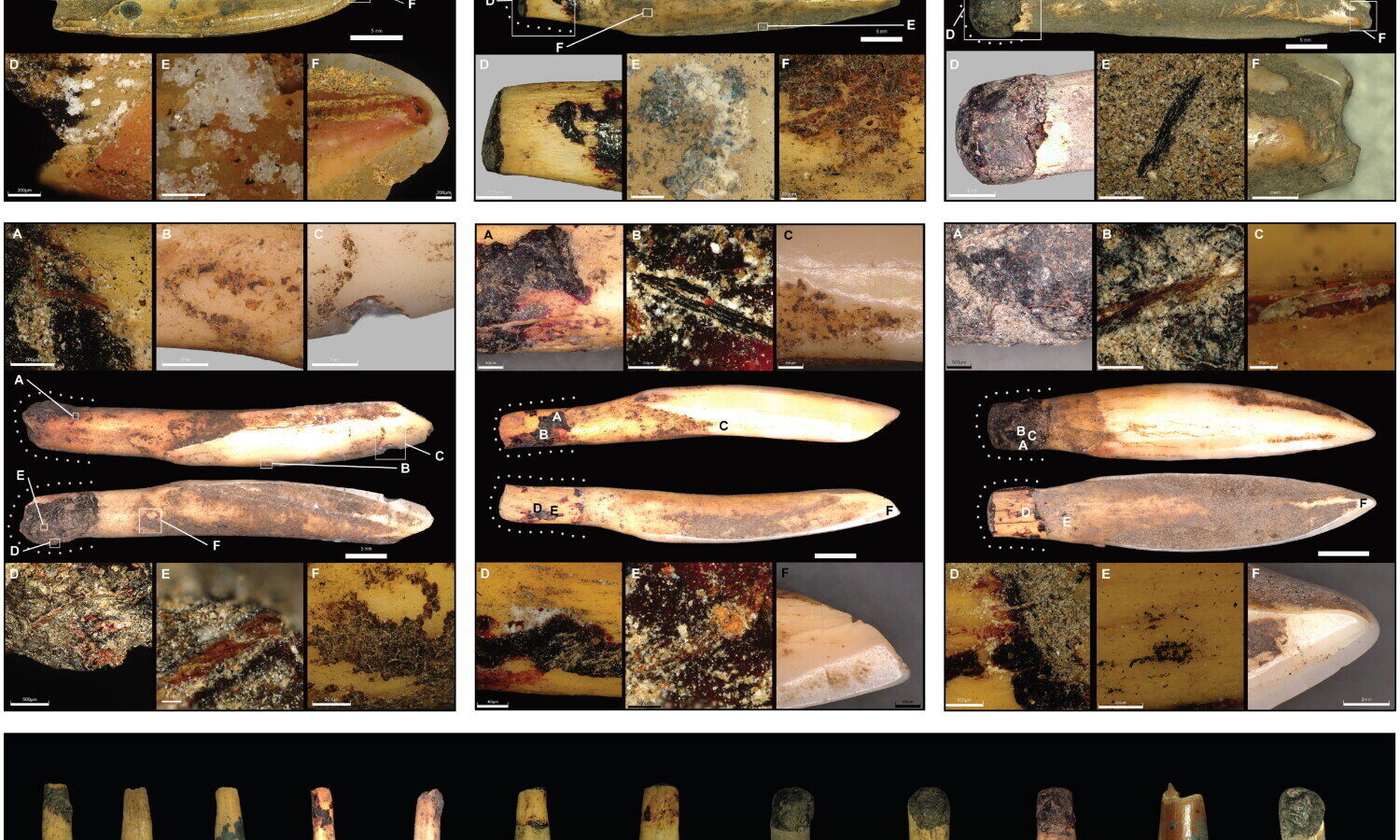
Archaeologists have discovered 12 resin-mounted wallaby teeth at Windmill Way, a rock shelter in Quinkan Country, Queensland, Australia. The finds represent the only known example of this type of tooth ornament found outside burials in northeastern Australia and the first documented example from Cape York Peninsula, according to a study published in Australian Archaeology.
The first tooth was identified when archaeologist Lynley Wallis of Griffith University was sorting through animal bones from the site. Something about it was “not quite right”: a blackish-brown, glue-like resin ball was attached to the tip of its root. Eleven additional teeth with the same substance were later found.
Wallis recalled the moment she showed the unusual tooth to Sam Lowdown, a Traditional Owner and member of the Laura Ranger team.
“I paused my automatic robot-like sorting to take a better look,” Wallis said.
Wallis then handed the tooth to Lowdown.
“I recall Sam looking confused initially, turning the tooth around in her hands, and then, as realization dawned, she broke out in the biggest grin, held it up and said loudly for the whole team to hear, ‘That’s resin!'”
Rare evidence of organic technology
Australia’s Aboriginal peoples have used wood, string, gum and other organic materials since arriving on the continent thousands of years ago. However, these materials rarely survive, even in favorable archaeological conditions.
Windmill Way is an unusual exception. Located in the southeastern part of Cape York Peninsula, the rock shelter has yielded more than 500 pieces of plant-fiber string, as well as ocher, shell, worked wood and thousands of gnawed animal bones. The abundance of bones initially led researchers to consider whether the shelter had been used as a dingo den.
Tooth ornaments are known from other parts of Australia, but most have been recovered from burials as grave goods. Examples include kangaroo-tooth headbands, necklaces made from Tasmanian devil canines and headbands decorated with small wallaby teeth. Nearly all of these discoveries come from southeastern Australia.
Despite decades of research, Cape York Peninsula had not produced a single known piece of animal-tooth jewelry. The Windmill Way discoveries change that record.
Resin analysis identifies the source plants
To determine what the more than 1,000-year-old resin was made from, researchers consulted Elders and Rangers from the Laura community. Their knowledge helped identify likely source plants, which were then examined using infrared analysis and mass spectrometry.
Infrared analysis identifies materials by measuring how chemical bonds absorb infrared light and matching the resulting pattern with known resin samples.
“The infrared analysis “works by shining infrared light onto a sample of uncertain material, and measuring how the chemical bonds absorb the light, producing a characteristic chemical ‘fingerprint,'” co-author Carney Matheson from Griffith University said.
Liquid chromatography-mass spectrometry separates the resin into individual compounds and measures their molecular weights. This allowed the researchers to identify the plant materials in the mixture.
The tests showed that all 12 teeth had been mounted using resin from grass trees, which still grow on the rocky slopes around the shelter. One tooth also contained traces of resin from ironwoods, trees that grow along nearby waterways.
Wallaby teeth may have formed jewelry
Grass-tree and ironwood gums have a long history of use in regional toolmaking. Kangaroo and wallaby teeth, also known as macropod teeth, were sometimes shaped into chisels and drills for scraping and engraving. However, none of the 12 wallaby teeth from Windmill Way showed signs of being used as tools.
Plant fibers and a fragment of animal hide were still attached to some of the resin balls, offering a clue to their purpose. The researchers suggest that the teeth may once have been strung into a headband or necklace, with the small resin balls acting as stoppers to keep the teeth from slipping off.
Tooth jewelry is common elsewhere in Australia, but it remains unclear whether this tradition was common or even known on Cape York Peninsula, the study authors wrote.
The researchers searched for comparable examples and found only one: a wallaby-tooth necklace held by the Pitt Rivers Museum in Oxford. Historical records do not identify its precise origin, stating only that it came from “Australia.”
“We wracked our brains to try and narrow the possible source location down to something more specific and spoke to curators about that, but there was nothing more to go on,” Wallis said.
Because many tooth necklaces in museum collections were made using other methods, Wallis believes resin may have been used for tooth jewelry on the peninsula only rarely.
Although the Windmill Way assemblage is currently unique, Wallis said the discovery “demonstrates to us the cultural continuity and resilience of Australia’s First Nations people.” She added that it shows how people everywhere choose “clothing, jewelry and artifacts that—in all sorts of ways, such as raw materials, colors and modes of manufacture—reinforce their cultural identity.”
Study: Lynley A. Wallis et al., An assemblage of resin-mounted macropod incisors from Quinkan Country, Cape York Peninsula, Queensland, Australian Archaeology (2026). https://doi.org/10.1080/03122417.2026.2694015