Casey Affleck’s ‘Company’ Premieres at Venice: A Puzzling Period Vampire Tale With Diminishing Returns
Casey Affleck’s second feature as writer-director, Company, debuted in competition at the Venice Film Festival to a muted reception, presenting distributors with a unique marketing challenge: how to sell a film whose central hook is also its most closely guarded secret. The period drama, which Affleck co-wrote with Ron Hansen, unfolds across three nested timelines before revealing its true genre identity well past the one-hour mark—a structural choice that critics argue yields steadily diminishing returns.
A Recursive Narrative Structure Across Three Eras
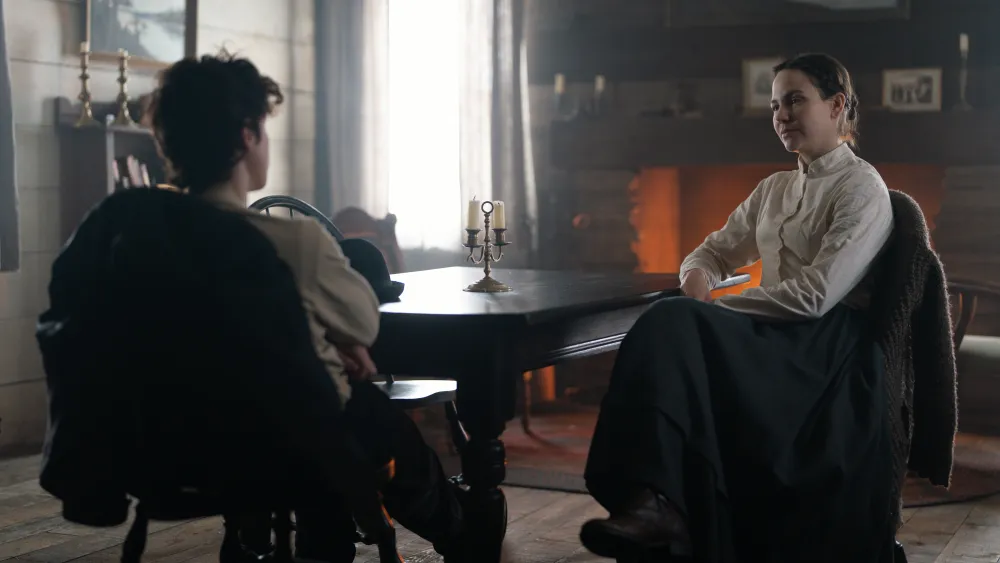
The film opens in 1975, as Evelyn (Emily Alyn Lind) arrives at a suburban Christmas party during a downpour, accompanied by Bob Dylan’s “Shelter From the Storm.” Invited inside by the unsuspecting host, she begins telling a story set in 1953, in which elderly widower Tom (Nick Nolte) takes in a mysterious young woman, Alice (Caylee Cowan). Alice, in turn, recounts a tale from 1903 about a Colorado farming couple, Rebecca (Adelaide Clemens) and Emmett (Scoot McNairy), who rescue an unconscious drifter named Caleb (Atticus Affleck) from the snow.
This “tedious roundelay of story introductions,” as described in early reviews, eventually settles on the 1903 narrative as the primary focus. Rebecca hires Caleb as a farmhand over Emmett’s objections, while rumors of brutal murders in the area heighten tension. The film’s recursive framing device—stories within stories—delays the genre reveal that recontextualizes the entire premise.
The Vampire Twist and Its Mythological Departures
Without spoiling the carefully concealed pivot: Company ultimately reveals itself as a period heartland vampire movie, drawing inevitable comparisons to recent genre entries like Sinners. However, Affleck and Hansen introduce “wildly divergent vampire lore,” positioning their bloodthirsty raconteurs as capable of grace and mercy when treated with kindness—a novel mythos within the tradition, though one early reviews describe as “not a terribly exciting one.”
The film attempts to use vampire conventions to explore the American spirit of community, or the lack thereof, but the thematic payoff is reported as “distinctly muted” relative to the elaborate narrative scaffolding.
Performances and Production Puzzles
Atticus Affleck, in a demanding lead role as Caleb, brings a “willowy insolence” and “still, pale-eyed, tacitly judgmental presence” that generates much of the film’s tension. His extended verbal confrontation with neighboring farmer Kleinschmidt (Ben Mendelsohn) allows the screenplay’s “dourly lyrical dialogue” to finally “crackle with something like foreboding.” Mendelsohn’s performance is singled out as the ensemble’s standout.
Perhaps the most perplexing production detail is the credit list for directors of photography: eight in total, including Masanobu Takayanagi (Springsteen: Deliver Me From Nowhere), Adam Arkapaw (Macbeth), Marcell Rév (White God), and Affleck himself. Early analysis suggests that if the intention was to give each nested narrative a distinct visual identity, the result is an “earthy visual consistency” that obscures that strategy. The final film, reviewers note, “doesn’t seem entirely worth the trouble.”
A Step Back From ‘Light of My Life’
Affleck’s 2019 debut, Light of My Life, was a somberly effective post-apocalyptic drama. By comparison, Company feels “less assured,” trading the earlier film’s emotional clarity for a “protracted shaggy-dog tease with no sense of humor, and an inflated sense of its own poetry.” While Affleck demonstrates continuing promise in atmosphere and visual craft—the film is “handsome in an appropriately ascetic, chambray-textured way”—the narrative convolution and delayed genre reveal undermine the overall impact.
As one review concludes: “Many hands don’t make light work of Company; many tellers don’t make one good story.”