An Amish family in Lancaster County, Pennsylvania, is grieving the death of a newborn whose case has become the center of a national dispute over measles, vaccination and public health.
The baby’s father had no idea that his son’s death had made national news when he emerged from his barn to greet me. Wearing a straw hat, black trousers, suspenders and a long-sleeved blue shirt, he stood near one of his similarly dressed sons, who was guiding a horse-drawn plow through a nearby field.
Like most Amish people, the man and his family do not watch television or use the internet. They do not read the newspaper, either. They were unaware that Pennsylvania Gov. Josh Shapiro had held a press conference the previous Tuesday to announce the state’s first two “measles-associated” deaths in 35 years.
Both people who died were from Lancaster County, home to the largest Amish community in the United States and the area hardest hit by Pennsylvania’s months-long measles outbreak. The county has recorded 210 cases so far this year.
The family also did not know that Shapiro’s political opponents had accused him of using the deaths to score political points. Nor did they know that the county coroner had told reporters his office performed an autopsy on an infant who tested positive for measles, but that the cause of death was a ruptured spleen.
The conflicting accounts prompted Robert F. Kennedy Jr., the secretary of health and human services, to mock Shapiro on X. Kennedy called the governor’s press conference “unseemly” and an example of “the weaponization of infectious disease fears for political gain.” Without evidence, Kennedy wrote that “the deaths may even have been altogether fabricated by one of the Governor’s hopeful staffers.”
An Amish family caught in a national controversy
The Amish father asked that his name, his family’s names and the exact location of their home be withheld to protect their privacy. His son has not been publicly identified as the newborn whose death has fueled the controversy. But the circumstances match, and when I told him about the case in the news, he said it sounded like his son.
When I shared the family’s biographical details with Lancaster County Coroner Stephen Diamantoni, he said his office was not currently investigating any additional infant deaths in the area. Pressed further, Diamantoni said he could neither confirm nor deny the identity of the child whose death his office was investigating.
The baby’s father filled in details absent from the public accounts given by the coroner and the state. His story also made clear that behind the political dispute and competing theories, an actual family is mourning the loss of a child.
I spent part of the previous afternoon speaking with the newborn’s father and mother, whom I’ll call John and Anna. After John and I had spoken for a while, Anna came out of the house. Though hesitant at first, she agreed to join us.
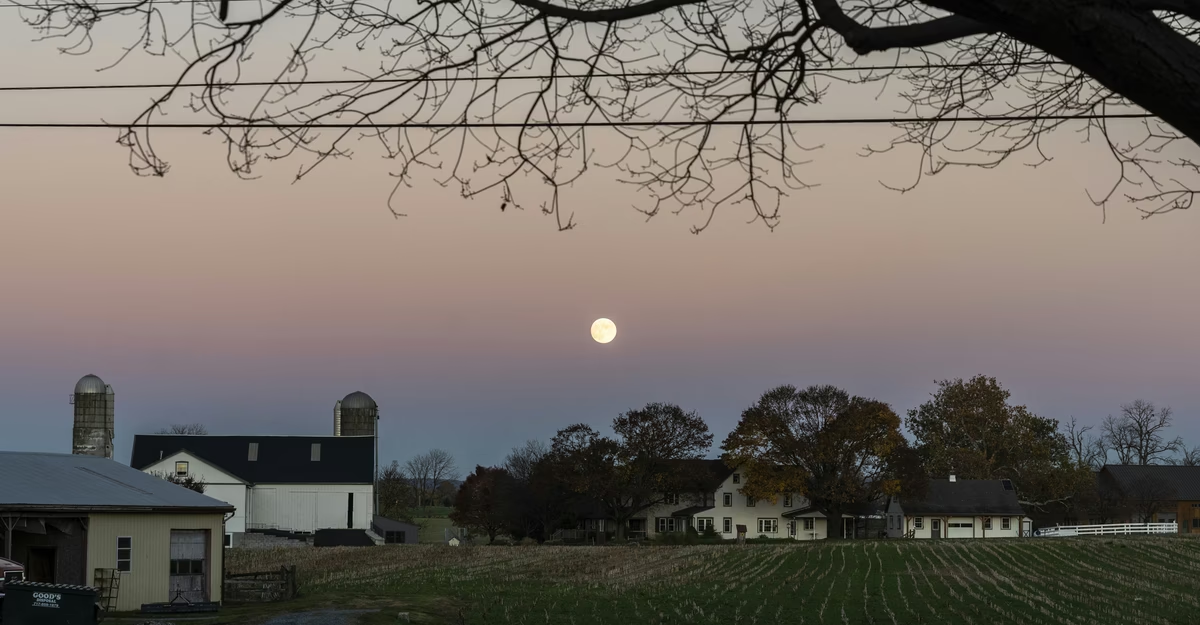
We sat at a table on their porch overlooking their picturesque farm, reached by a long gravel driveway. The family grows mostly corn on its 45 acres, along with hay and tobacco. A well-tended garden sits beside the house, near a small chicken coop.
John and Anna have lived on the property for 20 years and have 13 children. Some of the children stood nearby on the porch listening to the conversation, while others peered through screen-covered windows.
Measles spread through the Lancaster County community
About a month ago, John and Anna learned that measles was spreading through their community. Other than John, no one in the family had been vaccinated against the virus.
John said he had heard from someone that this strain of measles was not dangerous for pregnant women, but he was unsure whether that was true. In fact, measles, regardless of the strain, can cause serious complications during pregnancy.
Anna was pregnant and worried about the effect measles could have on her baby, but she did not believe she could avoid exposure.
“I saw we can’t even get away from it because so many people have it,” she told me.
Even if Anna had wanted to be vaccinated at that point, it would have been too late. The CDC recommends against administering the measles vaccine to pregnant women.
A few weeks ago, one of John and Anna’s older children became ill. The rest of the family soon followed. Two children became dehydrated and needed intravenous fluids.
Anna became extremely sick, at one point developing a fever of 102 degrees. She struggled to keep down food and fluids and could speak only in a whisper for several days. On August 13, she went to a clinic to receive an IV for dehydration.
The following day, she went into labor. Anna remembers feeling extremely weak.
“I didn’t have a single piece of energy,” she told me.
The baby was delivered at a birthing center by the same midwife who had attended the births of Anna’s other children and, remarkably, Anna’s own birth. He weighed seven pounds and was born shortly after 5 p.m. on August 14.
His parents immediately knew something was wrong. He had a pulse, but he was not breathing. The midwife called paramedics, who arrived within minutes.
John recalled the paramedics giving the newborn oxygen and performing gentle chest compressions with two thumbs, but the efforts were unsuccessful. The baby died in less than half an hour. The paramedics told the family that the county coroner would need to be contacted to take the body.
“I guess he chose us this time”
As John and Anna spoke with me, one of their sons, who recently turned 1, played with a toy horse and buggy. One of their daughters bounced an orange ball against the table.
Anna and John were somber but matter-of-fact when discussing their son’s death.
“There’s nothing we can do about it,” Anna told me.
John said he viewed the tragedy as part of God’s plan and noted that other parents lose children, too.
“I guess he chose us this time,” he told me.
Neither John nor Anna has strong feelings about vaccination. Anna said she did not know why her parents had not given her any shots. Choosing not to immunize their children was not a political statement, and the couple did not make the decision after extensive research. They simply did not vaccinate them.
Pennsylvania allows children to attend school without vaccinations when their parents object on religious or moral grounds. Although the Amish Church has no official doctrine opposing vaccines, vaccination rates among the Amish are generally low.
Last year, Pennsylvania’s health department estimated that only 25 percent of the Amish community in Lancaster County had received the measles, mumps and rubella vaccine.
In 2021, Kennedy declared that the United States needed to “think more like the Amish” at an Amish country fair a short drive from John and Anna’s home. Under a large white tent, Kennedy also joked that when he and his siblings contracted measles, they had to “stay at home and watch TV the whole week.” The remark drew a big laugh.
Kennedy also said the best treatment for measles was vitamin A and chicken soup. Shapiro has used that statement to criticize Kennedy’s views on vaccines since announcing the two measles-associated deaths in Pennsylvania.
What caused the newborn’s death?
Because they do not follow the news, John and Anna were unaware of the dispute between Shapiro and Kennedy. In fact, they did not know who either man was.
John said he had recently received a voicemail from someone saying that a man named Kennedy wanted to speak with him, but he did not return the call. An HHS spokesperson declined to answer questions about the call and instead criticized Shapiro for speaking prematurely about the measles-associated deaths.
John’s father told the couple that the local newspaper had published a story about a baby who had died. The description sounded as though the baby could be theirs, but the family was not sure.
John and Anna did not consider their baby’s death much of a mystery. They assumed that Anna’s severe case of measles had contributed to the loss. The midwife told them the same thing.
Much of the debate over whether measles caused the infant’s death has focused on the lacerated spleen. When children contract measles, the infection can cause an enlarged spleen, making the organ more likely to rupture. To some people, that may seem like evidence that measles caused the infant’s death.
Diamantoni, however, has publicly maintained that his office believes the spleen was not enlarged and that the cause of death was therefore unrelated to measles. Physicians have since pointed out that a ruptured spleen may not appear enlarged even if it was affected by measles.
“I’ve had several discussions with our forensic pathologist, and he feels adamantly that this was not a measles death and that it was a traumatic rupture of his spleen,” Diamantoni told me.
He said the investigation remained ongoing and that he did not know when it would be completed.
Diamantoni told me he is “very in favor of immunization,” but skepticism about whether measles contributed to measles-associated deaths has become increasingly common among anti-vaccine activists.
Last year, two young girls died during a major measles outbreak in West Texas. Soon after their funerals, anti-vaccine activists recast their deaths as the result of something other than measles. The argument was that although the girls had measles, they had actually died from another infection or a hospital error.
Children’s Health Defense, the anti-vaccine organization Kennedy founded before becoming HHS secretary, aggressively promoted that narrative.
What anti-vaccine activists often fail to mention is that measles can temporarily impair the immune system’s memory, leaving people vulnerable to other infections. Most young children who die from measles are killed by pneumonia after their immune systems have been overwhelmed. But they almost certainly would not have died without the measles infection.
Family awaits the coroner’s report
The exact circumstances of John and Anna’s son’s death remain unclear. A ruptured spleen is extremely rare in newborns under any circumstances, and the coroner has not determined what could have caused it.
John and Anna said they had no idea what happened. They had not heard anything about a ruptured spleen until I told them about the coroner’s public comments. They knew only that Anna had been seriously ill and that they had lost their child.
John said he called the coroner’s office on Friday but was told the investigation was still underway. The couple was surprised that details of their baby’s case were being discussed publicly—if the case that has attracted national attention is indeed theirs—while they were still waiting to hear from the coroner and were eager to read his report after the investigation concluded.
Asked why he had not been in contact with John and Anna, Diamantoni said, speaking generally, that “there may be lots of factors that go into when a notification is made,” but he did not elaborate.
The baby’s body was returned to John and Anna on August 17. He is buried in a cemetery a few miles from their home.
A small mound of fresh dirt sits in the center of the cemetery, marked at either end by flat wooden stakes. One stake bears the word sillborn—the t is missing—along with the baby’s father’s name.
As in other Amish cemeteries in Lancaster County, a white fence surrounds the neatly maintained graves, whose headstones are unadorned. The scene is everything the public narrative surrounding the boy’s death has not been: simple, modest and solemn.