England’s hopes of a swift series clean-sweep evaporated on day three at Edgbaston as Pakistan debutant Razaullah produced a stunning counter-attacking half-century to set the hosts a fourth-innings target of 130. The tourists, bowled out for 247 in their second innings, found unexpected resistance through their lower order, turning what appeared to be a three-day finish into an absorbing contest heading into Saturday.
Hollies Stand roused as Pakistan defy expectations
At 2:40 pm on Friday, with Shan Masood and Babar Azam constructing the series’ highest partnership (125), the famously partisan Hollies Stand erupted—not in celebration of an England wicket, but from a crowd forced to manufacture its own entertainment. For ten days, Pakistan’s wickets had fallen with metronomic regularity; this stand, stretching the tourists’ final innings to the longest of a dispiriting tour, broke the pattern.
Normal service briefly resumed when Dan Lawrence claimed a spectacular gully catch to dismiss Masood for 95, yielding just Gus Atkinson’s second wicket of the series. Yet the respite proved fleeting.
Razaullah’s chaotic brilliance turns the tide
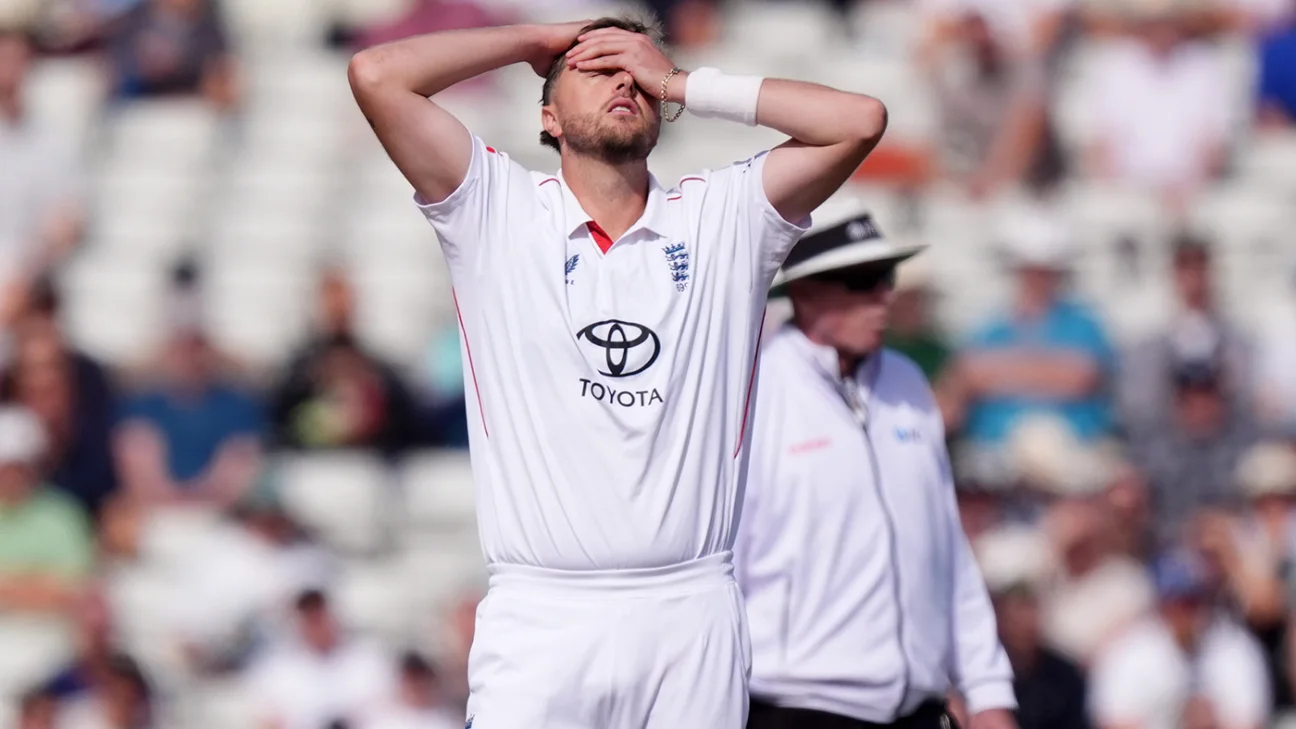
Enter Razaullah. The debutant’s cavalier assault—swinging at everything from the moment he arrived—single-handedly produced the most thrilling passage of the series, all at England’s expense. As the ball aged and the pitch flattened, England’s attack toiled for two full sessions before an elongated evening session saw their plans dismantled.
Razaullah’s fifty brought the 18,215-strong crowd to its feet, a higher proportion remaining than on previous evenings. “I was being selective with which balls to slog, but they all seemed within range,” he said in his end-of-play press conference, oblivious to England’s specific plans to starve his scoring arcs.
England’s bowling strategy exposed
Interim head coach Marcus Trescothick pulled no punches in his assessment: “Disappointing, of course. We were in a position where they were eight down, scores were level. We hoped to go through them pretty quickly.”
He continued: “I don’t think we bowled very well this morning. I thought we didn’t hit the areas that we wanted to hit. You know, the consistency in line or length or the top of the stumps, whatever you see it as, we weren’t in the areas that we needed to be. I think we probably expected we’ll come out, get a couple of early wickets and put them under pressure.”
England’s assumption that they could simply bowl Pakistan out by bowling at them—reasonable given the first two Tests—crumbled once the new ball softened. Jofra Archer and Josh Tongue proved particularly expensive as Masood and Azan Awais drove freely. Dan Lawrence’s part-time off-spin accounted for Awais (caught down leg by Jordan Cox via DRS), but Root used him for just five overs total.
Root’s captaincy under scrutiny as plans falter
The tactical burden fell heavily on captain Joe Root. With a raw attack, moments arrived where he appeared shorn of ideas—and support—when manufacturing breakthroughs. At one stage Root left the field, though Trescothick avoided confirming a dressing-room search for solutions.
“We tried many different things. You have variations of plans; you bowl short ball for periods of time, then you go length for periods of time, then you go a bit of spin for a period of time. I think you’re always chopping and changing. You have various ideas.”
Marcus Trescothick
To Root’s credit, he exhausted the playbook. A bouncer barrage—square leg, two deep fielders, catching cover, midwicket, slip, gully, fly slip, narrow deep fine—nearly paid dividends. Theo Wylie, the substitute fielder, grassed a relay catch at fly slip to dismiss Babar Azam (69), having earlier missed Masood at gully. Babar subsequently gloved Tongue to Cox, and Archer had Saud Shakeel caught at short midwicket—a 40-for-4 collapse where England’s bowlers were most effective.
Abbas joins the party as England’s plans backfire
Yet the morning’s loose half-volleys were bookended by a scatter-gun approach to Razaullah and Mohammad Abbas. The latter, in his 51st Test, smashed a first-class best 42—including two sixes, tripling his career Test six tally—feeding off the confidence his partner’s assault generated.
Trescothick explained the tactical conundrum: “I think looking at the way he [Razaullah] was hitting it, when we did bowl on the stumps, he played it pretty well and that was the balls that he was getting hold of more than anything else.”
“We were trying to keep it out of the swing, and try and keep it away from the plane of the swing because he played it well when it was going there. It was just above the stumps that we were hoping to try and get the edge as much as possible. Didn’t happen today.”
Marcus Trescothick
Chase of 130 offers jeopardy—and opportunity
England’s chase of 130 presents a moment to seize. Home batters have scrambled from pockets of discomfort this series—48/2 and 36/3 in the first innings of the first two Tests—but Saturday morning brings genuine jeopardy. At the dregs of an uncompetitive few weeks, England needed to be tested: to graft in the field, to confront an aging ball on a flattening pitch, to endure the realities of Test cricket beyond wobble-seam generosity and obliging opponents.
Pakistan found fight on the best batting track of the series. England, ultimately, took more blows. They will rest wearily ahead of an unexpected day four, knowing that when Pakistan finally came at them, they wilted.